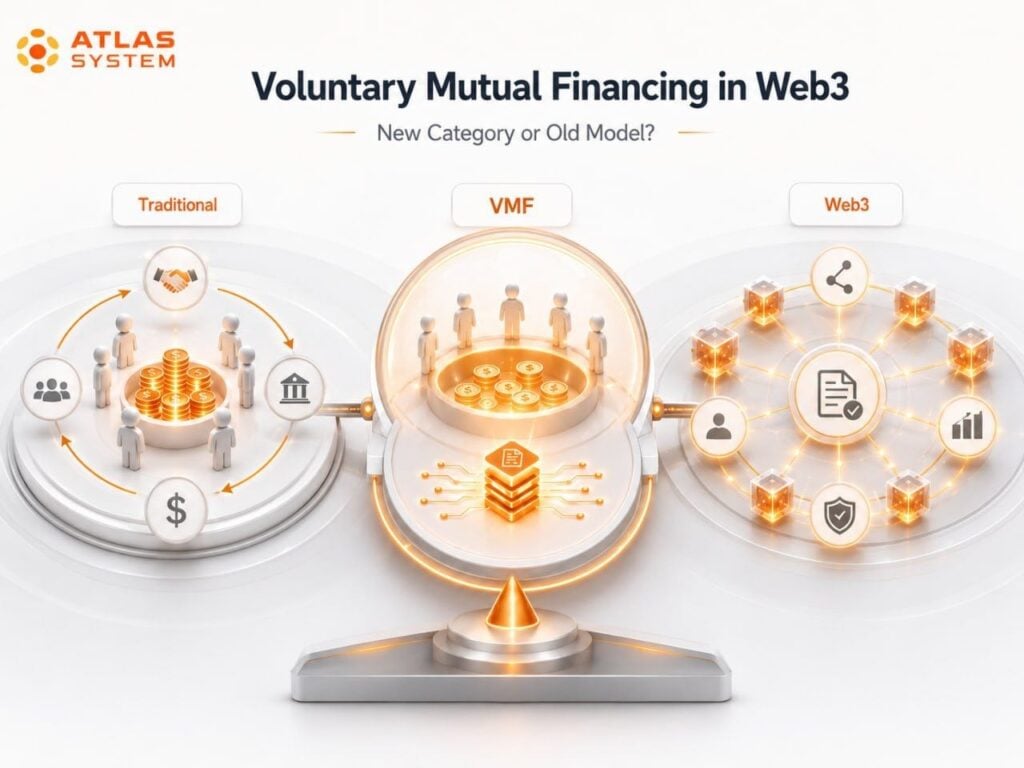
Web3 has repeatedly taken familiar models and rebuilt them around wallets, smart contracts and public ledgers. Lending became decentralized finance, community governance became DAO voting, and digital ownership moved from platform databases to tokenized assets.
Voluntary mutual financing may be the next model to receive that treatment. The basic idea is simple. Participants contribute funds to a shared system, while distribution follows predefined rules. Funds are not invested in external instruments, trading strategies or third-party financial pools. Instead, distributions are formed from contributions within the system and executed through smart contracts. That raises a central question: does putting mutual financing on-chain create a new Web3 category, or simply give an older model a more transparent technical layer?
What Smart Contracts Change
Traditional online earning platforms often require users to trust internal dashboards, private accounting and platform operators. Participants may see balances and payout requests, but cannot independently verify whether those records reflect actual fund movements. Smart contracts can reduce that information gap.
Atlas System uses BNB Smart Chain, USDT BEP-20 and several contracts that manage participation, claims, liquidity routing and partner distributions. Smart Cycle includes Lockup Flow for fixed-term participation, Daily Flow for daily calculated accruals, Transport for routing and Distribute for partner payouts. Transactions can be reviewed through BscScan. Users can inspect whether a wallet interacted with the correct contract, whether USDT was transferred and whether a claim transaction was submitted. That is a meaningful improvement over closed accounting.
Atlas System has also published its contract source code for review, along with a whitepaper, manifesto and external security reports. When mechanics are encoded in deployed contracts, users can compare the code with the platform’s public claims.
What Blockchain Does Not Change
The economic model remains the harder issue. Atlas System does not disclose a separate external revenue stream that funds the calculated delta. According to its documentation, claims depend primarily on shared liquidity formed by participant contributions and the conditions of the Smart Cycle.
Its ability to process claims therefore depends on available liquidity. Smart contracts can automate distribution, but they cannot create funds that do not exist. A blockchain can show how much USDT entered a contract and how much left, but it cannot guarantee that enough liquidity will always be available for future claims.
Automation can improve rule enforcement without improving economic sustainability. A transparent system may still face pressure if outgoing requests exceed incoming liquidity. Public contracts can make that imbalance easier to observe, but visibility does not resolve it.
Atlas System as a Case Study
Atlas System presents Smart Cycle as the first product in a broader Hybrid DAO ecosystem. Its main differentiator is not that it invented mutual financing. Similar principles have appeared in mutual aid structures, community funding systems and online contribution platforms.
Its differentiator is the attempt to make the process inspectable. Participants can review contract addresses, examine published code and trace transactions. External auditors can identify weaknesses, while the whitepaper explains the roles of the core contracts and their connection to liquidity infrastructure.
A Cyberscope audit identified one critical, two medium and seventeen minor or informative findings, listed as unresolved in the report. The issues included shared-liquidity risk, owner withdrawal permissions, claim conditions and centralization concerns. That is why audits should not be treated as security badges. Their value is that they show where risks remain.
Risk Disclosure Must Be Explicit
Web3 projects sometimes present transparency as evidence of sustainability. The concepts are related, but they are not interchangeable. Transparency explains who controls a contract, where funds are held, what rules are encoded and what transactions occurred. Sustainability asks where value comes from, whether the model can operate if participation slows, and what happens when claims rise faster than contributions.
A system can be transparent and still economically fragile. For Atlas System, the central sustainability issue is liquidity. The project’s own materials state that the return of contributed funds and additional calculated amounts is not guaranteed and depends on sufficient liquidity formed by participants. That disclosure should be central to the product, not buried in legal language.
Terms such as reward, accrual, cycle and payout can sound like promises even when the underlying mechanics provide no guarantee. A responsible disclosure framework should state that participation is voluntary, funds are not placed into external yield-generating strategies, claims depend on available liquidity, and audits do not eliminate technical or operational risk. It should also distinguish calculated amounts from guaranteed returns.
This is where Web3 can raise standards. On-chain activity allows users to test public claims against actual transactions rather than rely only on marketing.
A New Category, but Not New Economics
Voluntary mutual financing in Web3 may become a recognizable category, but not because blockchain changes where the money comes from. Its real innovation lies in structure: public contracts, traceable transactions, automated rules, published code and independent review. Atlas System illustrates both the promise and the limitation of that approach. It moves a familiar participation model into a more verifiable environment, but its sustainability still depends on liquidity, contract design and participant behavior. Blockchain can make the rules visible. It cannot make the economics disappear.
About the Project
Platform: https://atlas-system.io/
X: https://x.com/AtlasSystemWeb3
Facebook: https://www.facebook.com/profile.php?id=61590728242235
TikTok: https://www.tiktok.com/@atlas_system_official
Telegram Channel: https://t.me/atlas_system_official
Youtube: https://www.youtube.com/@Atlas_system_official
GitHub: https://github.com/atlas-system-dev/atlas-smart-cycle-v1