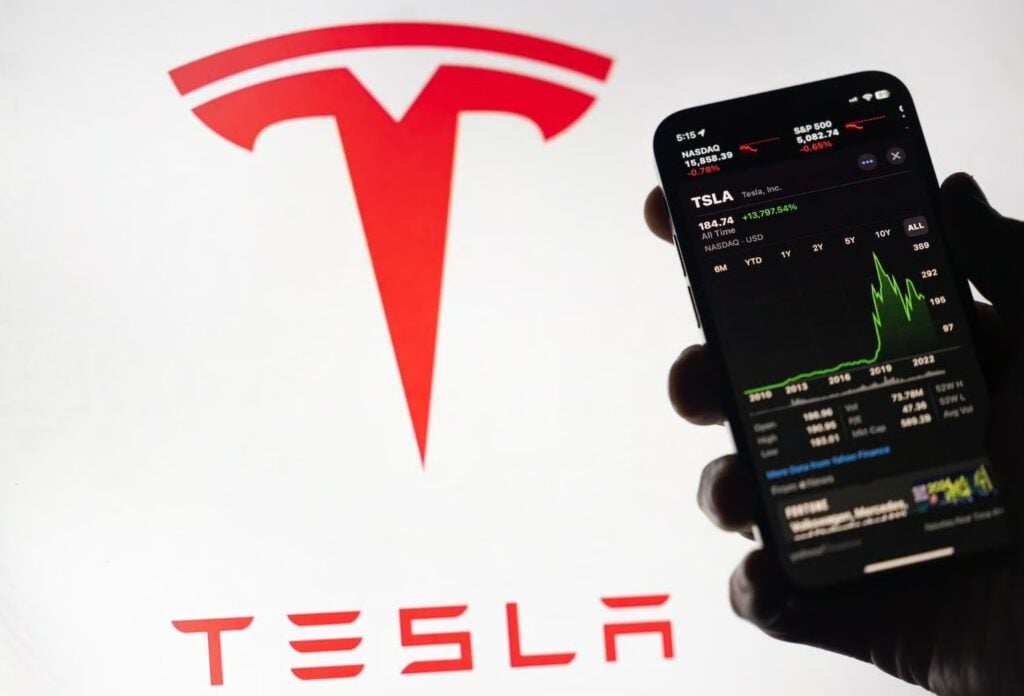

Wall Street analysts remain cautious on Tesla (NASDAQ: TSLA) stock over the next 12 months after a weak start to 2026.
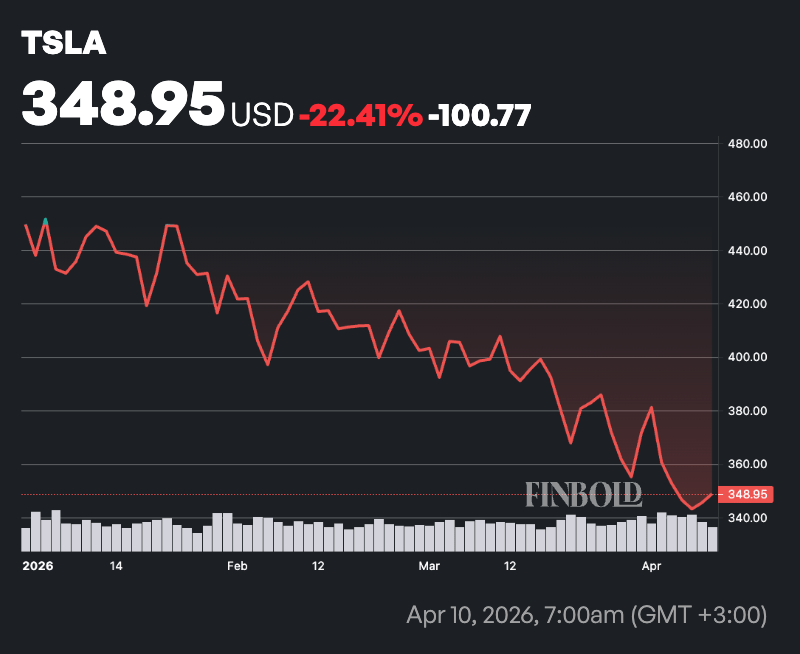
In this line, year-to- date, TSLA shares have fallen more than 20% to about $349, though the stock is still up nearly 40% over the past year.
Indeed, Tesla is facing rising competition from lower-cost Chinese EV makers and boycotts in key markets tied to backlash over CEO Elon Musk’s political views.
Fundamentals also remain under pressure. For instance, in the first quarter, Tesla produced 408,386 vehicles but delivered 358,023, missing Wall Street expectations of roughly 365,000 to 370,000 units. The shortfall left more than 50,000 vehicles in inventory.
Overall, these results point to softening demand in Tesla’s core automotive segment and a temporary slowdown in its high-growth energy business. Auto margins remain under pressure as the company continues to invest heavily in AI, Full Self-Driving (FSD), robotaxi, and Optimus robot development.
Looking ahead, Tesla is set to report full Q1 2026 results after market close on April 22. Investors will focus on updates around FSD progress, lower-cost EVs, energy recovery, and spending plans that could weigh on free cash flow.
Tesla stock price prediction
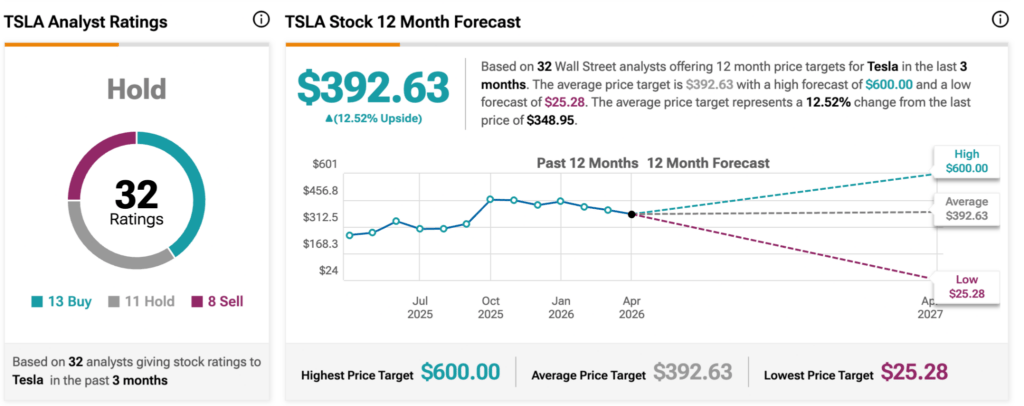
Regarding the EV maker’s stock price outlook, based on 32 analyst ratings compiled by TipRanks, Tesla holds an overall ‘Hold’ rating, with 13 ‘Buy’, 11 ‘Hold’, and 8 ‘Sell’ recommendations.

The average 12-month price target is $392.63, implying about 12.5% upside from the latest price. Bullish targets reach as high as $600, while the lowest forecast stands at $25.28.
At Morgan Stanley, analyst Andrew Percoco said Tesla is nearing 10 billion miles of training data for its autonomous systems, a milestone that supports its self-driving lead. However, he emphasized the need for clear evidence that fully unsupervised autonomy is close to justifying the valuation. He expects robotaxi operations to improve with more data, but flagged rising capital expenditures, potentially up to $35 billion, and projected negative free cash flow in 2026. He maintains an equal-weight rating with a $415 price target.
JPMorgan Chase analyst Ryan Brinkman, on the other hand, has taken a more cautious stance, warning Tesla’s stock could fall by as much as 60%, citing valuation concerns, execution risks, and the gap between current capabilities and expectations for autonomous driving. The analyst has assigned a ‘Sell’ rating with a TSLA price target set at $145.
At GLJ Research, analyst Gordon Johnson remains bearish, pointing to repeated delays in Full Self-Driving progress and extended timelines. He maintains a ‘Sell’ rating with a $25 price target.
In contrast, Deutsche Bank analysts led by Edison Yu offered a more balanced view after testing Tesla’s robotaxi service. They described it as impressive under supervision but noted inefficiencies such as longer routing times. They expect these issues to improve over time and maintain a ‘Buy’ rating, while trimming their price target to $465 from $480.