
Trading at $142 on September 2, 2026, SpaceX (NASDAQ: SPCX) stock is far below the record price of $225 achieved just a few days after the historic initial public offering (IPO) that priced shares at $135.
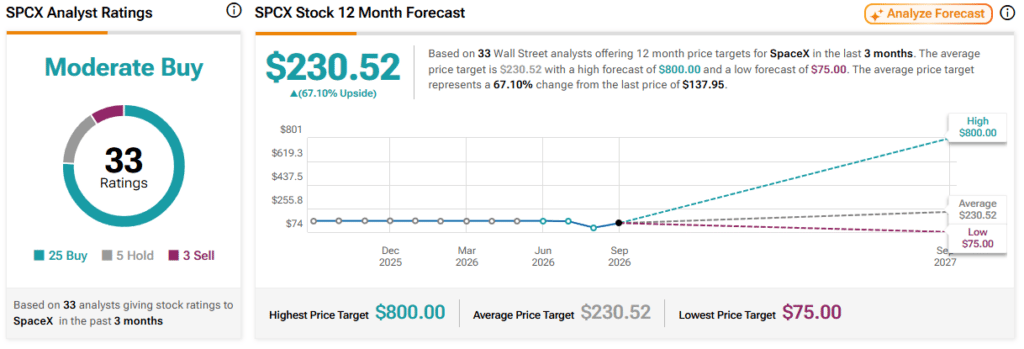
However, Wall Street analysts appear unfazed by the decline. Indeed, the average SpaceX stock price target stands at $230 as of press time, meaning that analysts see roughly 60% upside for the space exploration company over the next year, according to TipRanks data.
The most bullish forecasts come from Raymond James, which sees SpaceX trading at $800 following a 460% rally over the next 12 months. The second most optimistic analysis came from Arete Research, which has set a $450 target, implying roughly 225% upside in the same period.
Of course, not everyone is as optimistic. Phillip Securities, for instance, still rates SpaceX a ‘Sell,’ with a $75 price target that implies approximately 45% downside over the next year. For context, the company has been rated a ‘Sell’ only three times in the past 90 days, versus 25 ‘Buy’ recommendations.
The most recent revision came from JPMorgan on September 1, when the bank reiterated its ‘Buy’ rating with a $240 SPCX share forecast, which implies a 74% upside potential.
SpaceX stock performance depends on AI, analysts suggest
While Wall Street is generally bullish, the wide gap between the lowest and the highest price target calls for some kind of explanation, and the most likely one appears to be artificial intelligence (AI), both the most transofrmatice and the most divisie technology to grace the market in recent history.
In its prospectus, SpaceX estimated its total addressable market at $28.5 trillion, including $370 billion in space-related opportunities, $1.6 trillion across connectivity, and no less than a staggering $26.5 trillion in AI. In other words, AI represents roughly 93% of SpaceX’s estimated long-term total addressable market.
As the company’s own numbers suggest, then, the future of SpaceX stock is heavily dependent on management’s ability to turn its AI ambitions into a profitable business and, thus. Justify a premium valuation.
This is precisely the main concern of the aforementioned Phillip Securities. Indeed, the company is worried that the enormous capital expenditures required to build out SpaceX’s AI infrastructure are simply not feasible. What’s more, analyst Glenn Thum pointed to the company’s customer concentration, with nearly 20% of second-quarter revenue coming from a single AI customer.
As can be expected, analysts on the other end of the spectrum take the opposite view when it comes to AI. Goldman Sachs, for instance, expects SpaceX’s AI revenue to increase roughly 100-fold by 2030 but projects that SpaceX could generate approximately $105 billion in negative cash flow in 2029 before turning cash-flow positive around 2030 or 2031.
The huge spread between Wall Street’s price targets therefore reflects fundamentally different assumptions about AI, with the bull case strongly dependent on optimism surrounding the new tech.
Featured image via Shutterstock