

In the morning of Tuesday, May 12, Broadcom (AVGO) received its first major stock price target update in nearly a month following a 11.10% 30-day rally to $421.91.
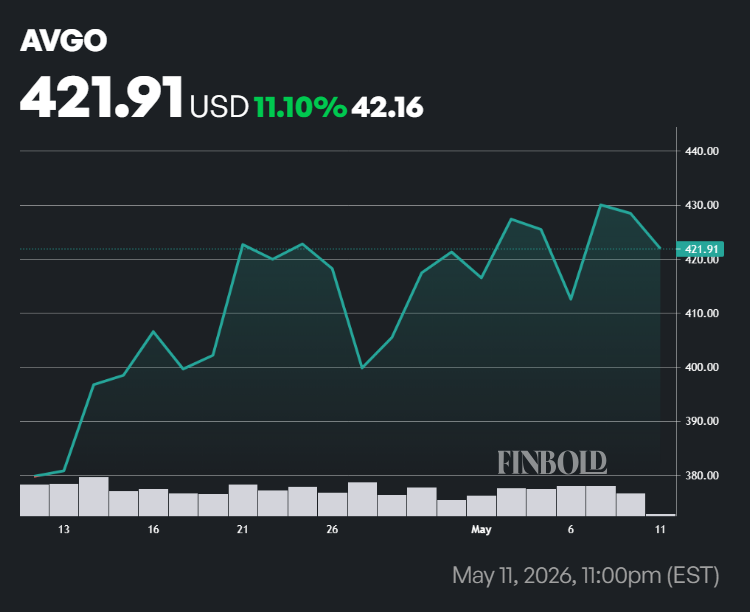
Specifically, Citi (NYSE: C) analyst Atif Malik reiterated his previous ‘Buy’ rating but increased the 12-month forecast from $475 to $500, effectively increasing the predicted rally from 12.83% to 18.76% relative to Tuesday morning’s valuation.
According to the Wall Street expert, the bullish update is backed by the continuously strong artificial intelligence (AI)-driven demand.
Notably, other major technology companies, including Nvidia (NASDAQ: NVDA), Advanced Micro Devices (NASDAQ: AMD), and Intel (NASDAQ: INTC), received optimistic updates backed by similar factors and provided by a variety of analysts on May 12.
Broadcom stock soars more than 11% in a month
Elsewhere, the increased Broadcom stock price target reflects AVGO shares’ recent stock market rally. Indeed, after struggling in early 2026, the equity entered a rally in late March that took it, by press time, 46% higher.
Malik’s previous $475 forecast – itself representing an increase from the preceding $458 – was provided in mid-March when the technology giant was changing hands at approximately $325.

Notably, despite Broadcom stock’s April and early May momentum, the latest forecast indicates that Citi believes AVGO is closer to a ceiling than two months ago.
Indeed, had AVGO managed a 12-month rise from $325 to $475, it would have constituted a 46.15% rally while the latest price target only foresees a 18.76% rise.
Is an AVGO stock crash imminent?
The apparent diminished confidence in decisive growth can, perhaps, be attributed to Broacom shares’ latest, 1.52% drop from $428.43 to $421.91 in the May 12 pre-market, and the facts technical analysis (TA) increasingly paints the equity as overbought.
Notably, at press time, the 14-day AVGO relative strength index (RSI) shows a reading of 63.43, which, while still considered ‘neutral,’ hints that a move toward 70 – ‘expensive’ – is imminent, increasing the risk of a greater correction.
Featured image via Shutterstock