
The tension between Tesla’s (NASDAQ: TSLA) recent stock market slowdown and persistent executive optimism is more than evident in the latest three Wall Street analyst rating revisions.
Indeed, the Tesla price targets provided on February 2 show that expectations vary widely, with some forecasting a 49.39% crash from the press time price of $424.78 and others a 17.7% rally.
So far, Tesla stock is down 5.55% year-to-date (YTD), but up 31.81% in the last six months, and 10.71% in the last 365 days.
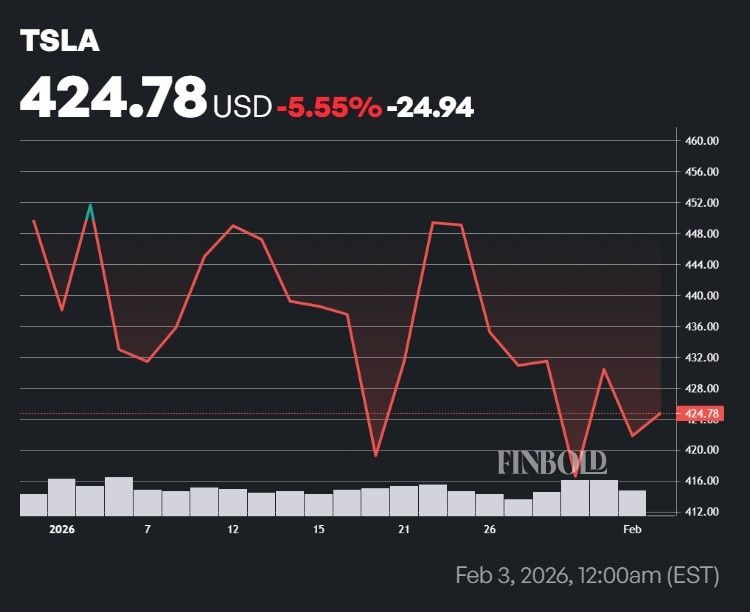
Analysts update Tesla stock price target
To begin with, Philip Securities analyst Glenn Thum proved rather bearish when he reiterated the ‘Sell’ Rating for Tesla stock and lowered his price target from the already-low $220 to $215.
China Renaissance, for its part, elected to maintain its previous ‘Hold’ rating while implementing a minor TSLA stock price upgrade from $380 to $380.
Still, despite the majority of the latest price target revisions being bearish, RBC Capital’s Tom Narayan provided the February 2 injection of optimism. Specifically, the famous expert confirmed he considers Tesla shares to still be a ‘Buy’ while forecasting a 17.7% rally to $500.
EV market gives no case for recovery of Tesla stock
Tesla’s latest business developments do much to explain the bearish tint in the latest expert ratings.
Elon Musk’s electric vehicle (EV) maker arguably underperformed in terms of deliveries in 2025 as the 1.64 million cars it shipped in the year mean Tesla recorded an annual drop, as, through 2024, the company delivered 1.79 million.
More recently, the situation appears not to have improved. The EV maker’s European slump in sales persisted in January 2026, with the firm’s registrations in France – a nation of 69 million people – dropping 42% to just 661 cars.
The results in Norway – once the prime adopter of electric vehicles – were even worse, with Tesla recording an 88% plunge, per a February 2 Bloomberg report.
Elsewhere, figures from China indicate the situation is not going to improve with any speed, with Tesla’s bigger competitor, BYD, logging five consecutive months of decline with an annual fall of 30% and a 50% crash since December for its new energy vehicles (NEV).
Featured image via Shutterstock