

A closely watched market valuation gauge long favored by billionaire investor Warren Buffett is flashing its strongest warning yet as 2026 begins.
The indicator, commonly known as the Buffett Indicator, compares the total market value of publicly traded U.S. stocks to the nation’s gross domestic product.
It is designed to show whether the stock market is growing in line with economic output or racing ahead of it.
When the ratio moves far above its historical norm, it suggests investors are paying increasingly high prices for each dollar of economic activity, raising the risk of sharp corrections or recessions.
According to the latest data, the Buffett Indicator has surged to roughly 224%, the highest level on record. This means the total value of U.S. equities is now more than twice the size of the U.S. economy, an extreme divergence that has historically preceded periods of significant market stress.
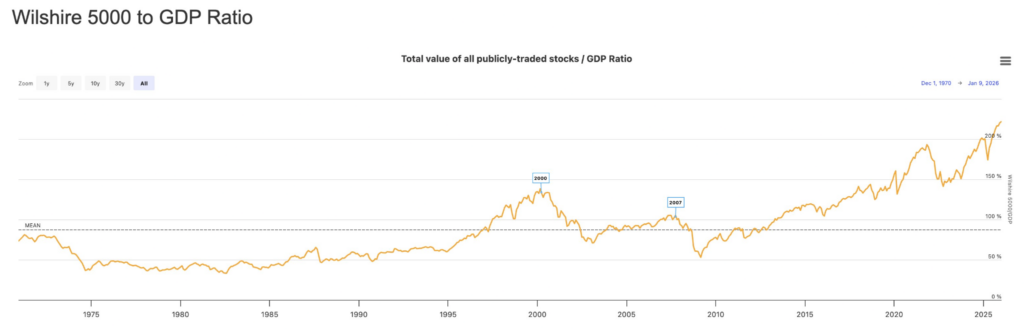
Notably, the ratio remained well below its historical average for much of the 1970s and 1980s before climbing rapidly during the late-1990s technology boom. It peaked around 2000, just ahead of the Dot-com crash, then fell sharply as markets corrected. A similar, though slightly lower, surge appeared in 2007 before the global financial crisis, followed by another steep decline.
Since 2010, the indicator has trended persistently higher, reflecting years of ultra-loose monetary policy, expanding corporate valuations, and strong investor appetite for risk assets.
The most recent leg higher, however, stands out for its steepness and scale. The ratio has pushed far beyond previous peaks, including those seen before the 2000 and 2008 downturns, indicating valuations have entered uncharted territory.
Slowing economic growth signals
What makes the current signal especially concerning is that the rise has occurred despite slowing growth signals in parts of the real economy. When market capitalization accelerates faster than GDP for prolonged periods, it implies expectations embedded in stock prices may be overly optimistic.
Historically, the adjustment back toward economic reality has tended to come through falling asset prices rather than rapid economic expansion.
The warning is emerging as many economists caution that the risk of an economic downturn is rising. Some analysts, including Henrik Zeberg, have pointed to increasing vulnerability to a prolonged market correction, citing slowing indicators such as labor market trends and weakening momentum across parts of the economy.
Featured image via Shutterstock