Economist Henrik Zeberg has warned about the direction of the U.S. economy, arguing that the Federal Reserve is failing to recognize clear signals pointing to a severe downturn.
According to Zeberg, the risk of a major recession is rapidly increasing, even as policymakers remain confident in their analytical frameworks and forecasting tools, he said in an X post on December 21.
At the center of his critique is what he described as a fundamental failure in economic interpretation rather than a lack of data or expertise.
Zeberg noted that the Federal Reserve employs hundreds of highly trained economists, yet still misses what he sees as an obvious and revealing economic pattern.
“Ladies & Gentlemen – we are heading right towards a massive recession – and the FED is completely blind despite extreme amount of resources,” he said.
Reality of business cycle
In his view, excessive complexity in analysis has obscured rather than clarified the underlying reality of the business cycle.
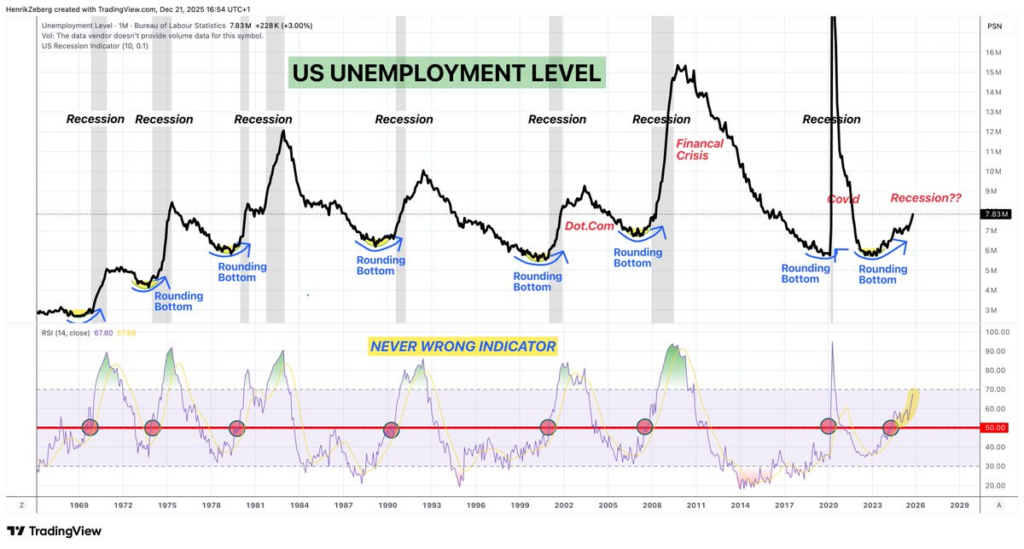
Zeberg emphasized that understanding the proper sequence of events within the business cycle is critical to anticipating recessions. He suggested that without a clear grasp of how economic phases unfold and interact, even years of study and vast institutional resources can lead to flawed conclusions. This misreading, he argued, has left policymakers ill-prepared for what lies ahead.
The economist’s assessment implies that the Fed’s current outlook underestimates the severity and timing of the looming downturn. Despite unprecedented access to data, research capacity, and analytical models, Zeberg believes the central bank is effectively operating without a clear line of sight into the next phase of the economic cycle.
Unemployment warning
To support his bearish outlook, Zeberg of Swissblock pointed to U.S. unemployment, arguing that it has preceded every major recession and remains a “never wrong” indicator.
He warned that rising joblessness suggests the economy is nearing a recession. U.S. unemployment reached 4.6% in November, the highest level in four years, edging closer to the Sahm Rule threshold and lifting recession odds to about 40%.
Zeberg maintained that weakening labor, housing, and consumer indicators point to a severe contraction ahead, with short-term Fed liquidity unlikely to offset deeper structural pressures.
Featured image via Shutterstock