
The next 100 million crypto users may not arrive through trading charts. Adoption will come through ordinary financial moments like getting a salary transfer, paying for groceries or holding value in an account that feels familiar.
That is the adoption thesis behind WeFi, a deobanking infrastructure provider focused on practical financial use.
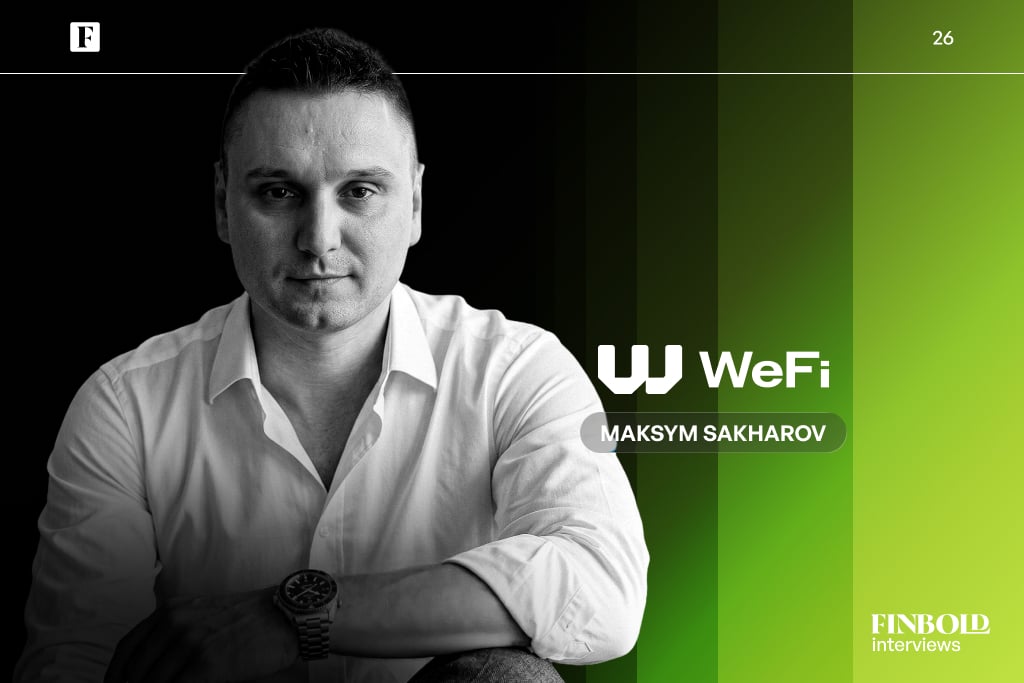
Maksym Sakharov, co-founder and group CEO of WeFi, sees crypto’s mainstream moment arriving through everyday financial actions, from receiving payments to moving money across borders.
When crypto becomes infrastructure
Sakharov says the company is open about using blockchain when users want to understand the system. But it does not ask users to think about blockchain as the main reason to use the product.
Consumers rarely think about the processors, banks and settlement systems behind a card payment. They expect the payment to work and the balance to be accurate. Sakharov argues that blockchain has to move in a similar direction if it is going to support mainstream financial behavior.
In his view, blockchain’s value lies in how ownership is recorded, how transactions are authorized and how value moves between systems. But if a user has to think about networks, gas or private keys every time they use a financial product, the system is still too early for mainstream use.
Some users may want more visibility into how assets are controlled or recorded on-chain, but Sakharov’s point is that everyday users should not be forced into that technical layer.
WeFi’s deobanking model is built around account-like financial products, which Sakharov says should “feel familiar at the surface while the operating layer becomes more efficient underneath.”
Moving beyond trading
The crypto industry’s earlier growth was built in large part around trading. For many users, the first contact with digital assets came through an exchange account, a market cycle or a price chart. Trading helped create liquidity and awareness, but it also trained many users to think of the technology mainly as something to buy and sell.
Sakharov argues that the industry has to stop treating investment as the entry point to crypto utility. “Most people do not need another market to watch,” he said. “They need to receive money, protect value, make payments, move funds across borders, and access services that work reliably.”
A typical WeFi user, according to Sakharov, could be a freelancer working with international clients. The user checks a balance, sends funds and spends with a card where available. The difference appears when a transfer that would normally take several business days clears within seconds.
In Sakharov’s telling, the point is to put fiat access, stablecoins and on-chain rails behind an account-like experience for users whose financial lives already cross borders.
Why users would switch
A user still needs a reason to leave the financial products they already know. “Nobody changes financial products because the architecture sounds interesting,” Sakharov said. “A user switches when the same familiar account experience works better.”
Cross-border use is where Sakharov sees the clearest reason for users to switch. Asked about WeFi’s stated 200,000 users and $150 million in monthly volume across 153 jurisdictions, he pointed to active use rather than simple registration, driven by users whose financial lives have outgrown conventional local bank accounts.
In WeFi’s case, the improvement is framed around faster money movement, lower costs and easier use of fiat and stablecoins in daily spending. The company is targeting users who may already have bank accounts, but whose financial activity crosses currencies, platforms and payment systems more often than local banking products can comfortably support.
Daily use creates a separate issue: volatility. For practical financial activity, Sakharov points to stablecoins as the better fit, since they offer stability, liquidity and broader acceptance. WeFi does have its own token, called WFI, but Sakharov separates its role from everyday finance: the token is tied to participation in the WeFi ecosystem rather than transfers or daily use.
“The token supports the ecosystem. Stablecoins support practical usage,” Sakharov explains.
Regulation as part of the product
Banking is heavily regulated, and any company using on-chain rails has to address consumer protection, financial crime risk, custody, reporting and accountability.
Sakharov says regulation has to be built into the product from the beginning, rather than added after the fact. He said WeFi provides services across jurisdictions where it is permitted to do so, excluding sanctioned or restricted regions. Access depends on compliance, risk controls and market requirements.
WeFi’s answer, according to Sakharov, is to pair on-chain settlement with compliance tools such as onboarding, transaction monitoring, transparent records and regulated access points where required.
Users may compare WeFi with digital banks, payments companies or stablecoin platforms depending on the use case.
In that sense, WeFi isn’t really trying to compete with banks or fintechs directly. It’s positioned as infrastructure for financial players that want to offer faster, account-like access to digital value. Sakharov sees the real competitor as an outdated financial model — one built on slow settlement, high cross-border costs and too many middlemen.
The future of crypto may look less like crypto
Sakharov expects the crypto market to split more clearly over time. One side will remain crypto-native, centered on trading, protocols, tokens and open experimentation. The other will move deeper into financial infrastructure, from stablecoin settlement to wallet-based accounts, payment products, business transfers and custody systems that ordinary users may not describe as crypto at all.
The word crypto may survive, but it may no longer describe the whole category. The strongest products may be the ones that keep the chain beneath the surface and let users focus on what they are trying to do with their money.
Read more interviews here.