
SpaceX (NASDAQ: SPCX) and Tesla (NASDAQ: TSLA) shares fell sharply in premarket trading on Wednesday, November 4, as investors reacted to Democrats’ sweeping victories in the 2026 U.S. midterm elections.
SpaceX shares closed the previous session at $141.31 before dropping to $131.85 in premarket trading, representing a decline of 6.69%. Tesla stock fell 5.50% from its previous close of $398.50 to $376.59.
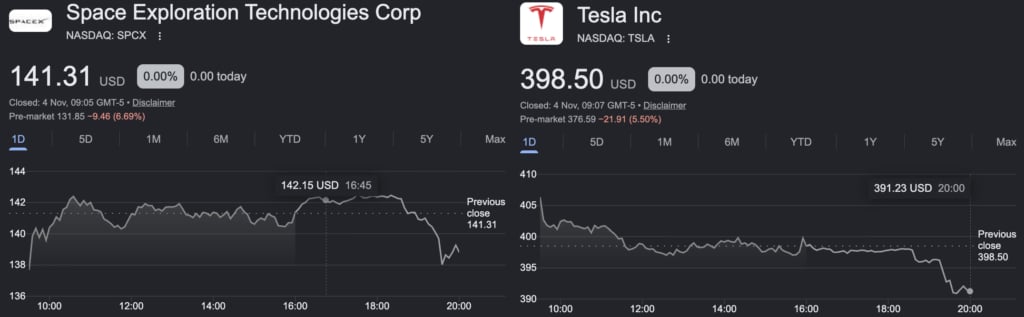
The declines came despite a relatively positive reaction across the broader U.S. stock market, suggesting that investors were primarily reassessing risks associated with Musk’s business empire rather than responding to a wider market sell-off.
Advertisement
Why Musk stocks are crashing
The main catalyst behind the declines was Democrats’ victory in both chambers of Congress, raising concerns about increased scrutiny of Musk’s businesses.
Musk has been a prominent financial supporter of Republican candidates, reportedly donating more than $250 million to Republican-aligned groups in the third quarter of 2026.
The election results therefore represent a setback for his political interests and could expose his companies to greater congressional scrutiny, particularly over government contracts and regulatory oversight.
SpaceX has significant government relationships through its rocket-launch business and Starlink satellite network, while Tesla faces regulatory exposure through its autonomous-driving operations. Investors may therefore be pricing in the risk of more challenging regulatory conditions.
Uncertainity around SpaceX-Tesla merger
At the same time, uncertainty surrounding a potential SpaceX-Tesla merger has added to the pressure.
Speculation about an all-stock transaction has raised concerns about corporate governance, valuation and shareholder dilution, while the companies’ government ties and national security implications could attract additional scrutiny.
Advertisement
XTB research director Kathleen Brooks warned that although Congress cannot directly block a merger, lawmakers could delay the process through increased scrutiny.
She also noted that the election outcome has introduced a political risk premium into both companies’ valuations.
For Tesla shareholders, an all-stock transaction could also create dilution concerns, depending on the valuation and exchange terms. The potential voting structure of a combined company has added to investor uncertainty.
Neither company has completed such a transaction, leaving investors to weigh the implications of a possible deal without definitive terms.
SpaceX locked shares impact
SpaceX also faces selling pressure following the October 22 expiration of restrictions on previously locked-up shares, which made approximately 1.3 billion shares eligible for sale.
Although this does not guarantee immediate selling, the potential increase in supply has weighed on sentiment. SpaceX has also reportedly lost more than $400 billion in market value since October 6.
Advertisement
For Tesla, political uncertainty adds to concerns about autonomous-driving regulation and weakening delivery momentum.
A Democratic-controlled Congress could increase scrutiny of its driver-assistance technology, while declining wholesale figures from its Shanghai factory following September’s record output have raised concerns about near-term deliveries in China.