

Micron Technology (NASDAQ: MU) has suffered a sharp correction over the past month, with shares falling about 25%.
Notably, MU shares have declined from a record high near $1,255 in late June 2026 to about $920 at press time.
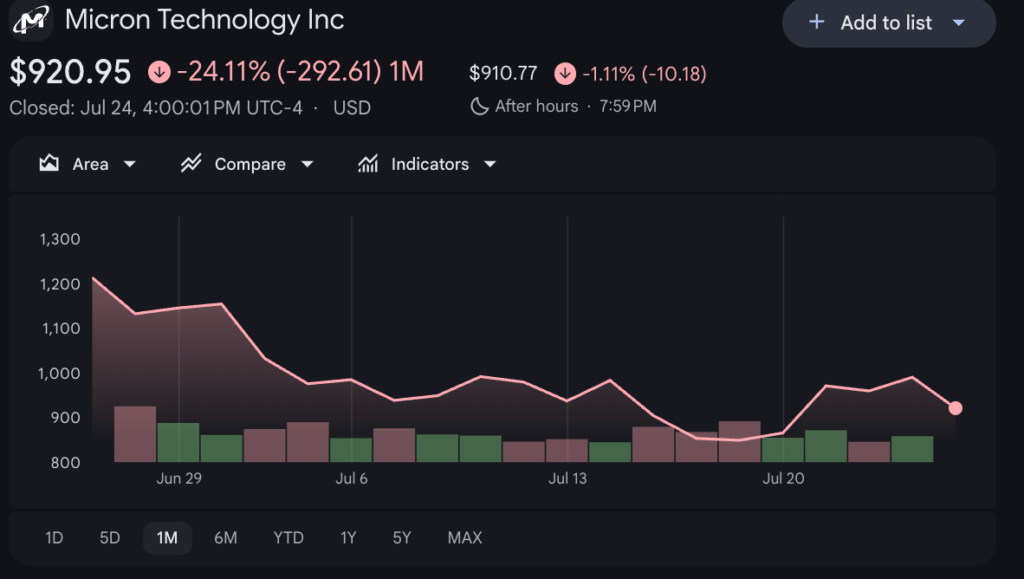
The drop comes despite the company reporting record revenue, earnings, and margins, highlighting growing investor concerns about the sustainability of the AI-driven memory boom.
The decline has surprised many investors given Micron’s strong financial performance. However, the sell-off reflects concerns over future memory chip supply growth, valuation risks, profit-taking after an extraordinary rally, and broader weakness across the semiconductor sector.
The downturn began shortly after Micron reported exceptional fiscal third-quarter 2026 results.
The company posted record quarterly revenue of $41.46 billion, up 346% year-over-year, while adjusted earnings per share reached $25.11, well above Wall Street estimates. Gross margins climbed to roughly 85%, and management projected fiscal fourth-quarter revenue of about $50 billion.
Why Micron stock has plunged
Despite the strong results, Micron faced heavy profit-taking after a rally that saw the stock gain more than 700% over the past year on booming AI memory demand. Following the earnings-driven surge, many investors opted to lock in gains, accelerating the sell-off.
Another key concern is the cyclical nature of the memory industry. In this line, Micron has benefited from shortages of HBM, DRAM, and NAND chips used in AI infrastructure, pushing prices and margins to record levels.
However, investors fear the industry may be nearing a cycle peak. Historically, strong profitability attracts new capacity, eventually leading to oversupply, lower prices, and weaker margins.
As a result, the market is questioning whether Micron’s current earnings strength can be sustained over the long term.
Meanwhile, concerns about future supply have intensified as Samsung Electronics and SK Hynix ramp up investments to expand memory production capacity.
Their aggressive spending plans have fueled expectations that current shortages could ease in the coming years. Meanwhile, Chinese memory maker CXMT is emerging as a competitive threat, with reports suggesting some customers are exploring alternative suppliers, raising concerns about Micron’s future pricing power.
The sell-off has also coincided with broader weakness across semiconductor and AI-related stocks. Investors are increasingly scrutinizing AI infrastructure spending and questioning whether hyperscalers can generate sufficient returns from massive data center investments.
Concerns about slower AI spending growth and the development of custom chips by major technology companies have further weighed on sentiment toward AI hardware stocks.
Despite the correction, investors remain wary of assigning premium valuations to earnings they view as cyclical.
After a rally of more than 700% over the past year, even modest concerns about future profitability triggered a sharp reassessment of the stock.
Micron stock outlook
On the other hand, Micron’s near-term outlook remains strong. The company has secured long-term supply agreements backed by billions of dollars in customer commitments while continuing to invest in advanced memory technologies and new U.S. fabrication facilities.
Management expects memory market conditions to remain tight through at least 2027, with only gradual supply improvements thereafter.