

Historical data is suggesting that the stock market may ultimately emerge on top despite the recent volatility tied to the Middle East conflict involving the U.S., Israel, and Iran.
Notably, the tension has weighed on equities, pushing the S&P 500 down roughly 5% since the onset of the conflict.
Now, about 15 trading days into the decline, market behavior is beginning to mirror a well-established historical pattern that has often preceded strong rebounds.
Data tracking more than 30 major geopolitical shocks since 1939 shows that U.S. stocks typically find a bottom around the two-week mark.
The current pullback appears closely aligned with both the historical average and median trajectories observed during past crises, reinforcing the idea that markets may be nearing an inflection point.
Insights shared by market commentary platform The Kobeissi Letter in a March 21 post on X indicate that, after an initial period of volatility and decline, equities tend to stabilize and reach their lowest levels around day 12 to 15.
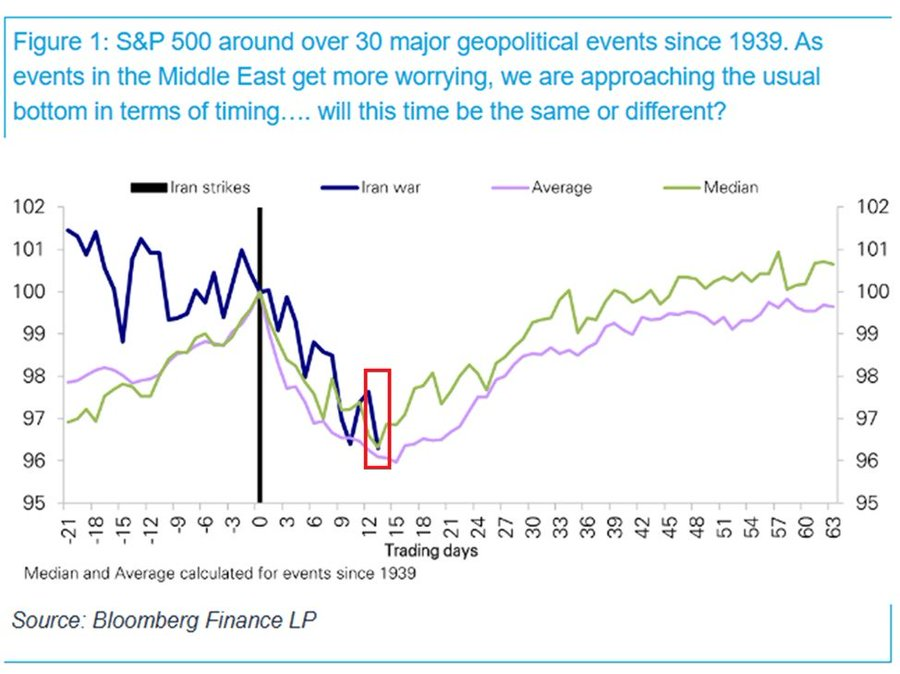
This phase is visible in the current cycle, where the index has dipped into a range similar to prior geopolitical sell-offs. Notably, the pattern points to a sharp but short-lived trough before a gradual recovery begins.
Historically, once this bottom is established, the rebound phase has lasted about 40 trading days on average. During this period, stocks have typically climbed back toward pre-event levels, often regaining lost ground and moving higher as uncertainty fades and investor confidence returns.
Stock market volatility escalates
Overall, stocks fell sharply on Friday, with the S&P 500 hitting a six-month low as the U.S.-Israeli war with Iran entered its fourth week, intensifying fears of oil supply disruptions and persistent inflation.
The index dropped 1.51% to 6,506.48, marking a 1.9% weekly loss, a fourth straight weekly decline, and a roughly 5.4% drop since the conflict began on February 28.
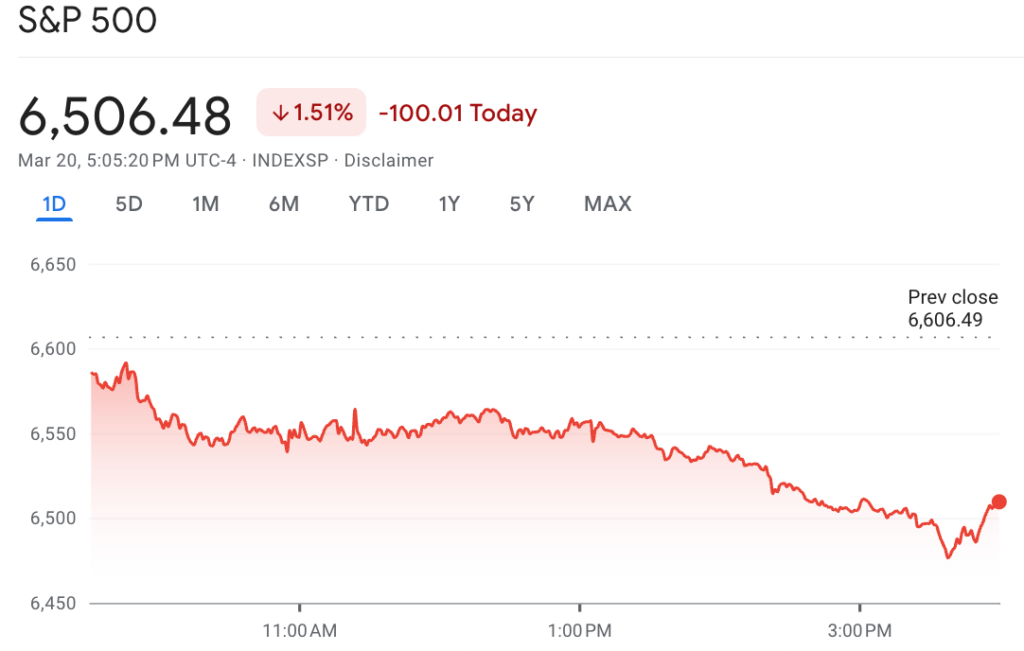
The sell-off has been driven by surging energy prices following attacks on key infrastructure, including Iran’s South Pars gas field, Qatari facilities, and disruptions in the Strait of Hormuz.
While U.S. markets have shown relative resilience due to domestic energy strength and hopes for a shorter conflict, analysts warn that prolonged uncertainty could lead to further losses.