

The reemergence of the North Atlantic trade war – all under threat of an actual North Atlantic war – ensured the term ‘trade bazooka’ entered the 2026 vernacular with the U.S. bond market possibly arising as a target for at least one of its rockets.
Specifically, as tension between the U.S. and E.U. over Greenland started simmering once more, multiple European bankers noted that the political bloc is among the biggest holders of American debt.
“Europe owns Greenland, it also owns a lot of Treasuries…For all its military and economic strength, the US has one key weakness: it relies on others to pay its bills via large external deficits”, per a note written by George Saravelos, Deutsche Bank’s global head of currency research.
Indeed, nations to the east of the Atlantic Ocean hold approximately $8 trillion worth of U.S. bonds, and, once other entities utilizing vehicles registered in the region are accounted for, the number rises above $12 trillion.
Is the E.U. ‘trade bazooka’ loaded with duds?
Such a setup ensured that some figures in Europe are, as of early 2026, considering a mass sell-off of American debt, a move that could trigger a veritable bloodbath for U.S. treasuries, given the sheer volume Europeans could move.
The threat, however, is also likely to never move beyond words. Despite the massive leverage on paper, most American bonds owned by Europeans are not under the control of national governments but private entities, with the Norwegian Sovereign Wealth Fund being a major exception.
Under the circumstances, it is doubtful if E.U. governments would be able to compel private companies and individuals to sell, barring a major escalation in the trans-Atlantic conflict. Furthermore, even if a sell-off is successfully ordered, the volume of trade is all but bound to shake European economies as well, while finding willing buyers could prove troublesome.
“It may be that European public sector investors in US assets either stop accumulating or start selling, but the situation probably needs to escalate a fair bit further before they damage their investment performance for political purposes”, according to Societe Generale’s chief FX strategist Kit Juckes
How the E.U. could grind down the U.S. bond market
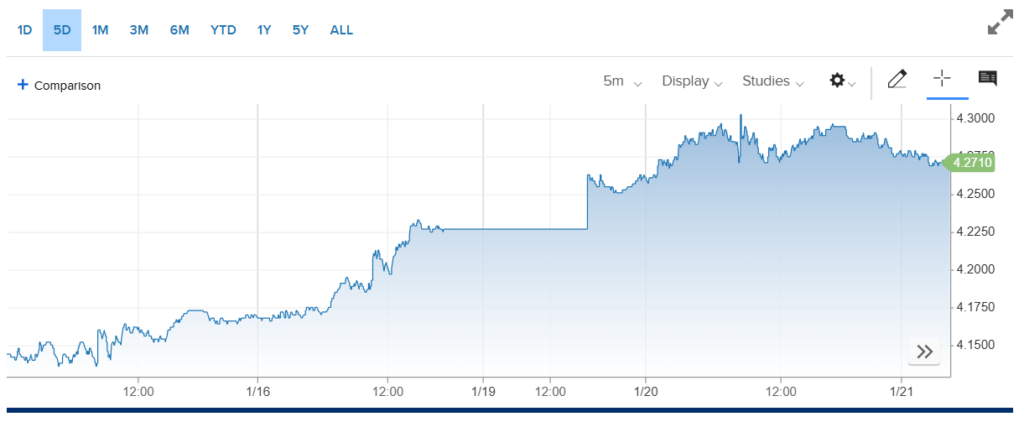
Still, even if offloading the entire $8 trillion appears unlikely, it is worth noting that the threat of a financial bloodbath can be effective at starting a bloodbath. Some buckling in the market could already be observed as Danish pension funds sold their U.S. treasuries – a move that led to a notable spike in the 10-year treasury yield in the weekly chart.
Another issue Uncle Sam could face in the coming years is facing more trouble in issuing debt. While the E.U. is unlikely to crack the bond market by selling, investors from the continent could put pressure on the American government by refusing to buy.
Traditionally, U.S. treasuries are an appealing investment for numerous reasons, but political stability, rule of law, economic strength, and relative diplomatic certainty at least toward the traditional allies from the so-called ‘Global North’ were important factors.
President Donald Trump’s belligerent behavior at home and abroad is threatening to uproot much of the value proposition.

Such a setup could be particularly damaging since, despite the campaign promises, the American government has continued nurturing the growth of its debt to the tune of trillions.
Additionally, should international actors become less willing to purchase treasuries, issuing additional debt could turn very expensive for the U.S. government, which has, for decades, been relying on borrowing money at a low cost.
Why the U.S. has the advantage in early 2026
Elsewhere, while the E.U. indeed has some bond leverage over the issue in the short-term and the potential to crack the market in the long run, the U.S. is likely in a far stronger position at the start of 2026.
In a turn of events that likely has Charles de Gaulle rolling in his grave, European countries are deeply integrated with the American economy, and Washington has something of a chokehold over the E.U. at press time on January 21.
Between the sanctions imposed on Russia and the destruction of the Nord Stream pipeline in the Baltic Sea, Europe is largely dependent on natural gas imported from North America.
Such a dependence ensures that the U.S. has a hand on the ‘off switch’ for European heating, and to alter the situation, the E.U. would likely have to swallow the bitter pill of thawing with regard to one of the international actors it has historically been adversarial toward.
Under the circumstances, it is notable that France’s President Macron recently commented about how Europe needs more Chinese direct investments.
Featured image via Shutterstock