

Michael Burry’s biggest short position of 2026 in software giant Palantir Technologies (NASDAQ: PLTR) has moved in his favor so far this year.
Notably, PLTR shares have fallen about 30.5% year-to-date, dropping from roughly $177 at the start of 2026 to around $123 as of August 3.
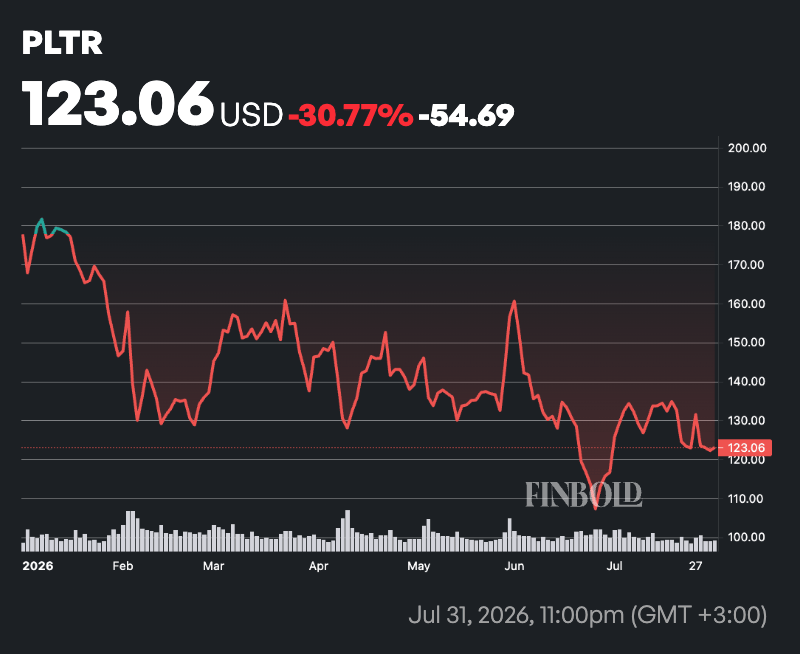
As a result, a hypothetical $1,000 investment in Palantir at the beginning of the year would now be worth about $695.
The decline has erased approximately $305 in value and strengthened Burry’s bearish thesis on the AI software company.
The famed investor, best known for predicting the 2008 financial crisis, has maintained a bearish position against Palantir despite the company’s rapid growth and expanding AI business.
Burry built the position through put options in late 2025. Regulatory filings showed notional exposure of about $912 million tied to five million shares before his fund deregistered. He has since continued referencing Palantir puts and direct short exposure in public updates.
His concerns center on valuation, with the investor arguing that Palantir’s share price reflects unrealistic growth expectations and excessive AI optimism.
He has also pointed to stock-based compensation, the company’s operating model, and its lofty valuation multiples as key risks.
The decline in Palantir stock comes despite strong business performance. In the first quarter of 2026, the company reported revenue of $1.63 billion, representing 85% year-over-year growth.
Demand has remained particularly strong across its U.S. commercial operations as enterprises increasingly adopt AI-powered software solutions.
Palantir’s core platforms, including Gotham and Foundry, are widely used by government agencies and commercial organizations to analyze data and support decision-making.
The technology firm has also expanded its Artificial Intelligence Platform, which has become a key growth driver.
Palantir stock valuation concerns
Despite those growth metrics, Palantir’s valuation remains one of the most debated topics on Wall Street. The company has frequently traded at roughly 40 to 50 times forward sales, leaving little room for operational missteps.
Skeptics point to risks including dependence on government contracts, intensifying competition in AI software, potential economic slowdowns, and continued shareholder dilution from stock-based compensation.
Those concerns have helped drive the stock lower in 2026 even as broader equity markets remained relatively resilient.
Notably, Burry’s bearish view extends beyond Palantir, with the investor remaining skeptical of several leading technology names.
During 2026, he also established or increased short exposure to several AI-related assets, including Nvidia (NASDAQ: NVDA), Micron (NASDAQ: MU), Applied Materials (NASDAQ: AMAT), Tesla (NASDAQ: TSLA), Caterpillar (NYSE: CAT), and the iShares Semiconductor ETF. The positions reflect his broader belief that parts of the AI trade have reached bubble-like valuations.