
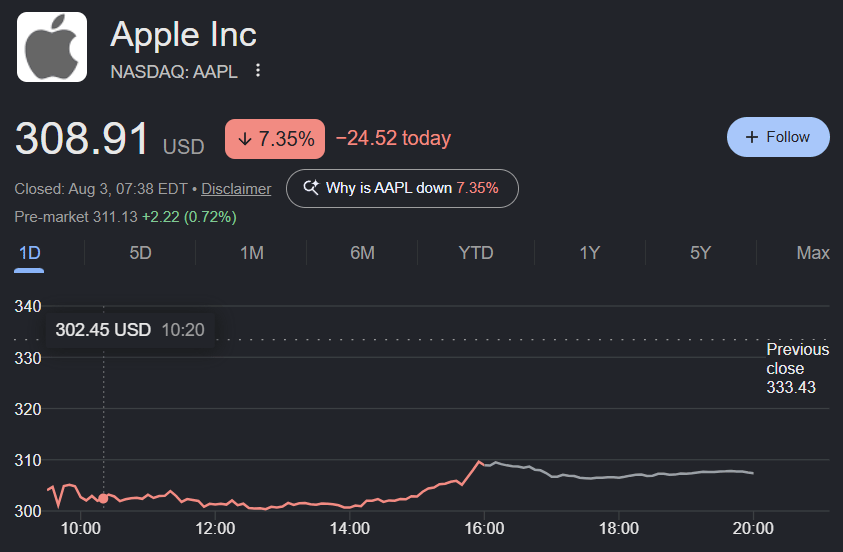
Apple (NASDAQ: AAPL) stock has suffered its worst daily decline in more than a year, sitting 7.35% in the red on Monday, August 3, after component shortages weighed on the company’s sales forecast last week.
The iPhone maker reported fiscal third-quarter revenue of $109.4 billion, up 16% from $94 billion a year earlier, while earnings per share (EPS) rose to $2.02 from $1.57, beating Wall Street’s consensus of $1.89.
However, the company also forecast fourth-quarter revenue growth of 9-11% year-over-year (YOY), implying roughly $113 billion in sales, which is below the analyst expectation of $114.9 billion.
At press time, Apple shares were trading at $308.91, with a modest 0.72% uptick in pre-market hours.
Apple stock crashes following Tim Cook’s last quarter as CEO
During the earnings call, CEO Tim Cook said component shortages, particularly in memory chips, will continue to limit production across the iPhone, Mac, and iPad lineups throughout the September quarter.
Moreover, he described the current environment as a “100-year flood on memory pricing,” pointing to surging DRAM and NAND costs driven by booming AI infrastructure spending, which has tightened global chip supplies.
Despite the cautious outlook, Apple’s core hardware business delivered solid growth. Namely, iPhone revenue climbed 22% year over year to $54.3 billion, beating expectations of $53.6 billion. At the same time, Mac revenue jumped 29% to $10.4 billion, well above the $8.62 billion consensus.
However, iPad revenue totaled $6.19 billion, missing expectations of $6.89 billion. Similarly, Services revenue increased 12% to $30.7 billion, also below the $31.4 billion forecast.
The results mark the final full quarterly earnings report under Tim Cook, who has been in charge for 15 years. He is now set to hand over the CEO role to John Ternus, the hardware chief, on September 1.
Overall, investors appear cautious as the leadership transition approaches, as Apple is increasing investment in its AI strategy, with research and development spending rising 32% year over year to $11.7 billion as the company accelerates work on generative AI hardware.
Featured image via Shutterstock