
A $1,000 investment in Micron (NASDAQ: MU) stock made one year ago would have grown nearly tenfold, highlighting the semiconductor company’s extraordinary rally driven by artificial intelligence demand.
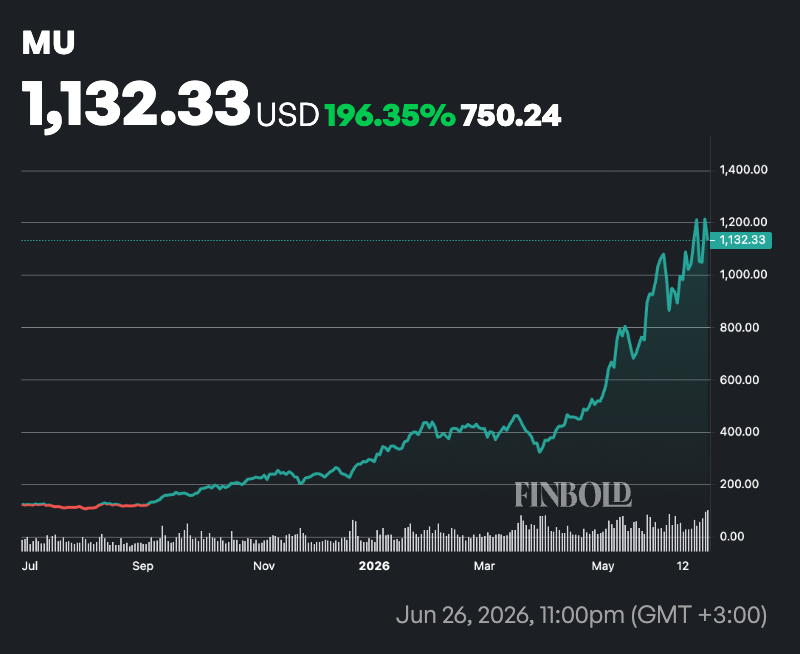
In this line, on June 27, 2025, Micron stock was trading at $124 per share. By June 27, 2026, MU stock had climbed to $1,132, representing a gain of about 812.9% over the 12 months.
Based on those figures, an investor who allocated $1,000 to Micron stock a year ago could have purchased about 8.06 shares. At the current share price of $1,132, that investment would now be worth roughly $9,129.
Why MU stock has rallied massively
The remarkable Micron stock performance has been driven primarily by soaring demand for high-bandwidth memory (HBM) and advanced DRAM products used in artificial intelligence infrastructure.
As AI companies continue expanding data center capacity, demand for high-performance memory has significantly outpaced supply.
To this end, Micron has emerged as one of the biggest beneficiaries of this trend, with its HBM products becoming critical components in AI accelerators and graphics processors.
At the same time, the company has reported that its entire 2026 HBM production capacity has been sold out under long-term agreements, providing strong revenue visibility and pricing power. The launch and rapid adoption of next-generation HBM4 products have further strengthened Micron’s position in the AI supply chain.
Meanwhile, Micron’s latest quarterly results provided another major catalyst for MU stock growth.
For its fiscal third quarter ended May 28, 2026, the technology firm reported revenue of $41.46 billion, far exceeding analyst expectations and marking a substantial increase from the same period a year earlier. Adjusted earnings per share also came in well above Wall Street forecasts.
Management further boosted investor confidence by issuing fourth-quarter revenue guidance of approximately $50 billion, surpassing consensus estimates and reinforcing expectations that AI-related demand remains strong.
The company also benefited from rising memory prices across the DRAM and NAND markets, helping drive significant margin expansion and strong cash flow generation.
Micron’s transition
Micron’s shift from a cyclical memory maker to a major AI infrastructure supplier has reshaped investor sentiment toward the company.
Analysts cite long-term supply agreements, strong AI memory demand, and ongoing supply constraints as key factors supporting future growth. Micron has also expanded its HBM market share and strengthened relationships with leading AI chipmakers.
Although risks remain around AI spending and growing competition, Micron is still widely viewed as one of the biggest beneficiaries of the AI boom.