
SpaceX (NASDAQ: SPCX) shares have extended their recent decline, tracking a broader technology-stock sell-off that has erased a significant portion of their gains.
At press time, SPCX was trading at $127, down more than 7% from its previous closing price and approximately 20% below its IPO price.
The stock has also remained in the red over the past two months, falling from $151 on September 21, 2026, representing a decline of approximately 15.89%.
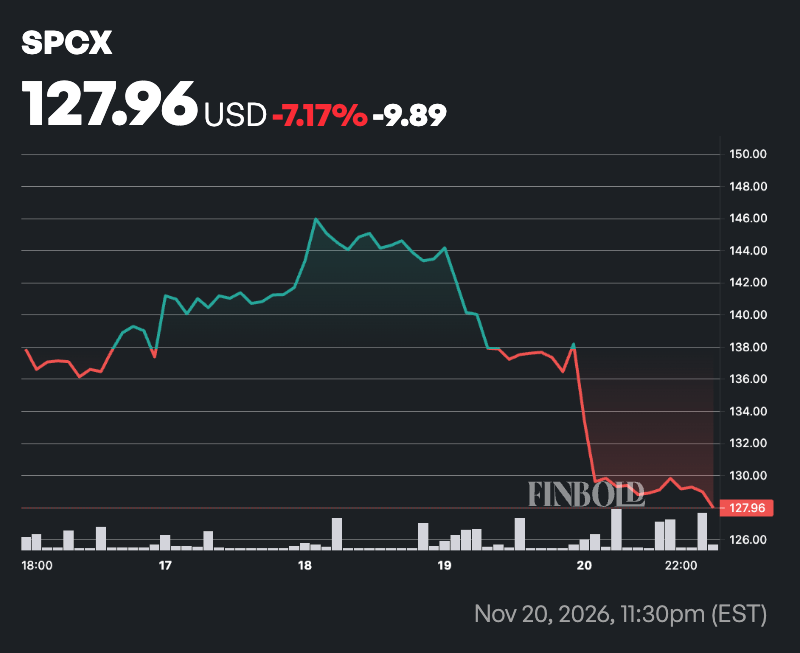
As a result, an investor who put $1,000 into SpaceX stock on September 21 would now hold $841 worth of shares, translating into an unrealized loss of $158, assuming fractional shares and excluding transaction costs.
The decline has pushed SpaceX shares below their $135 initial public offering (IPO) price for the first time since their June 2026 listing, as investors reassess technology valuations and growing AI infrastructure spending.
SPCX stock fundamentals
This weakness comes despite improving financial performance. SpaceX reported third-quarter 2026 revenue of $14.58 billion, up 161% year over year, while net income reached $4.4 billion, compared with a $1.1 billion loss a year earlier. Adjusted EBITDA surged 306% to $8.81 billion.
Its connectivity segment, primarily driven by Starlink, generated $5.25 billion in revenue, up 69% year over year, with 13.6 million consumer subscribers as of September 30. Meanwhile, its Super Intelligence segment contributed $7.56 billion, highlighting the growing importance of its AI operations.
However, expanding its AI business requires substantial financing. On November 20, Apollo Global Management and Goldman Sachs arranged a $44 billion financing package to fund SpaceX’s acquisition of Nvidia graphics processing units (GPUs) and related equipment, including infrastructure for its next-generation Vera Rubin chips.
The financing includes $25.17 billion in senior secured notes due in April 2033, yielding 8.259%, alongside other debt tranches carrying yields of 7.66% to 8.36%.
The deal attracted commitments from BlackRock, Goldman Sachs Asset Management and KKR-advised accounts. Lease payments are expected to begin once the equipment is delivered in the first half of 2027.
SpaceX shares risks
Meanwhile, heavy capital expenditure could weigh on SpaceX’s financial flexibility. The company spent approximately $19.59 billion in the third quarter, bringing its capital expenditure for the first nine months of 2026 to $48.07 billion, compared with $13.47 billion in adjusted EBITDA over the same period.
Much of this investment is directed toward AI infrastructure and expanding computing capacity.
Meanwhile, Starlink’s growing subscriber base, rocket-launch operations and AI investments provide several growth opportunities.
While its latest results demonstrate improving profitability and an expanding connectivity business, investors appear increasingly cautious about the costs and potential returns of its ambitious AI expansion.
Featured image via Shutterstock