
Nvidia’s (NASDAQ: NVDA) stock has been among the most closely watched on Wall Street, with investors analyzing both near-term catalysts and longer-range structural shifts in the AI hardware market.
As the company heads into 2026, a key long-term resistance level to watch sits at the $300 mark, while the stock faces nearer-term resistance around $200. In this context, NVDA shares ended the last session at $190.53, up more than 1%, and are up 38% year-to-date.
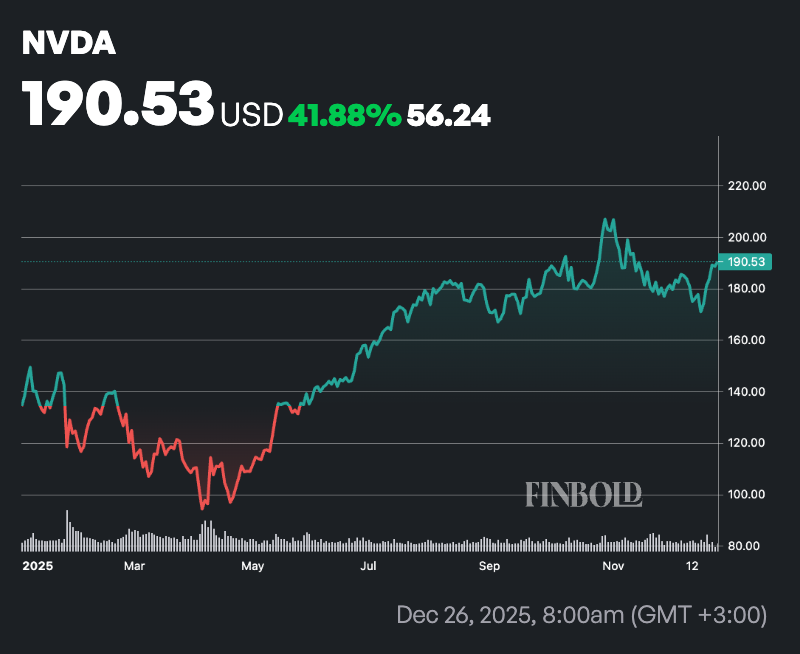
Based on fundamental factors, the $300 level looks plausible heading into 2026, provided the company maintains its dominant position in the AI space. To this end, Finbold has identified two reasons likely to help the American semiconductor giant reach a record high of $300 in 2026.
Groq deal
The first major catalyst is Nvidia’s strategic licensing agreement with AI chipmaker Groq, which has been widely welcomed on Wall Street. In late December, Nvidia reached a non-exclusive licensing deal valued at up to $20 billion to bring Groq’s inference technology and key personnel into its fold.
The move is intended to integrate deterministic, real-time language processing capabilities into Nvidia’s broader AI ecosystem and address a growing segment of the AI market that extends beyond traditional GPU training workloads.
By strengthening its inference performance capabilities, Nvidia enhances its value proposition to hyperscalers and enterprise AI customers at a time when demand for both training and inference infrastructure is rising. The market’s positive reaction and renewed analyst optimism around an expanded AI stack underscore the potential importance of this deal to Nvidia’s growth story in 2026.
Product roadmap
The second driver of potential upside is Nvidia’s aggressive product roadmap for 2026, most notably the planned rollout of its next-generation Rubin microarchitecture. Rubin is designed to deliver significant performance gains through advanced HBM4 memory and improved processing efficiency, representing a step change from current Blackwell-based platforms.
Industry forecasts suggest Rubin could achieve substantial throughput improvements, reinforcing Nvidia’s competitive lead in AI accelerators and helping secure a larger share of the global AI infrastructure market. Expectations of strong demand for Rubin-based systems, combined with broad adoption of the Blackwell series in 2025, position Nvidia for continued growth across data center and edge computing markets in 2026.
Nvidia’s risks
Despite these tailwinds, Nvidia’s path to a $300 stock price carries clear risks. One of the most significant is ongoing U.S. export controls and licensing restrictions on advanced chips to China, which have already resulted in inventory charges and could further limit access to one of the world’s largest technology markets. Prolonged or expanded restrictions could materially constrain Nvidia’s addressable market and temper revenue growth.
Another risk is intensifying competition from hyperscalers and custom silicon initiatives. Major technology companies are investing in proprietary AI chips, which over time could pressure Nvidia’s pricing power or market share if these alternatives prove sufficiently capable or cost-effective.
Featured image via Shutterstock