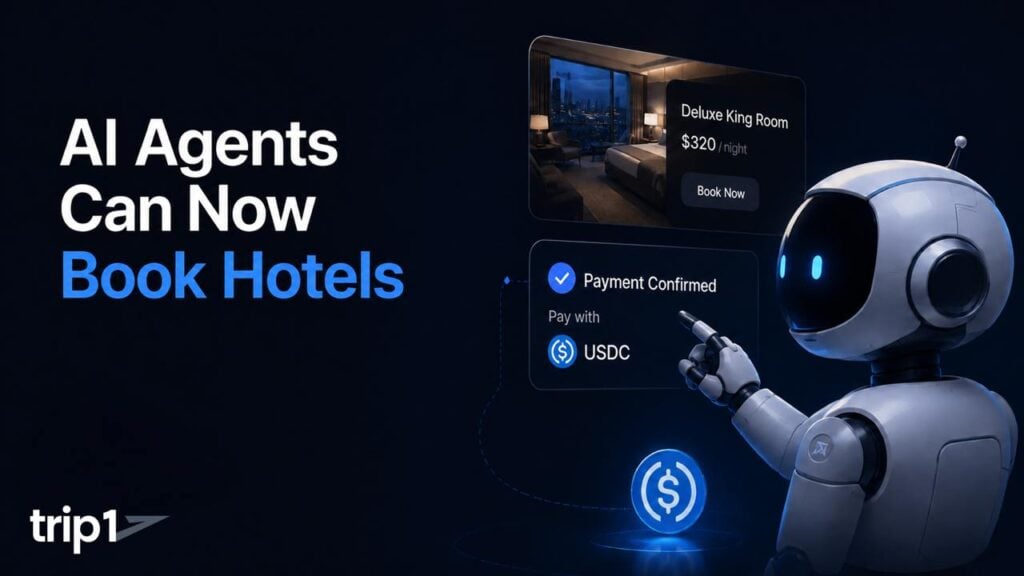
AI agents can now do something they could not do before: complete online purchases without humans manually handling the payment flow.
Trip1.com, a crypto travel platform, now allows AI assistants to search hotels, complete bookings, and settle payments using USDC on Base after user approval. Payments can be processed either through x402 agentic payments handled directly by the AI or through traditional CoinGate invoice URLs, where users complete the payment manually before the booking is confirmed automatically.
Powered by x402, Trip1 is one of the first examples of AI agents completing online purchases without using traditional checkout systems built for humans.
How AI Hotel Booking With USDC Works
Trip1 implementation uses x402, a protocol designed for internet-native payments between software agents and services. The booking flow works like this:
1. The AI agent searches hotel inventory based on the user’s request.
2. The user reviews the options and approves one.
3. The agent sends a booking request.
4. The platform responds with a payment requirement in USDC.
5. The agent signs and submits the payment on Base.
6. The payment settles on chain.
7. The booking confirmation is returned to the user.
The important detail is that the payment and the booking happen inside the same machine-driven workflow. There is no redirect to a traditional checkout page. No manual card entry. No human interaction during settlement. The user approves the purchase, and the AI handles the execution.
Explore the future of AI-driven travel booking
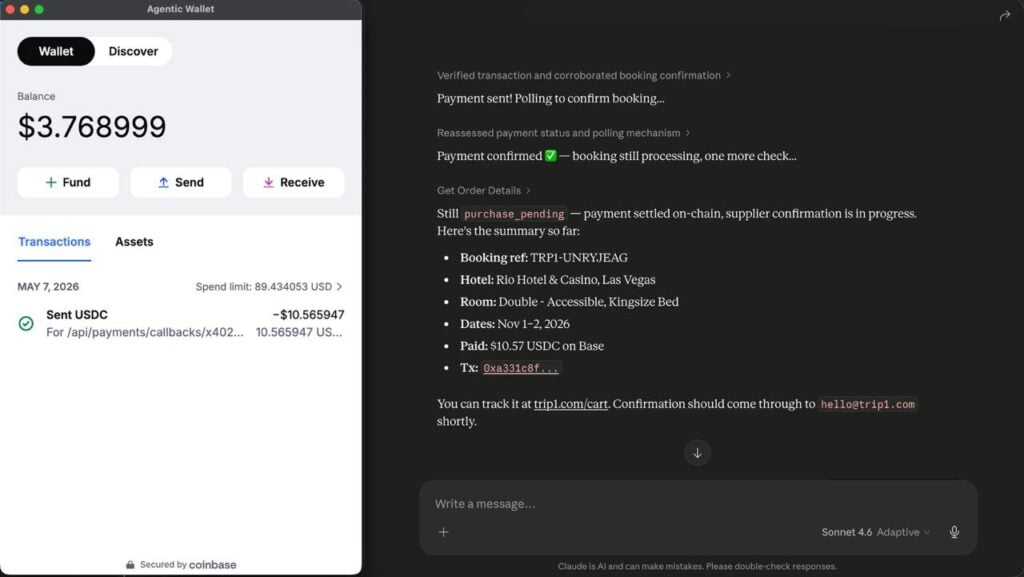
From Prompt to Reservation Number
Here is what a booking looks like in practice. You open Claude or ChatGPT with Trip1 connected and type something like:
“Find me a hotel in Istanbul near the Grand Bazaar for next weekend. Two nights, good reviews, under 120 USDC a night.”
The AI comes back with three or four options – name, location, price per night, rating, and cancellation terms for each. You pick one. The AI asks you to confirm the dates, guest name, and total price. You say yes.
The booking goes through. USDC settles on Base. You get a reservation number.
Here are more examples of what you can type:
“I want to spend a week in Mykonos in July. Find me something close to Little Venice with a sea view, well-rated, and book it for two guests.”
“Flying into Miami next Friday, leaving Sunday. I want to stay in South Beach – find the best-reviewed hotel under 200 USDC a night and book one room.”
“Heading to Los Angeles for four nights from the 10th. I need something in West Hollywood or Beverly Hills, good reviews, walkable. Keep it under 250 USDC a night.”
“Istanbul for five days in October – I want to stay in Sultanahmet, close to Hagia Sophia. Two rooms, one standard and one with a Bosphorus view if possible.”
The AI handles multi-room searches, budget limits, neighborhood filters, and view preferences. If a rate changes between when it searched and when it tries to book, it tells you and searches again. It never guesses. It always asks before spending anything.
Why Travel Is the First Real AI Commerce Use Case
The significance of this goes far beyond hotel reservations. AI agents are already being used to organize travel, manage software tools, automate workflows, and coordinate tasks across platforms. But until now, they could not actually complete transactions on their own.
If AI systems are going to operate independently online, they need payment infrastructure designed for software rather than humans. Traditional checkout systems depend on card forms, redirects, and manual approvals – workflows that do not fit autonomous agents.
That is where stablecoins become interesting. AI systems may adopt crypto payments not because they are ideologically better, but because they are technically compatible with machine-driven transactions.
The Bigger Shift Behind AI Payments
The real breakthrough is not booking hotels with crypto. It is that AI agents can now execute economic actions online from start to finish.
Instead of manually navigating websites, comparing options, entering payment details, and confirming purchases, users increasingly delegate intent:
“Find the best option.”
“Book it.”
“Pay for it.”
The real revolution is that intention now prevails over purchase execution.
Users no longer need to manually complete transactions themselves. They express intent, approve the decision, and AI agents handle the operational execution underneath.
That changes AI from a tool that suggests actions into software that can actually execute them.
Alternative Payment Flows
Trip1 supports two different crypto payment experiences depending on how users want to complete the booking.
Agentic payments via x402
In the fully automated flow, AI agents handle the payment directly using x402 – a machine-to-machine payment protocol designed for agentic commerce.
This allows AI systems to:
- request payment requirements,
- sign transactions,
- settle USDC on Base,
- and complete bookings automatically after user approval.
Traditional crypto checkout via CoinGate invoice
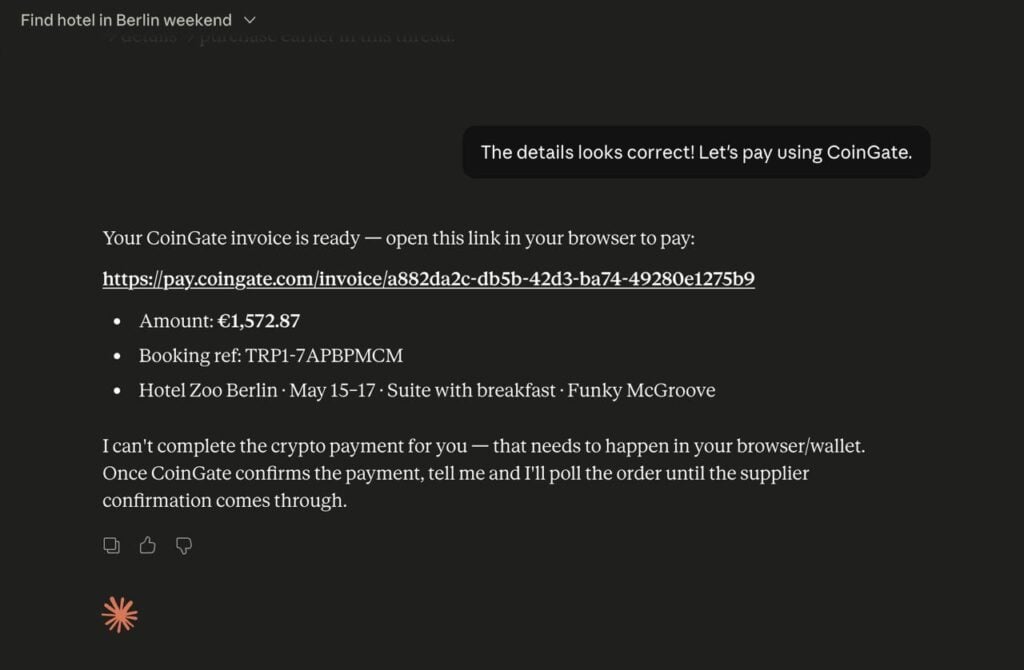
For users who are not using AI agents or x402-compatible wallets, Trip1 also supports a more traditional crypto checkout flow through CoinGate invoices.
In this setup, the platform generates a CoinGate invoice URL, the user completes the payment manually, and the booking system automatically detects and confirms the transaction afterward.
This makes the platform accessible both to advanced AI-agent workflows and to regular crypto users who simply want to pay with crypto through a familiar checkout experience.
See how AI agents can search, book, and pay automatically.
Frequently Asked Questions
Does the AI spend money without permission?
No. During conversation with agent, the user still approves the booking details before payment happens. The automation begins after confirmation, when the AI agent handles the USDC payment and booking flow automatically.
Why use USDC instead of credit cards?
Traditional card systems are built around human checkout flows – card forms, passwords, and verification prompts. Trip1 uses USDC because stablecoins are programmable and can be integrated directly into AI-driven workflows without requiring a manual checkout process.
What is Base?
Base is an Ethereum Layer 2 network developed by Coinbase. Trip1 uses Base for USDC settlement because transactions are low-cost and typically confirm within a few seconds.
What is x402?
x402 is a payment protocol designed for machine-to-machine transactions. Trip1 uses x402 to let AI agents request, verify, and settle payments directly during the hotel booking process without redirecting users to traditional payment pages.
Why is this important beyond travel?
The broader implication is autonomous commerce. If AI agents begin handling more online tasks independently – including travel bookings, software purchases, subscriptions, and digital services – they will need payment systems compatible with automated software interactions. Trip1’s hotel booking flow is an early example of how that infrastructure could work in practice.