

As Nvidia’s (NASDAQ: NVDA) stock trades just below the $200 mark, insights from OpenAI’s ChatGPT suggest the equity is likely to trade higher by the end of January 2026.
As of press time, NVDA shares were valued at $188, ending the last session up 1.2%. Over the past year, the semiconductor giant has rallied more than 30%.
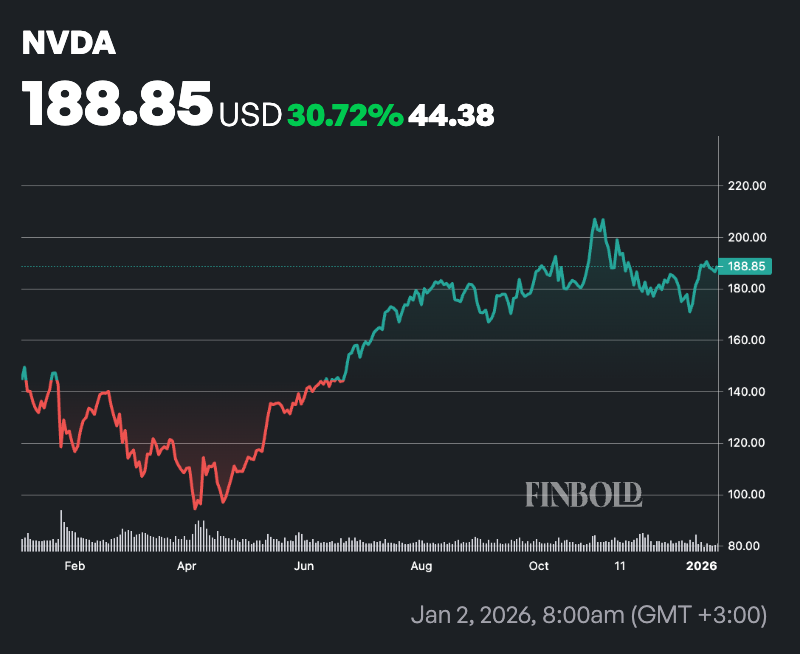
Regarding the price outlook for January 31, ChatGPT noted that the stock is likely to be supported by continued strength in AI-related demand, though gains could be tempered by valuation and macroeconomic risks.
Nvidia stock price prediction
ChatGPT’s base-case forecast places Nvidia’s share price in the $240 to $260 range by the end of January 2026, assuming sustained demand for AI accelerators in data centers, particularly advanced GPUs used for training and inference, alongside solid revenue and earnings growth.
The outlook reflects Nvidia’s dominant position in the AI hardware market, with hyperscalers and major technology firms continuing to invest heavily in AI infrastructure. Strong demand for high-end chips and a robust order pipeline are expected to keep revenue growth ahead of most large-cap peers.
The forecast also aligns with broader analyst expectations for further upside, while accounting for the likelihood that gains moderate as Nvidia’s valuation and market capitalization expand.
Nvidia stock bullish case
In a more bullish scenario, ChatGPT sees Nvidia trading between $280 and $320 by January 31, 2026. This would require stronger-than-expected earnings, faster global deployment of AI infrastructure, and supportive broader market conditions for high-growth technology stocks.
Conversely, a bearish scenario places Nvidia in the $180 to $210 range, potentially driven by a faster-than-expected slowdown in AI spending, intensifying competition, or broader market volatility leading to valuation compression across the technology sector.
Overall, ChatGPT’s point estimate centers around $250 by January 31, 2026, balancing Nvidia’s strong fundamental growth drivers against the risks tied to elevated valuations and shifting market sentiment.
Featured image via Shutterstock