
XRP has been on a generally declining trend over the past week or so, losing a portion of the late-August gains that characterized the broader crypto sector. Unfortunately, an artificial intelligence (AI) model suggests the losses are likely to continue throughout September.
Finbold’s AI-driven price prediction tool, which analyzed oscillators, the relative strength index (RSI), and the crypto’s moving averages (MA) as of September 2, estimates that XRP will be trading at $1.22 on September 30, 2026.
The figure suggests an 8.22% decline from the current price of $1.33. Although it’s certainly a blow to the confidence generated by last month’s rally, the projected price is nonetheless much higher than $1, which is where the asset mostly hovered this summer.
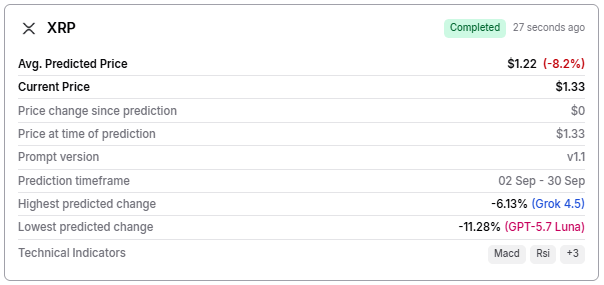
Machine learning algorithm XRP price prediction for September 30, 2026
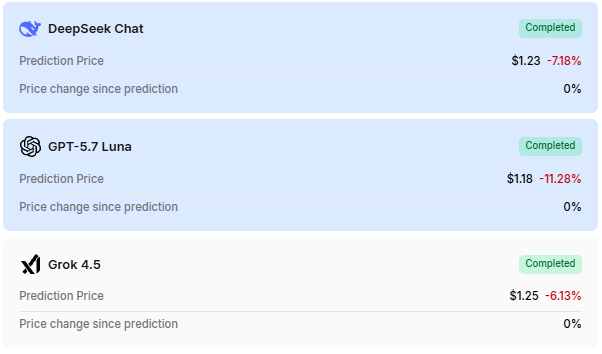
To generate the price target, our prediction tool used three large language models (LLMs): DeepSeek Chat, ChatGPT-5.7 Luna, and Grok 4.5
Grok proved the most bullish, setting its price target at $1.25 – a 6.13% correction during the coming month. OpenAI’s chatbot, ChatGPT, was the most bearish, with a projected 11.28% decline and an XRP price target of $1.18.
DeepSeek was slightly more positive than Grok, arguing the asset would end the month at $1.23 after falling 7.18% .
September XRP price action
XRP’s weakness at the time of writing appears to be part of a broader macro-driven risk-off move affecting the entire crypto market, rather than a reaction to a coin-specific development. Notably, Bitcoin (BTC) was down 1.1% on the day at press time, while the total crypto market capitalization declined nearly 1%.
At the same time, the Altcoin Season Index stands at 29, indicating a market environment where capital is favoring Bitcoin over altcoins, potentially adding to selling pressure on XRP and other large-cap altcoins.
However, the U.S. nonfarm payrolls report on September 2 could be a key catalyst. Specifically, a weaker-than-expected jobs reading may reduce expectations for further rate hikes and provide support for a broader rebound.
Featured image via Shutterstock