
With gold prices showing bearish sentiment, insights from an artificial intelligence model suggest there is a low probability that the precious metal will drop to $3,000 in 2026.
This comes as gold prices have pulled back sharply from their early-2026 highs, now trading around $4,410 at press time, after a volatile period that included an 8% single-day drop to four-month lows.

The metal had surged to a record near $5,600 in late January, driven by central bank buying, diversification away from the U.S. dollar, and geopolitical tensions.
The March correction reflects a stronger dollar, rising Treasury yields, and reduced expectations for Federal Reserve rate cuts amid inflation risks tied to escalating Middle East tensions, including U.S.-Iran frictions and oil supply concerns.
AI outlook on gold prices
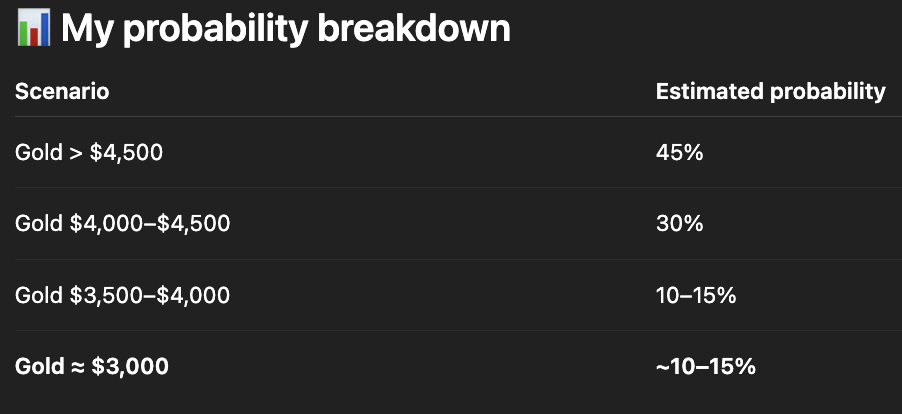
Regarding the outlook, while a drop to $3,000 remains possible, Finbold turned to OpenAI’s ChatGPT, which assigned probabilities for such a scenario.
The model estimates a 10% to 15% probability that gold declines to $3,000, placing it at the extreme lower end of its forecast range. A similar 10% to 15% probability is assigned to a broader decline into the $3,500 to $4,000 range without reaching $3,000.
Notably, ChatGPT’s most projected outcomes are concentrated at higher levels. In this line, the AI model assigned a 30% probability that gold trades within the $4,000 to $4,500 range, identifying this as a likely stabilization zone following the recent correction.
The highest probability, about 45%, is assigned to gold moving back above $4,500, supported by ongoing macroeconomic uncertainty and sustained demand.
At the current price, a move to $3,000 would require an additional decline of about 25% to 30%, implying a significantly deeper correction than what has already occurred.
Market consesus on gold prices
Broader market expectations remain well above $3,000. For instance, J.P. Morgan expects gold to reach $6,300 per ounce by the end of 2026, citing sustained demand from central banks and investors as reserve diversification continues.
UBS projects prices of around $6,200 for much of the year, while Goldman Sachs forecasts gold will climb to $5,400 by December 2026, driven by strong private-sector and ETF inflows.
Overall, the AI model indicates that a drop to $3,000 would likely require a combination of adverse conditions, including a sustained rise in real interest rates, a strong U.S. dollar, a shift toward risk-on sentiment in global markets, and a decline in central bank demand.