
Nvidia (NASDAQ: NVDA) is inching up in pre-market trading on Tuesday, December 9, with new NVDA price targets coming in following President Trump’s approval of H200 processor shipments to select customers in China.
Most notably, Bernstein’s Stacy Rasgon maintained an “Outperform” rating with a $275 price target, arguing that H200 chips are far more attractive to Chinese buyers than their H20 counterparts, which have limited performance thresholds.
Rasgon also warned that pushback from Washington still remains possible, although he remains optimistic, given that a lot of money is at stake. Specifically, he estimates that every $10 billion in artificial intelligence (AI) revenue adds about $0.25 to Nvidia’s earnings.
Wall Street says Chinese fees will not impact Nvidia’s outlook
Wells Fargo’s Aaron Rakers also doubled down on his “Overweight” rating following the news, with a $265 Nvidia price target. The analyst estimates that Trump’s policy shift is potentially worth $25–$30 billion in annual revenue, and his projection also reflects China’s historical 20–25% share of Nvidia’s data-center segment.
Further, Rakers thinks investors will now focus on how quickly Nvidia can allocate additional H200 supply to Beijing. In addition, he noted that the chipmaker might repurpose previously written-down H20 inventory to ramp up future shipments.
More noteworthy is Rakers’s comment that although the 25% U.S. fee will weigh on margins, it still won’t impact Nvidia’s positive outlook to any substantial degree. In fact, he argued the ride shift could very well translate to $25–$30 billion in annual revenue and another $0.60–$0.70 in earnings per share.
New Nvidia stock price targets
With the new adjustments, analysts set Nvidia price target for the next 12 months at $258 on average. This gives it a 39.05% upside potential from the last closing price of $185.55, as suggested by 41 total ratings recorded on the market analysis platform TipRanks over the past three months.
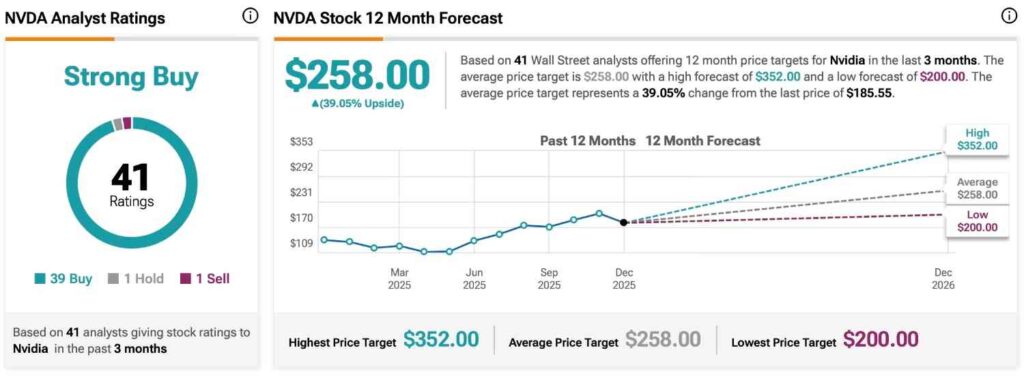
With 39 “Buy” ratings out of 41, the stock remains a “Strong Buy,” which, together with the upside, further illustrates Wall Street’s optimism regarding Nvidia’s trajectory in 2026.
Featured image via Shutterstock