
Bank of America is urging investors to rotate toward defensive assets as market risks increase, despite investor sentiment reaching one of its most bullish levels in recent years.
The bank’s August Global Fund Manager Survey found that investors are heavily positioned in equities, with a net 56% overweight stocks, the highest level since November 2021. Cash allocations, meanwhile, fell to 3.5% of assets under management, the sixth-lowest reading since the survey began in 1998.
According to Bank of America, the survey ranks as the third-most bullish since 2022. Investor optimism is approaching levels previously associated with major market peaks and periods of heightened confidence, including after U.S. tax cuts and during the post-pandemic recovery.
The indicator is now near the upper end of its historical range, reflecting elevated risk appetite across global markets.
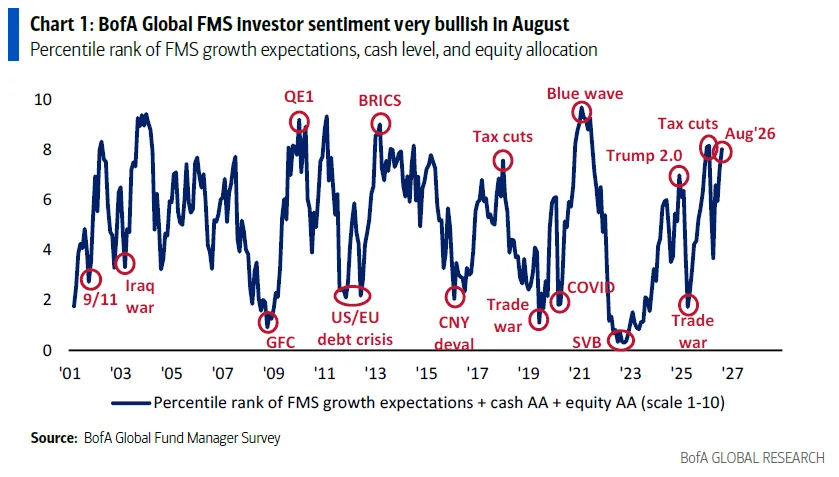
Despite the strong bullish positioning, Bank of America believes investors should become more defensive rather than increase exposure to risk assets.
The bank identified several contrarian investment opportunities for August, including long positions in bonds paired with short positions in commodities, greater exposure to consumer staples over technology stocks, and a preference for consumer discretionary shares over banks.
Bank of America also highlighted U.K. equities as more attractive than U.S. stocks.
Defensive picks to buy
Gold emerged as another favored defensive asset. A net 16% of fund managers viewed the precious metal as undervalued, making it the most undervalued asset class in the survey since March 2023.
The survey also showed growing confidence in the economic outlook. A record 56% of respondents expect a no-landing scenario, while 43% anticipate a boom, the highest reading since February 2022.
Confidence in artificial intelligence spending remains strong. In this line, long positions in global semiconductor stocks remained the most crowded trade, although the share of respondents citing the position fell to 53% from 82% a month earlier.
However, investors also identified AI-related risks as a key concern. About 32% named an AI bubble as the biggest tail risk, while 38% said hyperscaler AI spending is the most likely source of a future systemic credit event.
The banking giant’s cash rule remains on a sell signal, with cash allocations below the 4% threshold, a level historically associated with increased market risk.
Featured image via Shutterstock