
Bank of America (BofA) has reinstated coverage of Oracle (NASDAQ: ORCL) with a “Buy” rating and a $200 price target, suggesting a roughly 30% upside from March 24 levels.
Citing key growth catalysts, the bank pointed to rising demand for artificial intelligence (AI) infrastructure and cloud services, as well as a substantial backlog of long-term contracts.
Analysts, led by Tal Liani, described Oracle as “a giant going all-in on AI infrastructure and the cloud,” adding the renewed coverage reflects the view that the company is successfully navigating the surging market demand and the challenges tied to its own growth and evolution.
“Oracle has large revenue potential ahead, supported by $553bn in RPO tied to long-duration AI training and cloud infrastructure commitments. This provides solid visibility for a meaningful growth opportunity, but the company will need to demonstrate it can deliver capacity, convert long-dated contracts into revenues, and manage a capital-intensive buildout,” Liani wrote.
Oracle stock outlook, according to Bank of America
A key part of the analysis was Oracle’s $553 billion in remaining performance obligations (RPO). As it is linked to long-duration commitments for AI training and cloud infrastructure, BofA argued the backlog offers strong visibility into a significant growth opportunity, albeit with a caveat that execution will be crucial as the company converts the aforementioned contracts into revenue.
Furthermore, the bank highlighted three main debates shaping the Oracle stock outlook. The first concerns the timing of revenue conversion. Specifically, more than 57% of the RPO is expected to be recognized beyond three years. About 22% stretches past five years, which increases reliance on data center, GPU supply, and partner execution.
The other two problems are customer concentration, as a sizable portion of the backlog is tied to a limited group of AI developers, including OpenAI, and the capital intensity as Oracle ramps up investment toward hyperscale levels.
All in all, BofA expects Oracle’s capital expenditures to reach roughly $50 billion in fiscal 2026 and continue climbing through fiscal 2029. During that period, however, free cash flow is projected to remain negative, meaning the company will likely rely on external financing.
Still, despite the risks, BofA believes expectations have already reset after the stock’s sharp pullback from its 2025 peak. Accordingly, the bank projects revenue growth of 17%, 33%, and 46% from fiscal 2026 through fiscal 2028.
Oracle stock price target
With the newest forecast, the average ORCL share price target for the next twelve months has climbed to $245.11, which translates to a 58.81% upside potential, judging by the figures presented on the stock market analytics platform TipRanks.
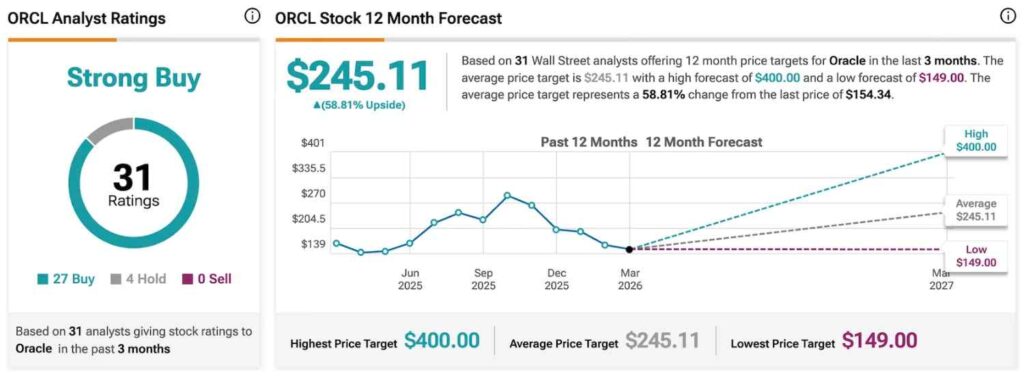
Liani’s rating is also the twenty-seventh “Buy” in the past three months, and considering Oracle has been rated a “Hold” by only four and “Sell” by no analysts at all, the Wall Street consensus on the AI company is “Strong Buy.”
Featured image via Shutterstock