
Macro strategist Henrik Zeberg has warned that Big Tech stocks may be entering their final powerful rally before a sharp market collapse.
In an X post on September 20, the strategist argued that the technology sector remains in the late stages of a bubble that could eventually unravel dramatically.
According to Zeberg’s latest analysis of the FAANG-focused U.S. Big Tech Index, the sector is still positioned for another strong advance despite growing concerns about the broader economy.
However, he believes the move higher will mark the final phase of the current bull cycle before a severe correction takes hold.
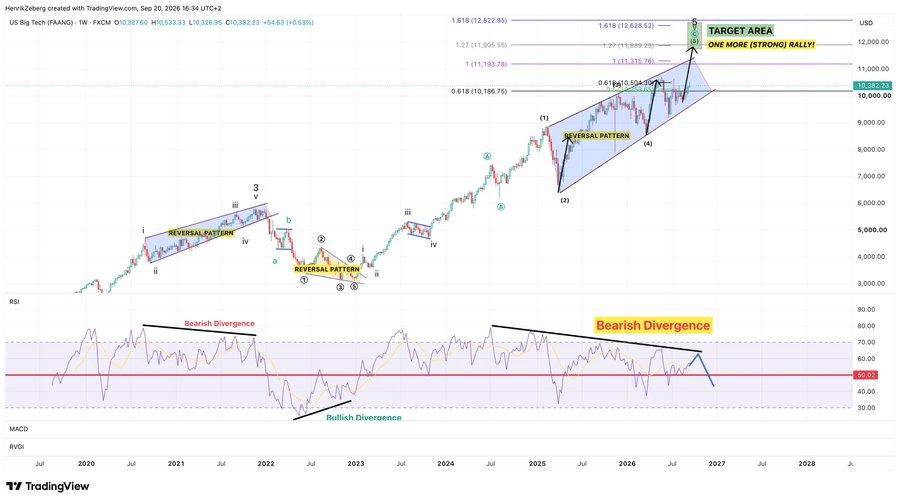
The strategist’s outlook suggests the Nasdaq 100 could climb to between 37,000 and 39,000 in the coming weeks or months before reversing sharply.
He projects that the index could eventually fall back toward its 2022 lows near 10,600, implying a decline of roughly 70% from the eventual peak.
His analysis indicates the current uptrend remains intact, with the FAANG Index potentially heading for one final rally before a major reversal.
Zeberg’s outlook also highlights bearish RSI divergences, a signal of weakening momentum despite rising prices.
He maintains that technology stocks can continue advancing in the near term, even as broader economic conditions deteriorate, before a much larger downturn takes hold.
Dot-com bubble comparisons
A central part of Zeberg’s thesis is that current technology valuations have reached levels that rival or exceed those seen during the dot-com bubble.
He has previously pointed to the Nasdaq’s market capitalization relative to U.S. GDP as evidence that valuations have become increasingly stretched.
In his view, the current environment forms part of a broader “Everything Bubble” that extends beyond equities to include real estate and cryptocurrencies.
Zeberg argues that market leadership has become heavily concentrated in a small group of technology companies, increasing the risk of a significant reversal once investor sentiment shifts.
While Zeberg frequently compares today’s market to the dot-com bubble, he believes the fallout could be more severe.
He maintains that unlike in 2000, when the broader economy remained relatively strong, signs of weakness are already emerging across multiple sectors, increasing the risk of wider financial stress once technology stocks peak.
Despite that outlook, Zeberg continues to expect further upside in Big Tech before the eventual collapse of what he calls “Tech Bubble 2.0.”
Featured image via Shutterstock