

The U. S. stock market ended the week of November 20 at a rare technical extreme, with major indexes extending their losses amid mounting pressure on technology stocks.
The S&P 500 closed Friday at 6, 910, marking its seventh consecutive decline and leaving it 11. 6% below its October 6 record high, officially confirming a market correction.
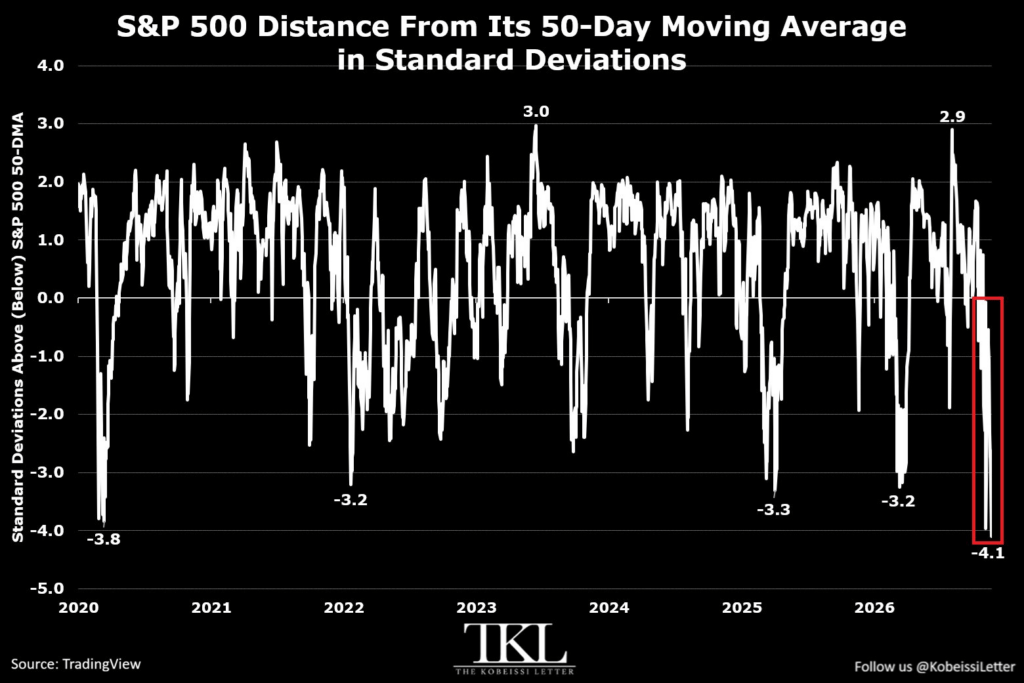
The index also closed 4.1 standard deviations below its 50-day moving average (MA), its widest gap since August 2015 and among the most extreme readings in at least two decades, according to data shared by The Kobeissi Letter on November 21.
Losses spread across major indexes, with the S&P 500 falling 8.6% for the week and the Nasdaq Composite recording its worst weekly performance since March 2020, erasing its year- to-date gains.
Technology and communication services stocks led the decline, falling roughly 25% from recent peaks, while semiconductor shares suffered one of their steepest weekly sell- offs in decades.
Nvidia also weighed heavily on the S&P 500 during Friday’s session amid leadership uncertainty and regulatory scrutiny.
Meanwhile, weakness in AI- related stocks reinforced concerns about the sustainability of valuations across the technology sector.
Notably, the stock market sell-off has been fueled by growing doubts about whether massive artificial intelligence (AI) investments will deliver returns sufficient to justify elevated valuations.
Persistent inflation has also kept the Federal Reserve cautious, while political uncertainty has raised concerns about potential regulatory hurdles for data center expansion and technology development.
What next for the stock market
Historically, extreme oversold conditions relative to the 50- day moving average have often preceded market stabilization.
However, some strategists warn that further losses remain possible despite improving market breadth and sentiment indicators.
Technical analysts see room for a short- term rebound toward the S&P 500′ s 200-day moving average near 7,350, although renewed economic or monetary policy concerns could extend the sell-off.
Investors will now focus on the Federal Reserve’s December meeting, upcoming inflation data, including the personal consumption expenditures (PCE) report, and earnings from major technology suppliers.
While some firms have lowered year-end targets, many retain a positive outlook for 2027, citing resilient economic conditions and corporate earnings forecasts.
Featured image via Shutterstock