
An artificial intelligence tool modeled on the investing principles of billionaire hedge fund founder Ray Dalio has identified key assets investors should consider if markets crash within the next year.
The guidance comes from “Digital Ray,” an AI twin built around Dalio’s long-standing investment philosophy focused on diversification, risk management, and macroeconomic cycles.
The AI model warned that markets are showing several conditions historically linked to major downturns, including rising leverage, concentrated equity exposure, and tightening liquidity.
According to the analysis, the U.S. stock market has become increasingly vulnerable as corporate debt growth outpaces the broader economy, while a handful of mega-cap stocks dominate the S&P 500.
Meanwhile, higher interest rates and tighter Federal Reserve policy are reducing the flow of cheap capital that fueled leveraged investing.
The tool added that a rapid rise in interest rates, a major credit event, geopolitical tensions, or a sharp sell-off in large technology stocks could trigger a broader market decline.
While it does not predict a full-scale crash, the model said the likelihood of a 15% to 20% correction over the next 12 to 18 months is higher than normal under current conditions.

Asset’s to buy in case of market crash
To help protect portfolios during periods of elevated volatility, the AI system highlighted gold as a traditional safe-haven asset that tends to preserve value during times of monetary instability, inflation concerns, and geopolitical uncertainty.
The model suggested maintaining a modest allocation to gold as part of a diversified strategy.
The second recommended asset was short-duration Treasury bonds, which the AI tool said can provide stability and liquidity during equity market declines.
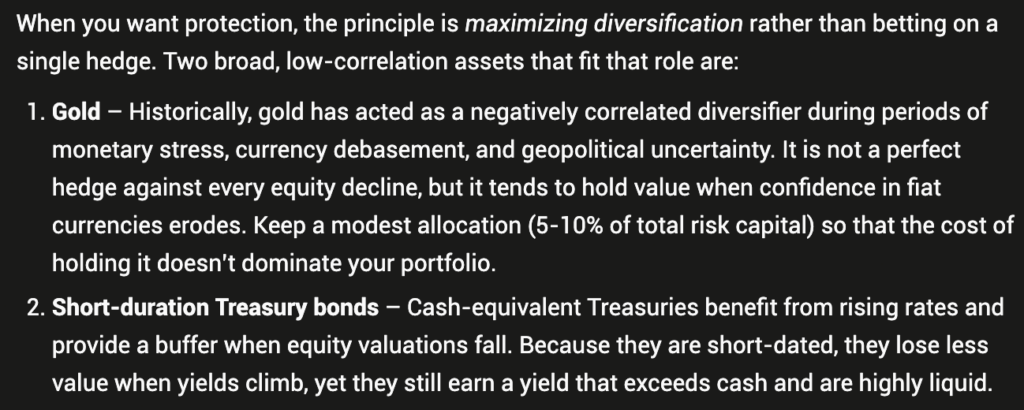
Because they are short-dated, these securities are generally less sensitive to rising interest rates while still offering yields above cash holdings.
At the same time, the AI model also emphasized that investors should avoid relying on a single hedge and instead build portfolios capable of performing across different economic environments, echoing Dalio’s “All Weather” investing framework.