

One of the software long bets the legendary ‘Big Short’ trader Michael Burry unveiled on April 13, Veeva Systems (NYSE: VEEV), appears poised to generate exceptional short-term gains for the famed investor and most of its other shareholders.
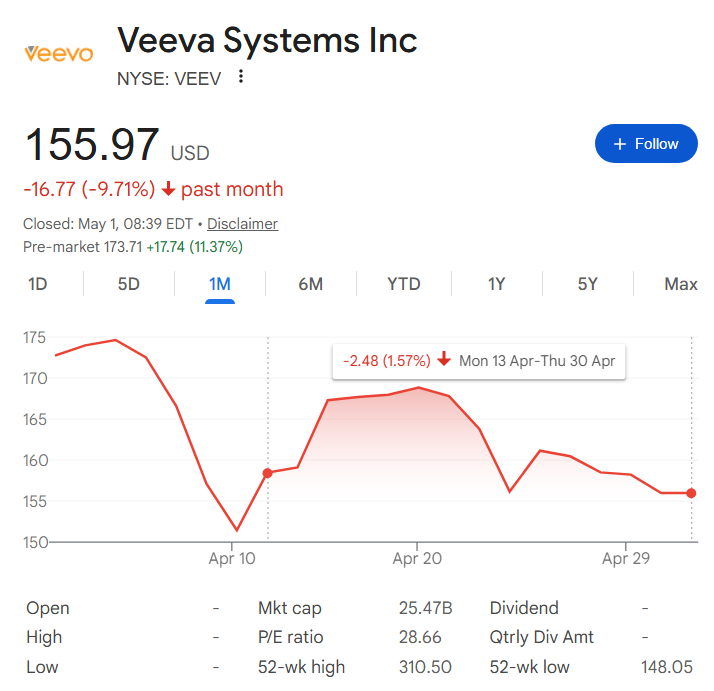
Specifically, while the equity declined 1.57% by the April 30 close and is down 9.71% for the month, the May 1 pre-market saw it soar 11.37% in a rally that is likely to persist for at least another two weeks.
Indeed, late on Thursday, it was revealed that VEEV shares are set for inclusion in the benchmark S&P 500 stock market index before the May 7 session starts, triggering the upsurge from $155.97 at the last closing bell to $173.71 at press time.
A major reason for the sudden bullish turn is that assets that get included in popular indices tend to benefit from the automatic buying activity that index funds are, by design, compelled to execute.
While the exact size of Burry’s position in Veeva Systems is unknown, the prominent short trader disclosed that his investment in VEEV is larger than in the other purchases revealed on the day: Adobe (NASDAQ: ADBE) and Autodesk (NASDAQ: ADSK).
Why Michael Burry’s bet on Veeva might be bearish on the stock market
Notably, the development hints that Michael Burry’s decision to make a series of bullish bets in April might have been cynical. Indeed, the long positions were taken while the trader was publishing a series of critical articles on some of the top investor darlings of recent years.
The Substack article that the legendary investor considered important enough to make free to read within the first day indicates he may have calculated that Veeva stock is bound for inclusion in the S&P 500.

Within the text, Burry explains that the next major financial crisis could see a drawdown in excess of 50% as the same forces that have enabled the U.S. stock market to enjoy an almost-unbroken bull run since the Great Recession are set to turn against it.
Specifically, the ‘Big Short’ trader identified the proliferation of index funds and similar passive vehicles as generators of a positive feedback loop in which successful stocks effectively enforce additional purchases through their rallies while simultaneously generating instability by removing price discovery from the equation.
According to the outlined theory, once the majority of the largest and wealthiest generations in the U.S. – Baby Boomers – grows old enough that they start cashing out on their investments, the same mechanisms that allowed for the recent record highs will turn on the bulls.
Michael Burry identified 2028 as the year in which the shift is likely to begin.
Featured image via Shutterstock