
Intel (NASDAQ: INTC) has become one of the market’s strongest comeback stories in 2026, with investors increasingly betting the chipmaker can establish itself as a major player in the artificial intelligence infrastructure boom.
Following Intel’s latest rally, Finbold consulted ChatGPT for insights on when the company could join the trillion-dollar club.
Based on current market conditions, recent developments, and Intel’s long-term growth prospects, ChatGPT’s base-case forecast suggests Intel could reach a $1 trillion market cap by June 2028.
The projection comes as Intel’s market value stands at approximately $554 billion, meaning the company would need to gain about 80% from current levels to reach the milestone.
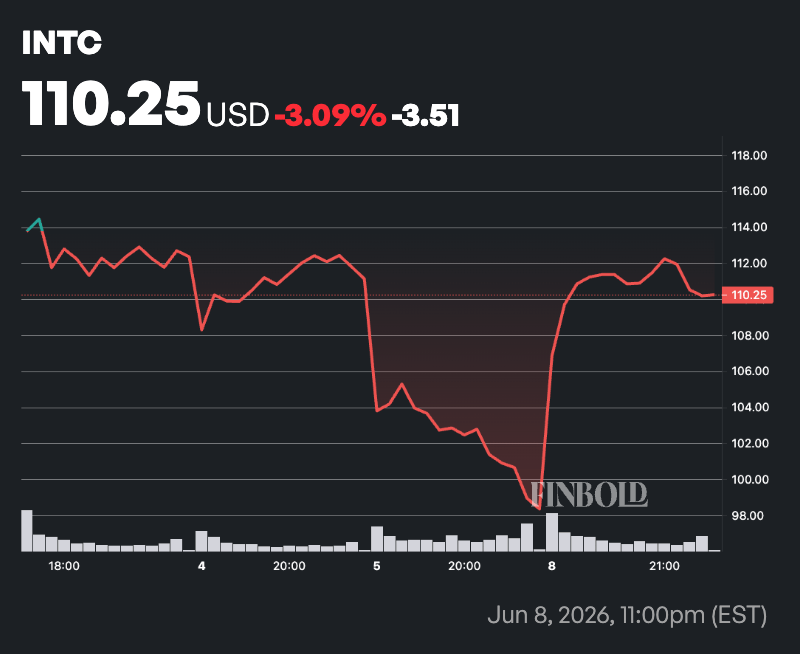
At its current share count, Intel stock would likely need to trade in the $195 to $200 range to support a $1 trillion valuation. By press time, INTC stock was trading at $110.
Intel stock fundamentals
The forecast follows a sharp shift in investor sentiment toward Intel’s foundry business, which has become a key driver of the stock’s recent gains.
Optimism accelerated after reports emerged that Google plans to have more than three million Tensor Processing Units (TPUs) manufactured by Intel beginning in 2028.
Investors viewed the development as a major endorsement of Intel’s manufacturing capabilities and a sign that large technology companies are increasingly considering alternatives to Taiwan Semiconductor Manufacturing Company (TSMC).
Sentiment was further boosted by reports that Nvidia (NASDAQ: NVDA) is evaluating Intel as a potential secondary manufacturing partner.
Although no formal agreement has been announced, the possibility that one of the world’s leading AI chip companies could eventually rely on Intel’s manufacturing network strengthened the bullish case for the stock.
The reports helped fuel an 11% rally in Intel shares on June 8 as investors reassessed the company’s long-term earnings potential and role in the AI supply chain.
Intel’s path to $1 trillion market cap
The forecast assumes investors will need evidence that Intel’s growing foundry opportunities can translate into meaningful revenue and profits before assigning another roughly $446 billion in market value.
The timeline also aligns with the reported start of Google’s TPU manufacturing program, which could provide a clearer picture of the foundry business’s revenue potential.
A faster path remains possible if Google confirms its reported manufacturing plans, Nvidia becomes a foundry customer, Intel successfully deploys its 18A and 14A process technologies, and the foundry business moves closer to profitability. The company could reach the $1 trillion milestone as early as the first half of 2027.
However, delays in advanced manufacturing, weaker AI demand, or continued dominance by TSMC could push the target beyond 2028.