
Foreign governments are sharply reducing their U.S. Treasury debt holdings as the Middle East conflict pressures currencies across Asia.
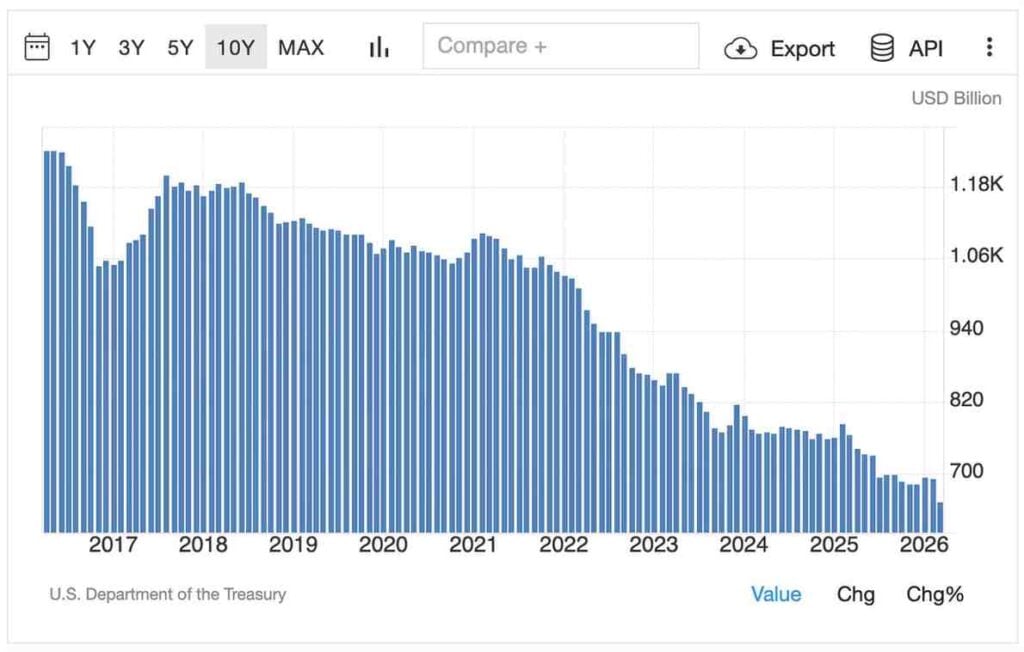
Most notably, China cut its Treasury holdings to $652.3 billion in March, down about 6% from February, according to U.S. Treasury data Finbold analyzed on May 20.
The cut marked the country’s lowest level of U.S. debt ownership since September 2008, when the global economy had nearly collapsed.
Japan, which is still the world’s largest foreign holder of U.S. government debt, also reduced its position to $1.191 trillion, down roughly $47 billion.
However, the United Kingdom actually increased its Treasury holdings by about $29.6 billion to $926.9 billion.
Overall foreign holdings of Treasuries fell to $9.25 trillion in March, compared with $9.49 trillion the previous month.
Asian countries back away from U.S. Treasuries
As mentioned, the decline coincided with the outbreak of the U.S.-Iran conflict, which sent crude oil prices sharply higher and weakened several Asian currencies.
According to Frederic Neumann, chief Asia economist at HSBC, foreign exchange intervention has also very likely forced some central banks to sell Treasuries in order to stabilize local currencies.
“Given increased financial volatility since the start of the war in the Gulf, and resultant pressure on exchange rates, especially in Asia, it is not a surprise that U.S. Treasury holdings by central banks have fallen,” Neumann told CNBC.
At the same time, some central banks also appear to be adjusting their portfolios amid inflation fears and falling bond prices. That is, rising Treasury yields in March could reflect concerns that the Middle East conflict could generate further inflationary pressures and force markets to seek higher returns for holding U.S. debt.
Now, analysts expect Treasury data for April, due next month, which is set to provide further insight into how far governments are willing to go in their exchange rate defense if market volatility persists.
Featured image via Shutterstock