

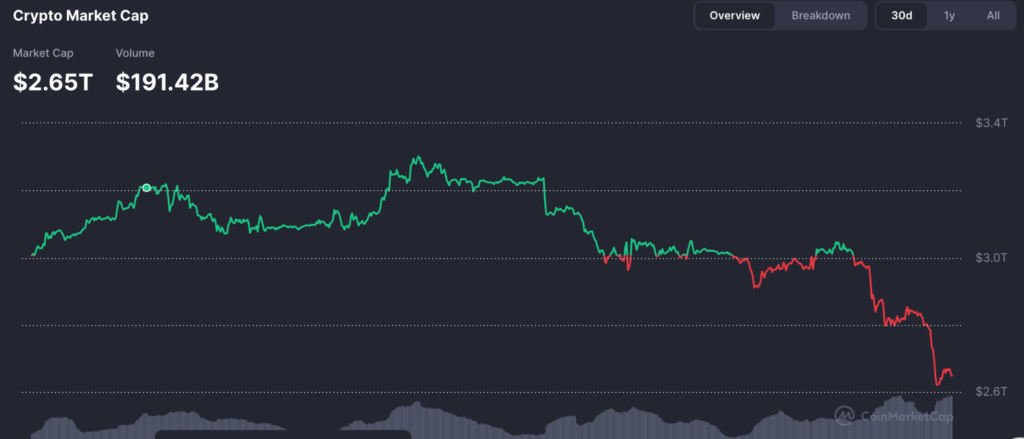
The cryptocurrency market extended its sharp sell-off over the past 24 hours, with total market capitalization falling significantly, led by major assets such as Bitcoin (BTC).
Indeed, as of press time, the total cryptocurrency market cap stood at $2.65 trillion, representing a drop of $200 billion from the $2.85 trillion recorded 24 hours ago.
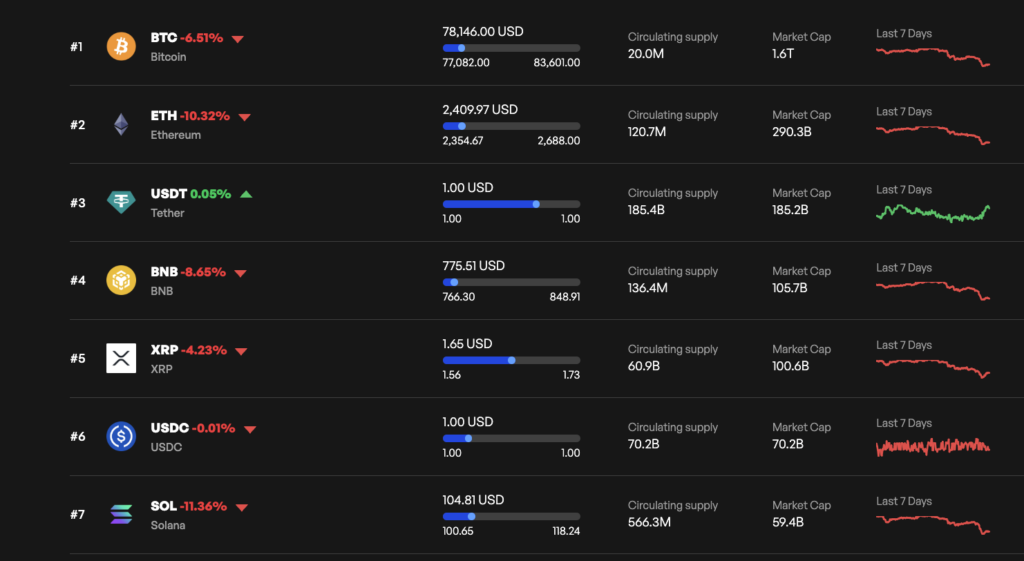
In this context, major cryptocurrencies were firmly in the red. Bitcoin, the market’s largest asset, slid more than 6% over the period, trading near the mid-$78,000 area after breaking below several key technical levels.
Ethereum (ETH) posted even steeper losses, dropping over 10% to around $2,400, while Solana (SOL) shed more than 11% as it slipped toward the low-$100 range.
Binance Coin (BNB) and XRP also recorded notable declines, reinforcing the sense that the sell-off spared few corners of the market.
Why crypto market is crashing
The latest downturn has been driven by macroeconomic and policy concerns, notably reports that former Fed official Kevin Warsh may be nominated as Fed Chair under Donald Trump.
In this case, Warsh is seen as favoring tighter monetary policy and a smaller Fed balance sheet, fueling expectations of higher-for-longer rates and reduced liquidity. These conditions typically pressure risk assets such as cryptocurrencies while supporting a stronger U.S. dollar.
Beyond monetary policy, the broader market has turned risk-averse. Investors are cutting exposure to volatile assets amid tighter liquidity concerns, a partial U.S. government shutdown, and rising geopolitical tensions, including renewed U.S.–Iran friction following reports of an explosion at a major Iranian port. Sharp declines in traditional safe havens like gold and silver further signal broad deleveraging.
Market sentiment has also deteriorated sharply, with the Crypto Fear and Greed Index plunging into extreme fear, reflecting elevated anxiety. While such levels have sometimes preceded market bottoms, in the current environment, they appear to be amplifying selling pressure rather than attracting buyers.
The Bitcoin liquidity factor
On the other hand, analysis from The Kobeissi Letter shared on January 31 pointed to a liquidity-driven liquidation cascade as the primary driver of the sell-off.
In this line, Bitcoin’s drop below $79,000 was largely the result of market structure rather than new fundamental shocks.
Price action shows three distinct liquidation waves within 12 hours, erasing about $1.3 billion in leveraged positions. Bitcoin first consolidated near $84,000 before forced selling broke support, with subsequent waves pushing prices lower as overleveraged longs were flushed out.
Therefore, thin liquidity and excessive leverage created sharp price “air pockets,” while rapidly shifting sentiment from extreme optimism to fear intensified the decline.
Featured image via Shutterstock