

Gold could face additional downside pressure after forming its first daily death cross in nearly three years, a bearish technical signal that has historically coincided with extended corrections in the precious metal.
According to analysis by TradingShot shared in a TradingView post on June 29, spot gold has formed a one-day death cross, the first such occurrence since September 27, 2023.
The signal comes as the yellow metal trades around $4,017 per ounce after a sharp decline from its January 2026 record highs above $5,400.
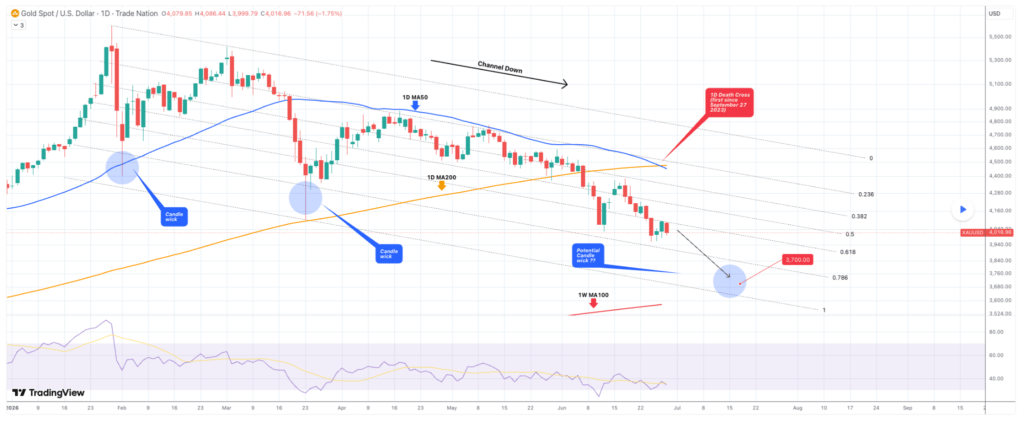
The bearish crossover has emerged while gold remains trapped within a five-month descending channel, raising the possibility of another leg lower toward the $3,700 level before a more meaningful rebound develops.
TradingShot’s analysis shows gold continuing to trade within a well-defined channel down pattern that has been in place since its January peak.
The precious metal recently broke both its 50-day and 200-day moving averages (MA), with the shorter-term average crossing beneath the longer-term average to form the death cross. Historically, this pattern signals weakening medium-term momentum.
The analysis also noted that previous lower lows within the current downtrend formed between the 0.786 and 1.0 Fibonacci retracement levels.
Those declines were accompanied by sharp daily candle wicks, indicating aggressive selling before buyers temporarily stepped in.
Technical indicators suggest the next major support zone sits near the weekly 100-period moving average.
Gold’s next low price target
Based on the current channel structure and prior price action, Tradingshot expects gold to potentially test the $3,700 level through another sharp downside wick before finding stronger support.
The latest weakness follows a rally that pushed gold to all-time highs between $5,405 and $5,600 earlier this year.
Since then, gold has undergone a significant correction, with prices falling roughly 10% in June and about 14% during the second quarter.
The decline has been driven by a stronger U.S. dollar, expectations that the Federal Reserve could keep interest rates elevated for longer, and slower investor inflows into gold-backed exchange-traded funds.
Those factors have offset traditional bullish drivers such as geopolitical uncertainty and continued central bank buying.
Gold price outlook
Despite the near-term bearish technical setup, many major financial institutions remain constructive on gold’s longer-term outlook.
Several Wall Street banks continue to forecast a recovery during the second half of 2026, supported by persistent central bank demand, de-dollarization trends, and safe-haven buying.
For instance, Goldman Sachs expects gold to reach around $4,900 by the end of 2026, while UBS and Morgan Stanley forecast a range between $5,200 and $5,500.
Bank of America and J.P. Morgan maintain some of the most bullish outlooks, projecting gold could approach $6,000 by year-end.