
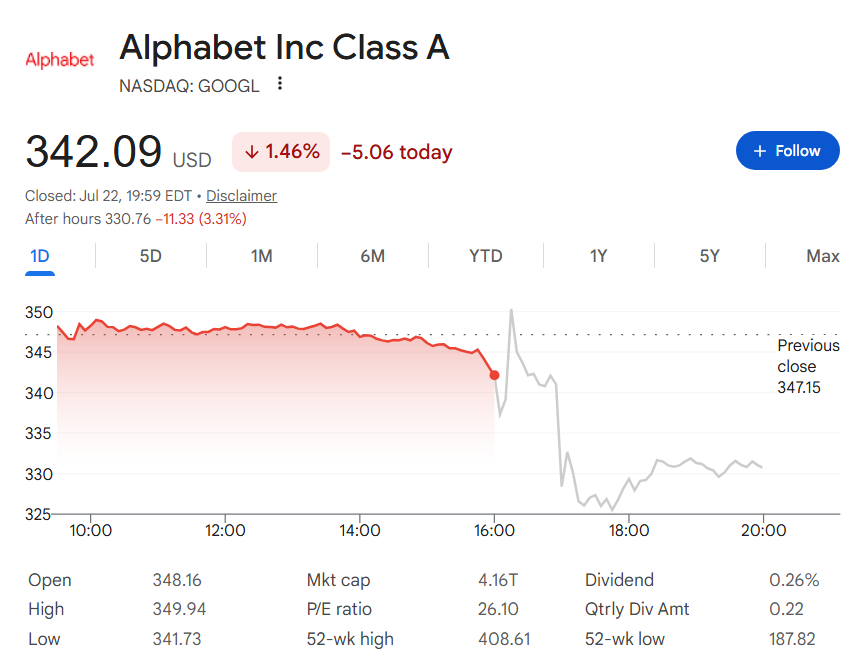
In the July 22 after-hours session, immediately after filing second-quarter (Q2) earnings, Google (NASDAQ: GOOGL) stock plummeted 3.31% from its close at $342.09 to $330.76, effectively wiping $138 billion from Alphabet’s market capitalization.
At face value, the downward move appears odd given that the blue-chip chipmaker unveiled a massive revenue beat, revealing its sales were $119.80 billion when $116.93 billion was expected.
However, already the other most-cited metric following quarterly filings – earnings per share (EPS) – offers a hint into the reason for the crash. Indeed, Google’s Q2 EPS proved lower than the expected $2.89, at $2.85.
Google CapEx to soar to $200 amid rising AI profitability concerns
Additionally and perhaps most damningly from the point of view of shareholders, Alphabet has revised its capital expenditure (CapEx) expectations from the range between $180 billion and $190 billion from the previous quarter to a staggering $195 billion to $205 billion.
The move follows growing discomfort over investments in artificial intelligence (AI) as, despite the reported progress from various involved firms, there remains a general lack of clear evidence that adoption is unambiguously beneficial – especially following the 2026 trend of increasing usage prices, arguably in an effort to stop subsidizing customers.
Google’s CapEx is, in particular, controversial as the company made its first equity offer in decades in June, signalling its profits – or creditors – are no longer able to support expenditure fully.
Additional evidence backing the concern can be found in the fact that Google’s free cash flow dropped to a negative $5.9 billion for the first time in over a decade.
Meanwhile, July also brought rising competition from cheaper Chinese models, which appear to be perceived as a sufficient threat that multiple AI companies now seem to be calling for tighter regulation.
Notably, these firms have previously been against such constraints to a sufficient degree that the Federal Government made attempts to ban States from implementing their own regulation.
Google laments supply constraints, plans to lease external AI compute
Finally, Alphabet also reiterated its previous point about constraints presented by insufficient capacity supply, signalling it would seek external compute and warning the new approach could have a temporary negative impact on margins.
Google recently entered an agreement with Elon Musk’s newer public company, SpaceX (NASDAQ: SPCX), to lease some of its data centers along with Anthropic and might be able to find additional external capacity with Meta Platforms (NASDAQ: META).
By press time, the actual availability of compute across the industry remains as unclear as the actual revenue and profitability from AI on account of comparatively little available information on completion of data centers relative to press releases on new planned facilities.
Featured image via Shutterstock