
Programmatic advertising grew 20.5% to $162.4 billion in 2025, adding $27.6 billion of new spend in a single year, according to the IAB and PwC Internet Advertising Revenue Report published in April 2026.
All of that money clears a bank account before it clears an ad platform. For an affiliate marketer or media buyer, the account is not a place to park cash. It is what stands between a campaign that scales and one that stalls because a card hit a ceiling.
Most business banking comparisons rank on monthly fee and APY. Neither moves much when media spend is 70% of the P&L.
Key Takeaways
- Card headroom and cashback decide more than the monthly fee when media spend dominates the P&L.
- Rewards vary by product, so check the rate on the specific card rather than assuming from the card type.
- Published issuance caps, such as Relay’s 50 cards, arrive faster than most operators expect.
- Deposit protection comes from the sweep network behind the account, and the figures differ by an order of magnitude.
- How a network pays out, by ACH, wire or platform deposit, decides how fast cash returns to the buying account.
Criteria for comparing an account when media spend dominates
- Payout ingestion: how network and platform payouts arrive, and how long they take to become spendable.
- Card headroom: how many cards can be issued, and whether the limit tracks deposits or waits on underwriting.
- Cashback on spend: whether the rate is published before applying or set after, and what it pays on the categories you actually buy.
- Deposit protection: the sweep network behind the account and the amount of coverage it provides.
1. Slash, for operators whose card spend dwarfs their headcount
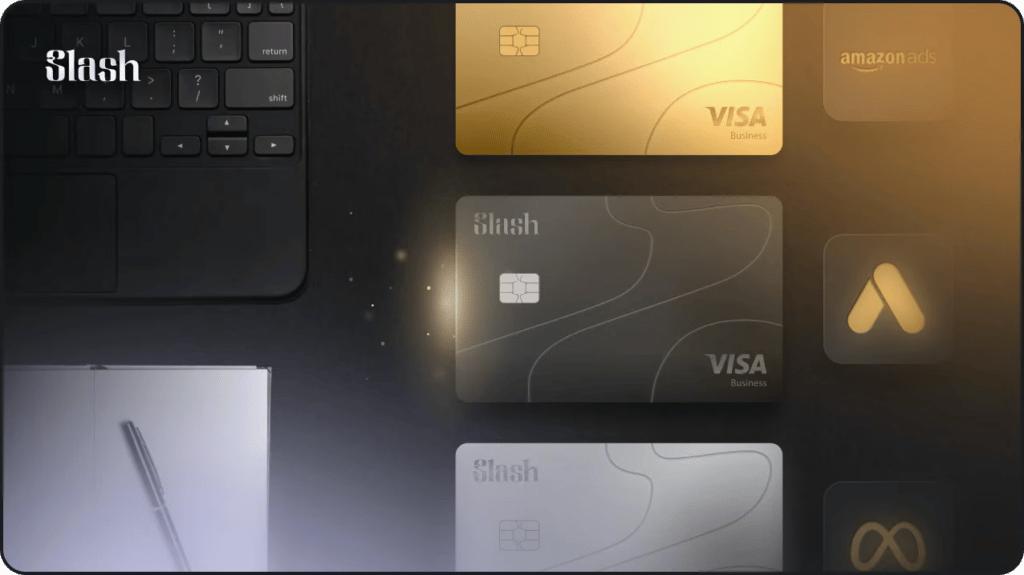
Slash is a financial technology company. Banking services come from Column N.A., Member FDIC. It runs a business banking platform serving more than 10,000 businesses, with unlimited virtual cards on both plans and up to 2% cashback.
- Unlimited virtual cards on Free and Pro: one card per platform, per traffic source or per network, each with its own spend limit, per-transaction ceiling and merchant restriction. Physical cards are available for any team member.
- Card groups: roll cards into a per-client or per-channel budget with a single ceiling, so the finance lead watches a handful of numbers instead of dozens.
- A limit that tracks deposits: the effective limit is the lower of a risk-based maximum and funds on deposit, updated in real time, so funding the account raises the limit the same day.
- Receipts collected at the charge: Twin, an AI financial assistant, texts the cardholder for a photo and matches it to the transaction by OCR.
The Free plan costs $0 a month with up to 1.5% cashback, domestic wires at $6, same-day ACH at $1 and outgoing FedNow or RTP at $5. Pro costs $25, pays up to 2%, and takes all three domestic payment rails to $0. Above four wires a month Pro covers itself, and both plans are published instead of quoted.
Deposits are FDIC-insured up to $150 million through Column N.A.’s insured cash sweep network, which protects against the failure of an insured depository institution and reaches that figure through Column and its sweep network banks together. Accounts serve US-registered LLCs, C-Corps and S-Corps. Sole proprietors are not eligible.
2. Payoneer, a fit for collecting from networks that already integrate it
Payoneer is built around getting paid by platforms. An operator collecting from Amazon, Upwork or a network with a native Payoneer integration gets local receiving accounts in USD, EUR, GBP and other currencies, wired into the payout side already.
The fee structure is where operators get caught. Receiving by US ACH bank debit runs 1%, client card payments run up to 3.99% plus $0.49, and same-currency withdrawals under $50,000 a month carry a $1.50 flat fee, per Payoneer’s published fee guide. An annual account fee of $29.95, per Payoneer’s own FAQ, applies when an account receives less than 6,000 USD or equivalent across any 12 consecutive months. At six figures of monthly collection, the 1% ACH receiving line alone outweighs every plan fee on this page.
3. Relay, a fit for splitting revenue across offers and reserves
Relay turns one login into up to 20 real checking accounts, each with its own routing and account number. For an operator splitting revenue across tax, owner pay and per-offer media budgets, that structure does real work. Banking runs through Thread Bank with FDIC sweep coverage up to $3 million, and per NerdWallet’s review Starter is $0 a month, Grow is $30 and Scale runs $90 to $120.
The ceiling is published. Relay caps issuance at 50 debit cards across the business on its own product page, and its debit cards earn nothing on the spend. A buyer running one card per offer across five networks reaches that number inside a quarter and gets no cashback along the way. Relay works as a cash organization layer alongside a rewards card.
4. Mercury, a fit for venture-backed operations that value free wires
Mercury offers free checking and savings with no minimums, no monthly fees and no fees on USD wires, which is a solid baseline. Mercury is a financial technology company with banking services through Choice Financial Group and Column N.A., and deposits eligible for up to $5 million of FDIC coverage through partner sweep networks.
Its IO card, issued by Patriot Bank, earns a flat 1.5% cashback with no personal guarantee and no credit check. The structural catch for a media buyer is that Mercury’s help center states the IO limit is tethered to the cash held with Mercury and refreshes daily, adjusting downward after a large withdrawal. That is prudent underwriting, and it is the opposite of what an operator wants the week a campaign starts working.
Running the numbers on your own volume
Take last month’s card spend and multiply it by the rate difference before comparing any plan fee. At $200,000 a month, the gap between up to 1.5% and up to 2% is $1,000 a month, or $12,000 a year. A $25 plan against a $0 plan is $300 a year, so the rate decides and the fee does not.
Then price the collection side the same way. At $150,000 a month arriving by US ACH, a 1% receiving fee is $1,500 a month, which outweighs every plan fee above it combined. Sort last quarter’s payouts by rail first, because an operator collecting by platform deposit and one collecting by ACH reach different answers from the same table.
Frequently Asked Questions
What should media buyers look for in a business bank account?
Card headroom, a published cashback rate, how payouts arrive, and the deposit protection behind the account. Monthly fee and APY move the smallest numbers when media spend dominates the P&L. A half-point of cashback on $200,000 of monthly spend is worth $12,000 a year, which no plan fee in this category approaches.
How many virtual cards does a media buying operation need?
One per offer, per traffic source and per client, which reaches dozens quickly for an operator running several networks. That is why a published cap matters. Relay stops at 50 debit cards across the business, while some providers publish no limit at all.
Are these accounts FDIC insured?
Coverage comes from the sweep network behind the account rather than from the platform, and the figures differ widely. Slash reaches up to $150 million through Column N.A.’s insured cash sweep network, Mercury up to $5 million through its partner networks, and Relay up to $3 million through Thread Bank. In each case the insurance covers the failure of an insured depository institution.
Featured image via Slash.