

Every year, someone declares crypto is entering its “next phase.” Most years, the claim doesn’t survive the second quarter. However, 2026 has been harder to wave off.
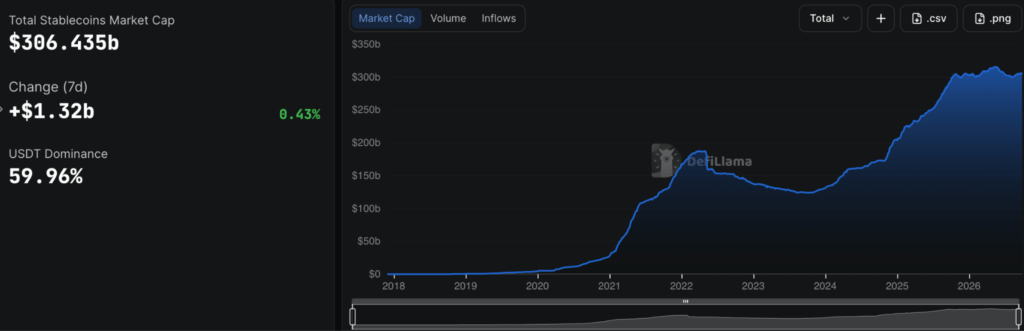
For context, on the spot ETF front, institutional capital managed by crypto passed the $100 billion mark while stablecoins are becoming the mainstream payment system in the ecosystem. It held a market cap of around $306 billion as of September 27, according to DeFiLlama.
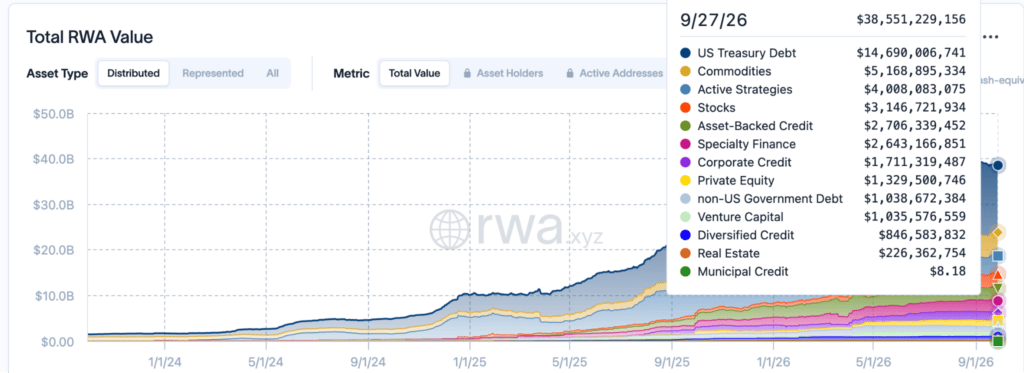
The market cap for real asset tokenization also topped $38 billion, compared to $5 billion two years ago, according to rwa.xyz.
On the regulation end, frameworks that used to be only draft legislation – like the GENIUS Act in the United States or the MiCA in the EU – are now the rules exchanges trade by.
That shift matters for exchanges. Clearer rules raise the cost of operating, and the exchanges most vocal about “the next cycle” are largely the ones that have lasted long enough to see several of them.
Binance turns ten next year. Robinhood has spent the past two years building out its crypto and tokenized-asset offerings alongside its equities business. Coinbase and OKX have both turned regulatory compliance from a hurdle into a selling point.
CoinW sits in also in the same bracket. It marks its ninth anniversary this year and is using the occasion to outline how it intends to compete in a more mature industry.
Longevity alone, though, isn’t a credential in a market that has watched plenty of well-funded platforms collapse. It’s only reasonable to ask any platform celebrating a milestone year in the crypto industry, “Well, after nine (or ten or fifteen), what have you done for us?”
Exchanges Are Betting on Tokenized Assets and AI Agents
Perhaps the most obvious indication of what the cycles think is next can be gleaned from what they are trying to build, and in this case, that consists of two main categories: tokenized RWAs and AI-native trading infrastructure.
Robinhood has moved furthest, fastest. In June 2025, Robinhood rolled out tokenized versions of more than 200 US stocks and ETFs for EU customers. A year later, in July 2026, the firm introduced Robinhood Chain, an AI-native Layer 2 protocol.
Other exchanges are also catching up with the trend. CoinW launched its CoinW TradFi product, which combines over 100 traditional assets like stocks, gold, and commodities into price-referenced perpetual contracts, enabling users to trade traditional assets 24/7 with USDT settlements. It also offers reference products associated with private-market companies, such as OpenAI.
On the AI side, in March 2026, Binance released its open-source AI Skills Hub, while OKX released its 80-tool Agent Trade Kit in just hours to follow, both focused on infrastructure development for autonomous agents.
CoinW, on the other hand, frames its AI push as a shift from just an exchange to what it calls an “AI-Driven Super App.” The platform intends to connect assets, data, services, and automated agents in one system.
The GPT-TradeAI product was introduced to the trading public in March 2025. The tool automatically converts real-time financial data into trend assessments and trading signals, alongside the possibility to copy another trader’s strategy with just one click.
In addition, the exchange has an AI Trading Toolbox that includes a number of different tools. Among them is the Similar Candles tool that compares the present chart with past trends, showing how similar setups played out before. Another example is its AI Trend Prediction tool, which projects likely near-term price moves directly onto the chart. There is also the AgentFi tool used for automated trading strategies.
One mechanic sets it apart from the rest of the exchanges: its CWC platform token, upgraded and relaunched from the earlier CWT in July 2026, does more than the usual fee-discount utility, it is also designed to gate access to the platform’s higher-tier AI tools and ignite the growth of its creator community. That’s a model few of the larger exchanges have adopted.
CoinW also offers the On-Chain Smart Money product, which aggregates on-chain addresses with sustained profitability and allows users to follow market-proven wallets within a centralized trading environment.
A Record Year for Hacks and How Exchanges are Responding
2026 hasn’t given the industry one defining catastrophe the way Bybit’s $1.5 billion cold-wallet breach did in February 2025. The closest was the BitGet hack worth $351 million that occurred on September 25, 2026. However, it gave something more unsettling: the volume of hacks.
The second quarter of 2026 recorded 83 protocol and exchange hacks, the highest quarterly count ever tracked, totaling $755 million in losses. April 2026 alone saw the single most-hacked month in crypto’s history by number of incidents.
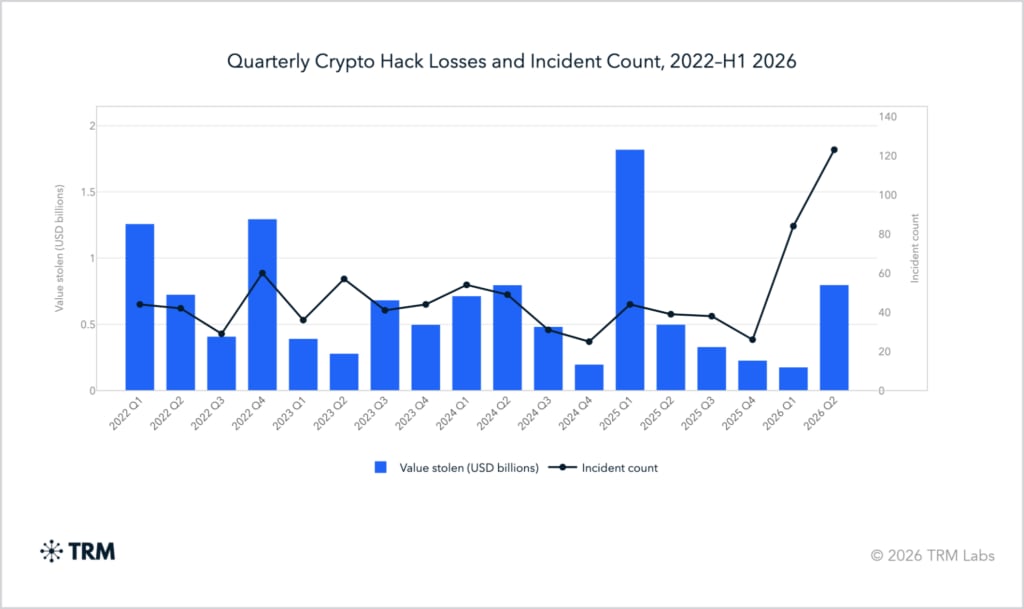
In the first half of the year, there were 207 instances of hacks and $972 million worth of losses, of which North Korean groups were responsible for around 66%. This wasn’t spared on exchanges either.
The Grinex exchange faced a loss of around $15 million due to hot wallet hacking in April, while BingX was hit with a loss of around $45 million from eleven blockchain networks through hot wallet hacking.
Exchanges have done their part to make sure that such instances can be controlled and provide help if a breach occurs. Binance has a SAFU fund that is used to pay back users in case of any hacking. In Bybit’s case, it pledged $140 million in bounties for fund recovery after its hack and also promised to create a “HackBounty” platform.
CoinW’s strategy of security is similar to what almost all the exchanges have done since 2025 but more advanced with a layered defense model that combines proprietary systems with open collaboration. The exchange states that its security stack consists of a self-developed real-time risk engine, zero-trust architecture, proprietary MPC wallets, hardware security modules, and separation of hot/cold wallets.
The exchange collaborates with CertiK and Hacken to conduct audits and also conducts a bug bounty program It works with CertiK and Hacken on audits and runs a bug-bounty program on HackenProof, which the company says has logged over 200 responsibly disclosed vulnerabilities in the past 24 months, with critical bugs fixed in under 48 hours on average. The program is open to top security researchers worldwide for responsible disclosure of vulnerabilities.
Sponsorship as a Trust Bridge: Why Crypto Keeps Investing in Sports
Sports sponsorship has become one of crypto’s fastest-growing marketing categories. Blockchain companies are on track to spend about $5 billion on sports sponsorships in 2026, up about 800% since 2021, the fastest growth rate of any sponsorship category, according to Nielsen.
Binance, Coinbase, OKX, Crypto.com, and Bybit have all signed deals in football, F1, and the NBA leagues. Crypto.com owns a 20-year naming rights deal worth $700 million at the stadium of the Los Angeles Lakers. Exchanges have together paid $174 million in F1 sponsorship deals in one year alone.
Nielsen’s research on sponsorship also found that consumers rank brand sponsorships as more credible than most other forms of advertising.
That’s the rationale CoinW went for in its signing of Luka Modrić, the 2018 Ballon d’Or winner, as a global brand ambassador on April 9, 2026. The signing was timed ahead of the summer’s FIFA World Cup, where Modrić captained Croatia, giving the exchange visibility in one of the most-watched sporting events globally.
The exchange also followed up in July this year by making a second signing in the field of combat sports. The firm entered into a partnership with UFC champion Conor McGregor as a second global ambassador.
Regulation: The Bar That Keeps Moving
Every single one of the other pillars that were discussed here ultimately hits the same brick wall: regulation. For most of crypto’s history, exchanges could treat compliance as optional or, at best, jurisdictional.
In 2026, the GENIUS Act was adopted in the United States, which set out licensing standards and reserve requirements for stablecoin issuers and exchanges. On the other side of the pond, the European Union introduced similar standards via the MiCA regulation.
The result is that there are now different tiers in the crypto industry that did not exist before. For instance, Coinbase works with the SEC and state-level regulators, while OKX focuses on MiCA regulation.
None of this is set in stone, though. Licensing systems are still evolving, and where an exchange stands in terms of regulation now does not have to be where it stands in two years’ time.
But as regulation becomes more than just “on paper,” those exchanges that made compliance core infrastructure from the start will be best equipped to withstand the coming storm.
Featured image via Shutterstock.