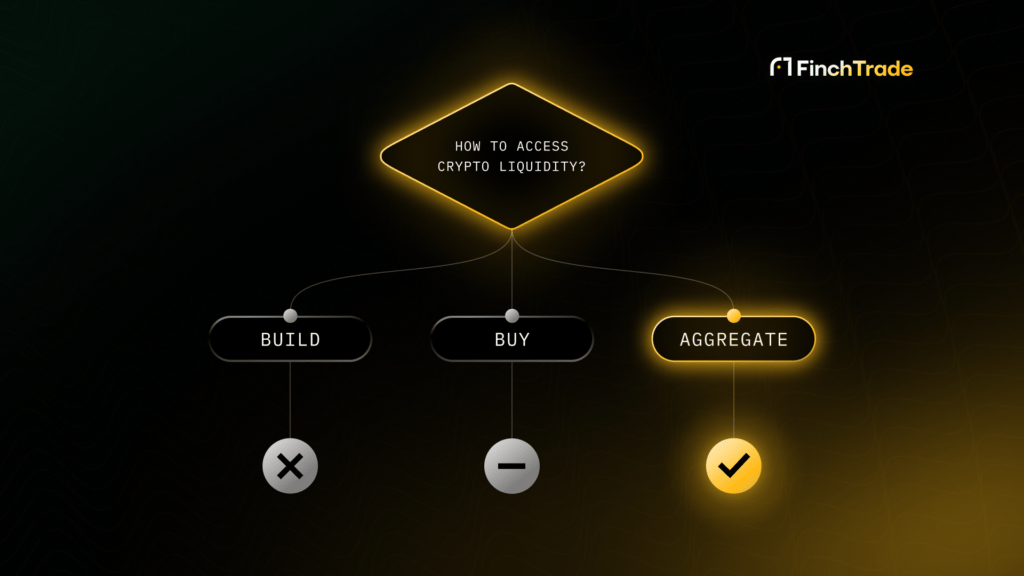

Every payment service provider (PSP) adding crypto to its product stack faces the same structural decision: build the liquidity infrastructure in-house, buy access through a single partner, or route through a liquidity aggregator.
The answer depends on transaction volume, team size, compliance capacity, and the number of fiat corridors a PSP needs to cover. Selecting the wrong partner for liquidity and settlement can result in locked-up capital, delayed payments, or unforeseen compliance challenges. Conversely, making a wise choice can transform crypto conversion into a straightforward and reliable element of the finance system. Providers range from exchanges and payment platforms to dedicated institutional OTC desks, each structured around different volumes, settlement models, and levels of operational support.
This guide lays out a decision framework for PSP leadership teams, covering what building in-house actually requires, where the economics shift under a single-partner buy model, and how leveraging a liquidity aggregator functions in practice.
What the building in-house model looks like
Most PSPs underestimate what full in-house liquidity management requires before they commit to it. The operational surface covers six distinct areas:
- Regulatory counterparty relationships: Each exchange or OTC desk requires its own onboarding process, compliance documentation, and ongoing relationship management. Onboarding a single direct exchange integration can take weeks per venue, while building a full in-house liquidity desk from scratch typically takes six to eighteen months;
- Compliance ownership: When sourcing liquidity directly, Know Your Customer (KYC), Anti-Money Laundering (AML), and Know Your Transaction (KYT) obligations sit entirely with the PSP at every venue. This requires dedicated compliance headcount for ongoing KYT screening and regulatory reporting, not a one-time setup cost;
- Pre-funding across venues: Direct exchange integrations require 100% pre-funding per venue. A PSP trading across multiple venues must maintain funded balances at each simultaneously, with capital locked until settlement completes. On a €1 million trade, the full notional must be wired upfront;
- Technology maintenance: Each venue has its own API, price feed format, and settlement workflow. A PSP building in-house must integrate, maintain, and update each connection independently, with no unified reporting layer unless it builds one;
- 24/7 monitoring: Crypto markets run continuously. Operating crypto payment flows requires monitoring and incident response coverage around the clock, including weekends and public holidays when traditional banking infrastructure is offline;
- Counterparty risk management: When a PSP holds pre-funded balances across multiple exchanges and OTC desks, it carries direct exposure to each counterparty. If a venue experiences operational issues, a regulatory action, or insolvency, pre-funded capital at that venue is at risk. Managing that exposure requires active monitoring of each counterparty’s financial health and regulatory standing, and in some cases, maintaining relationships with backup venues to avoid single-point-of-failure risk in settlement flows.
The hidden costs that compound at scale
The fixed costs of building in-house do not stay fixed. Capital locked in pre-funded venue accounts is capital not generating return elsewhere, and as the number of active venues grows, so does the total idle balance required.
Each new jurisdiction adds regulatory overhead. Each new venue integration adds an engineering dependency. Neither cost is proportional to the revenue generated, which means margin per transaction tends to compress as the operation expands.
When does building in-house actually make sense?
The decision to build in-house rarely fails on technical grounds. It fails because the fixed costs arrive before the volume that justifies them.
The strategic question is not whether building is possible, but whether the business is at the stage where the fixed cost is justified. That depends on transaction volume, compliance capacity, and whether a treasury function is already in place for other reasons. For a PSP where those conditions are not yet met, building in-house means absorbing significant overhead before the revenue exists to support it.
For most growth-stage PSPs, the volume does not yet justify the fixed cost. The breakeven point tends to arrive when a compliance and treasury team is already in place, making the marginal cost of adding in-house liquidity management relatively low.
What the buying model looks like
Buying means sourcing the entire liquidity layer through a single counterparty rather than managing direct exchange or OTC relationships in-house. The PSP integrates once, and the partner handles execution, settlement, compliance, and counterparty relationships.
Key characteristics to highlight:
- Operational simplicity: One contract, one API, and one bilateral relationship.
- Trade-offs: Concentrates counterparty risk onto a single entity and locks the PSP into that single provider’s pricing/spreads without execution competition.
- Compliance division: The partner handles exchange counterparty KYB and transaction KYT, while the PSP retains merchant/user KYC.
The primary trade-off is margin. What the PSP gains in speed, compliance coverage, and capital efficiency, it gives up in the spread between what it pays the partner and what it could access directly at sufficient scale.
What the aggregating model looks like
For most PSPs however, the practical path is aggregating liquidity. The liquidity layer is sourced externally through an infrastructure partner that dynamically routes orders across multiple underlying exchanges and OTC venues.
In practice, this means:
- Single API integration replacing multiple venue relationships, with one unified reporting layer across all settlement activity;
- Compliance handled on the partner’s side, removing the need for the PSP to own KYC, AML, and KYT obligations at the liquidity layer;
- Scalability without proportional headcount growth, since adding new corridors or assets does not require new venue integrations or additional compliance resources on the PSP’s side.
This model does not mean losing control of the customer experience. The PSP still sets pricing, manages the merchant relationship, and owns the product. What it gives up is the margin difference between the partner’s rate and its own retail rate, which needs to be weighed against the capital, headcount, and time cost of running the liquidity layer in-house.
For PSPs that are not yet at the volume or team size where in-house justifies the investment, this path typically delivers better unit economics.
Institutional liquidity in practice
For PSPs evaluating the different paths, FinchTrade illustrates what sourcing liquidity through an institutional partner looks like in practice.
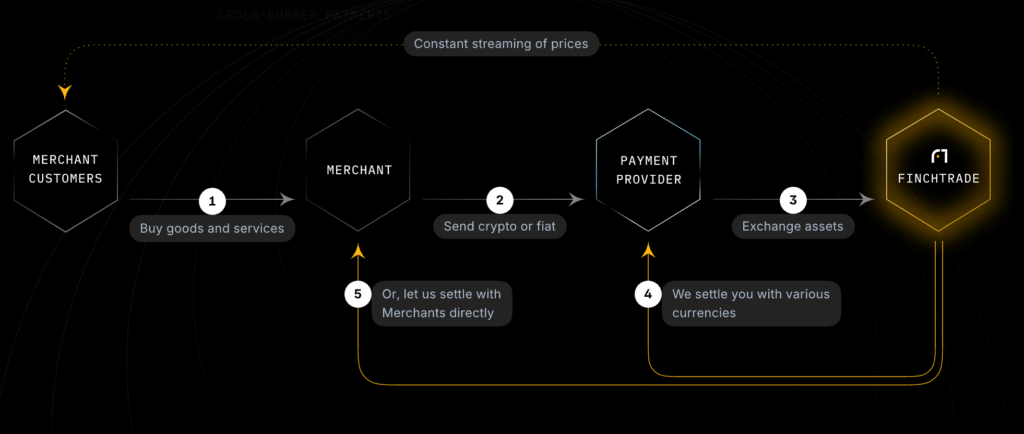
FinchTrade is a Swiss VASP providing OTC liquidity and settlement, operating a non-custodial execution and settlement model. It serves PSPs, EMIs, and OTC desks through a single API integration covering crypto-to-fiat conversion, stablecoin settlement, with KYB and AML at onboarding.
The operational model addresses the two costs that tend to weigh most heavily on PSPs sourcing liquidity directly: pre-funding and settlement speed. FinchTrade operates on 30% collateral rather than 100% pre-funding, with average settlement of approximately 30 minutes, available 24/7. Onboarding runs one to five days under automated KYB.
How to make the decision
The build, buy, or aggregate decision is not binary, and it is not permanent. The right answer depends on a variety of factors, among which: transaction volume, compliance capacity, the number of fiat corridors needed, and how quickly the PSP needs to move.
For providers looking to balance capital efficiency with execution quality, an aggregated liquidity source offers clear structural advantages. By aggregating liquidity across multiple execution venues through a single API, OTC desk like FinchTrade deliver optimal pricing and tighter spreads via smart order routing, mitigate single-counterparty risk, and free up working capital.
The right structure will change as the business grows, which makes flexibility one of the most important factors when choosing a liquidity provider.
Featured image via FinchTrade.