![UPay Review [2026] How Crypto-to-Real-World Spending Works](/cdn-cgi/image/format=auto,quality=85/https://assets.finbold.com/uploads/2026/07/UPay-Review-2026-How-Crypto-to-Real-World-Spending-Works.jpg)

In this article, we go through UPay, explaining what it is, how it works, and what products it offers to retail and business users. In addition, we cover the platform’s fees and security features and explain how to get started with its crypto-to-real-world spending platform.
What is UPay?
Launched in 2023, UPay bridges the gap between cryptocurrencies and everyday spending through an integrated ecosystem that includes a non-custodial crypto wallet, virtual and physical payment cards, and crypto-to-fiat conversion. For enterprises, UPay offers white-label card issuance, crypto payment processing, and fiat settlement solutions.

What products does UPay offer?
UPay has a range of features that allow it to act as the bridge between digital assets and daily commerce, catering to individual consumers and businesses alike.
Personal products
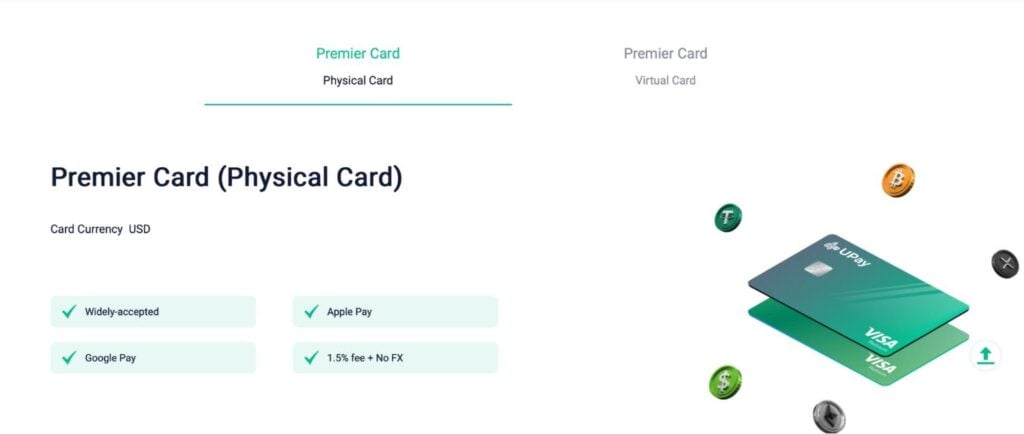
Retail UPay solutions make it possible for users to store digital assets, use them to fund payment cards, swap crypto for cash, and spend their digital assets through digital wallets and payment cards.
UPay Wallet
The UPay Wallet is a non-custodial mobile crypto wallet that allows users to manage supported digital assets and access UPay’s payment services from one application.
It offers an all-in-one crypto wallet, direct wallet-based card spending, flexible savings, and improved security with Two-Factor Authentication (2FA).
The app is available on the Apple App Store for iOS devices and Google Play for Android devices, and with it, eligible users can:
- Store and manage supported digital assets;
- Apply for virtual and physical UPay cards;
- Fund and manage their cards;
- Monitor transactions and spending;
- Convert supported digital assets for real-world payments;
- Access eligible rewards or savings features;
- Manage card security and payment settings;
- Connect eligible cards to supported mobile payment platforms.
Virtual UPay Cards
Alongside the wallet, UPay has introduced the Virtual Crypto Premier Card, enabling users to spend crypto globally without preloading funds, whether in hotels, restaurants, shopping centers, grocery stores, or a wide range of other establishments.
The card supports online and in-store purchases, features an independent card number for added security, charges a flat 1% transaction fee with no deposit or cross-border fees, and allows users to earn up to 4% on idle funds through flexible savings.
Physical UPay Cards
UPay also offers physical payment cards for users who want to spend supported digital assets in physical retail environments. Physical UPay cards may likewise be used for:
- In-store purchases;
- Restaurants and cafés;
- Hotels and travel services;
- Shopping centres;
- Grocery stores;
- Entertainment venues;
- Other supported merchant transactions;
- ATM withdrawals where available.
The physical card connects the user’s available balance with traditional payment infrastructure, helping digital assets function as practical spending tools.
Business products
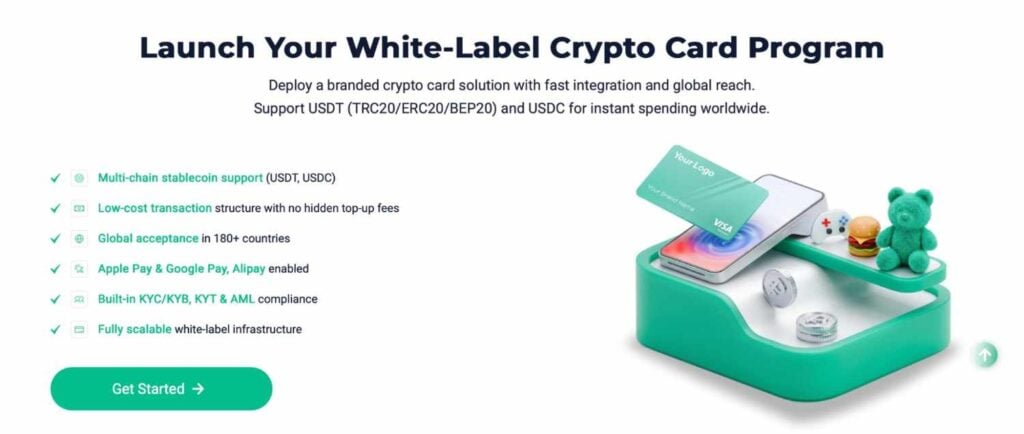
On the other hand, businesses looking to integrate cryptocurrency can leverage UPay’s branded crypto card programmes to launch new, customized crypto cards instead of building their own payment systems from the ground up.
Further, the B2B (Business-to-Business) offering includes white-label card issuance, Application Programming Interface (API) integrations, payment infrastructure, and compliance support.
In addition, the unified dashboard comes with cryptocurrency-to-fiat conversion functionalities, transaction monitoring, fraud and risk controls, card and account management tools, as well as payment operations.
White-Label Cards
The White-Label Card service helps businesses launch and manage branded crypto card programs with greater speed and flexibility. Notably, the offering includes instant card issuance, seamless API integration, and real-time card lifecycle tracking. This allows companies to build customized payment solutions without managing the underlying infrastructure.
Through the platform, UPay also handles transaction monitoring on existing platforms, supported by a comprehensive dashboard for managing transactions, compliance, and spending controls in real time.
Fiat settlement, on- and off-ramp, and remittance services
Similarly, UPay offers infrastructure that connects digital assets with traditional financial systems through fiat settlement, on- and off-ramp, and remittance services.
In other words, businesses can use the platform to convert crypto payments into supported fiat currencies, manage merchant transactions, reconcile activity, and reduce exposure to digital asset price volatility.
Further, the ramp solutions allow users and businesses to move between fiat and supported digital assets, with integrations available for wallets, exchanges, fintech platforms, Web3 products, and payment applications.
With cross-border and remittance services, users have access to stablecoin settlement, crypto-to-fiat conversions, payment collection and distribution, and international transaction flows.
How does UPay work?
UPay’s business model is a hybrid, combining B2C (Business-to-Consumer) and B2B (Business-to-Business) fintech infrastructures and serving both individual consumers and businesses through a comprehensive digital payments ecosystem.
As such, UPay provides payment infrastructure and embedded financial services to fintech companies, cryptocurrency exchanges, digital wallets, e-commerce businesses, Web3 projects, and other enterprise clients.
UPay requires users to register before using the platform. Notably, the user has to set up a UPay account and go through a Know-Your-Customer (KYC; ID verification) process before they manage their digital assets through the UPay Wallet or apply for a UPay card (virtual or physical).
Once the card has been activated, users can fund it and spend their crypto in different ways, be it for online shopping or in-store purchases, or even withdraw funds from ATMs where available.
Businesses, on the other hand, have to integrate UPay’s Application Programming Interface (API) in order to issue cards, manage users, track transactions, and so on. Additional functionalities include compliance and fraud checks that promote a compliant crypto payment infrastructure.
To register on UPay:
- Step 1: First, you will have to download the UPay app on your phone;
- Step 2: Then, create an account and verify it by going through a Know-Your-Customer (KYC) process and providing personal information, a photograph or facial verification, and a valid official document for identity verification (it might take some time for the review process to wrap up). Where applicable, additional supporting documents might be required;
- Step 3: Next, you can choose and apply for a card (physical or virtual, depending on your needs and preferences). Card availability depends on the user’s location, eligibility, selected product, and program requirements;
- Step 4: Finally, you can fund your wallet and start spending with your UPay Card. You can top up the wallet via a bank account or an eligible Visa or Mastercard. For crypto wallets, you can use stablecoins such as USDT.
UPay Fees
UPay generates revenue through multiple streams. Some of those include card activation fees, transaction fees, cryptocurrency-to-fiat conversion fees, and other service-related charges.
For instance, UPay charges a 2% recharge fee and a $10 issuance fee for virtual cards. The Premier Physical Card, however, comes with a $100 activation fee, as do Platinum Physical and Precious Cards. It’s noteworthy, though, that the Precious Card only has a 1% recharge fee.
As for UPay Wallet, there’s a 1.5% transaction fee and no recharge fees. Also noteworthy is that UPay has no annual fees. In addition, the platform has a ‘no FX fees’ policy, meaning that when you make a purchase in a foreign currency, you won’t incur extra charges.
Is UPay safe?
In terms of safety and security, UPay has built-in Know Your Customer (KYC), Know Your Business (KYB), and Know Your Transaction (KYT) features, which help verify user identities, authenticate businesses, and monitor transactions for suspicious activity.
In addition, the platform has Anti-Money Laundering (AML), fraud prevention, and compliance tools to ensure a secure and regulatory-compliant experience. Together, these capabilities strengthen fraud prevention, support regulatory compliance, and provide a more secure environment.
Moreover, UPay has also partnered with Sumsub, a global identity verification provider, to strengthen the security and compliance of its payment platform. More specifically, Sumsub’s AI-powered KYC and AML solutions enhance identity verification, reduce fraud, protect customer assets and data, and meet international regulatory requirements.
Likewise, the integration has allowed for automated customer verification and onboarding, enabling faster account approvals while improving fraud detection and compliance. This is important for global clients, as Sumsub’s verification technology allows for secure, compliant, and seamless payment services to customers across international markets.
Who is UPay for?
As mentioned, UPay serves both individual consumers and businesses through its dual B2C and B2B offerings. The primary consumer audience includes:
- Cryptocurrency users seeking to spend their assets through familiar payment methods;
- Stablecoin holders looking for practical real-world payment solutions;
- Travellers who benefit from crypto-funded payment cards;
- Users who want to connect their digital asset holdings with traditional card payments for everyday purchases.
On the business end, UPay solutions are developed for organizations looking to embed cryptocurrency payment capabilities into their products and services, or, in short:
- Fintech companies;
- Cryptocurrency exchanges;
- Digital wallet providers;
- e-commerce businesses;
- Other Web3 platforms.
Companies that are also likely to benefit from the UPay API include international payment providers and developers building crypto-native financial products. UPay also serves product teams launching card or payment solutions, as well as businesses aiming for borderless, programmable payments via crypto. UPay is available in over 150 countries, including the United States, Germany, France, Argentina, and Canada.
Conclusion
UPay is a relatively young but nonetheless comprehensive crypto payment infrastructure provider catering to both individual clients and businesses. Its biggest strengths lie in its geographical coverage, strong emphasis on security and identity protection, as well as customizable card offerings.
As such, the platform finds a wide range of use cases among fintechs, Web3 companies, e-commerce businesses, digital wallet providers, and crypto exchanges. At the same time, its ease of access makes it a viable option for everyday users, such as travellers and online shoppers, who are looking for a hassle-free way of using crypto in their day-to-day lives.
Disclaimer: The content on this site should not be considered investment advice. Investing is speculative. When investing, your capital is at risk.
FAQs
What does UPay do?
UPay is a platform offering a digital asset payment infrastructure that allows users to make everyday crypto payments with digital or virtual cards.
Is UPay free?
UPay comes with some fees, such as card activation fees, transaction fees, cryptocurrency-to-fiat conversion fees, and other service-related charges. However, there are no annual fees.
Who can use UPay?
UPay is marketed to individuals and businesses seeking additional real-world crypto utility. The target audience thus includes crypto users who want to use digital assets in their daily lives, fintech companies, crypto exchanges, Web3 platforms, etc.
What countries is UPay available in?
UPay is available in over 150 countries, including the United States, Germany, France, and the Netherlands. The cards issued by the platform are usable where Mastercard is accepted, and they work with Apple Pay, Google Pay, Samsung Pay, Alipay, WeChat Pay, and PayPal.
Is there a UPay mobile app?
Yes, UPay wallet is available on mobile (iOS and Android).
Does UPay offer a crypto wallet?
Yes. UPay offers a non-custodial mobile crypto wallet that allows eligible users to manage supported digital assets and access UPay’s payment products.
Does UPay offer virtual and physical cards?
Yes. UPay offers both virtual and physical payment cards, subject to eligibility, product availability, and regional requirements.
Where can UPay cards be used?
UPay cards can be used across a global network of more than 55+ million supported merchants.