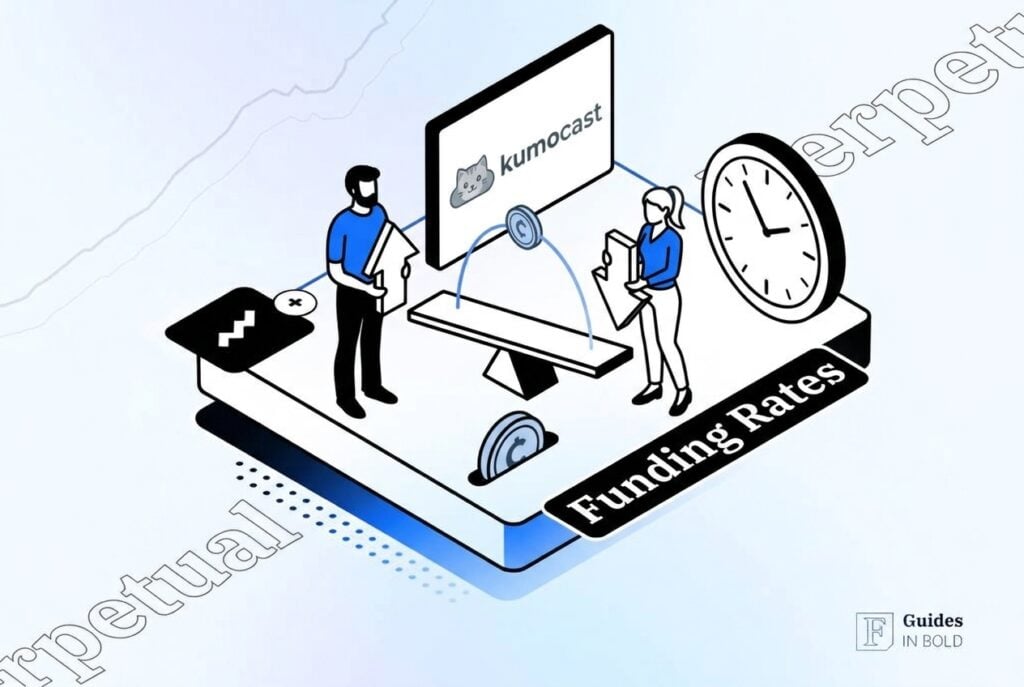

Funding rates are periodic payments exchanged between long and short traders on perpetual futures contracts, and they add to the cost of holding a leveraged position. This guide explains how they work, what they cost, and where to track them for free.
What is a funding rate in crypto?
A funding rate is a periodic payment exchanged between traders holding long and short positions in a perpetual futures contract, a type of derivative that lets traders speculate on an asset’s price without owning it.
Perpetual futures, often called perps, differ from traditional futures in one key way: they never expire. A standard futures contract converges with the spot price at settlement, but a perpetual has no settlement date, so it needs another mechanism to keep its price anchored to the underlying asset. Funding rates fill that role.
Advertisement
The direction of payment depends on where the contract trades relative to spot. When the perp trades above the spot price, the funding rate is positive and longs pay shorts. When it trades below, the rate turns negative and shorts pay longs. This turns any lasting price gap into a carrying cost for the crowded side, which gives traders an incentive to take the other side until the gap narrows.
Funding is also not an exchange fee. On most exchanges, the payments pass directly between traders.
How are funding rates calculated and paid?
Funding rates are typically built from two components: an interest rate and a premium index, which measures how far the perpetual contract’s price sits from the spot price over a given period. The exact formula differs between exchanges, so traders should check how their platform calculates it before opening a position.
The interest component is usually small and fixed. Some exchanges, for example, set it at 0.03% a day, or 0.01% per funding interval. The premium component does most of the moving, rising when the contract trades well above spot and falling when it trades below. Many platforms also cap and floor the rate to limit costs during extreme market conditions.
Once the rate is set, the payment itself is simple to work out:
Funding payment = position value × funding rate
Advertisement
For instance, if the funding rate on a Bitcoin (BTC) perpetual is +0.010%, a trader holding a $40,000 long position would pay $4 for that interval, while traders on the short side would receive it. Position value is generally based on the contract’s mark price at the moment funding settles.
Funding is commonly settled every eight hours, for example at 00:00, 08:00, and 16:00 UTC. Some platforms settle more often and may switch to hourly settlement when the rate hits its cap.
Only traders holding an open position at the settlement time pay or receive funding, so a position closed before settlement owes nothing for that interval.
Where can you check funding rates for free?
Most exchanges display the current funding rate and a countdown to the next settlement on their futures trading page. The drawback is that this only shows one venue at a time.
Kumocast, a free market data site, fills that gap. Its live funding rates page compares rates for 50 coins across 12 exchanges, refreshed every 15 minutes, along with perpetual contracts tracking stocks, gold, oil, and forex. Rates can be viewed per eight hours or per year, which makes venues that settle at different intervals easier to compare.
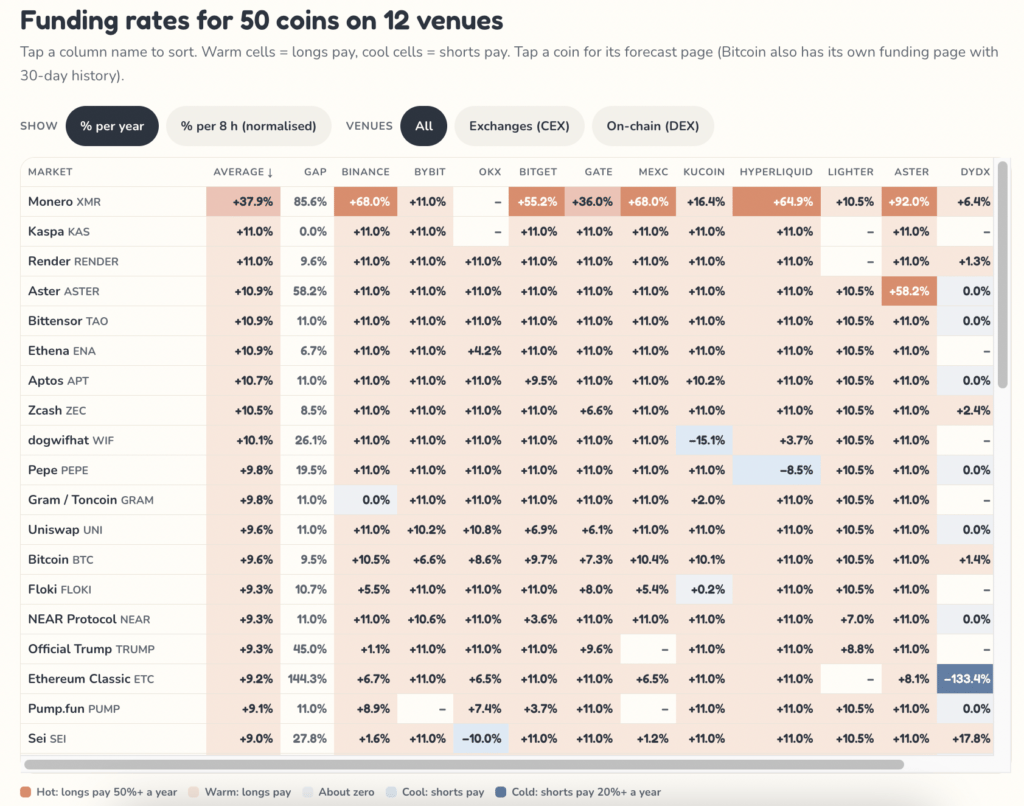
Its Funding Rate Calculator fills in the live rate for a chosen market and exchange. It then shows what a position would cost per payment, per day, per year, and as a share of margin, and compares the same trade across all 12 exchanges. The site is free, with no account required.
Advertisement
How much do funding rates cost over time?
A single funding payment is usually small, but because it is charged every interval, the cost adds up the longer a position stays open. At 0.01% per interval, settled three times a day, a long position pays around 11% a year before any price moves.
Actual costs have shifted a lot over time. According to Kumocast data, longs on the typical coin paid 38% a year in funding in 2021, compared with 1.8% so far in 2026. For Bitcoin, the annual cost fell from 30.6% to 3.1% over the same period.
The venue matters too. Kumocast found that Bitcoin longs paid roughly twice as much on a major on-chain exchange as on a leading centralized one, at an average of 14.3% a year against 7.2% between 2023 and 2026.
What can funding rates tell you about the market?
Beyond their role as a cost, funding rates are widely tracked as a real-time gauge of market sentiment, because they show which side of the market is paying to hold its position.
Positive funding means demand for leveraged longs is outweighing demand for shorts, pushing the contract above spot. When rates climb to extreme levels, it may signal crowded positioning, with a market that is overleveraged on the long side and more fragile as a result.
Negative funding works the other way. It is less common and can point to extreme bearish sentiment, with the market heavily positioned short. These conditions have sometimes come before short squeezes, where a price rise forces short sellers to close their positions and pushes prices higher still.
That said, funding reflects how traders are positioned, not where prices will go. Extreme readings can persist for some time, so funding works best as context alongside other indicators rather than as a trading signal on its own.
Bottom line
Funding rates are easy to miss. They don’t show up as a trading fee, and a single payment rarely amounts to much. But for anyone holding a leveraged position for days or weeks, they can eat into returns, or add to them, depending on which side of the trade you’re on.
They’re also one of the clearest windows into market positioning. When rates spike, it shows traders piling into one side with borrowed money, which can leave the market more fragile.
Perpetual futures are leveraged products tied to highly speculative assets, so price swings will almost always outweigh funding costs. Even so, checking the current rate and what it adds up to over your planned holding period is a quick step that can prevent an unpleasant surprise.
Disclaimer: The content on this site should not be considered investment advice. Investing is speculative. When investing, your capital is at risk.
FAQs
What is a funding rate?
A funding rate is a periodic payment exchanged between long and short traders on perpetual futures contracts. It keeps the contract’s price close to the spot price of the underlying asset.
Who pays the funding rate?
It depends on the sign. When the rate is positive, longs pay shorts. When it is negative, shorts pay longs.
Is the funding rate an exchange fee?
No. On most exchanges, funding payments pass directly between traders rather than going to the platform.
How often are funding rates paid?
Most exchanges settle funding every eight hours. You only pay or receive funding if you hold a position at the settlement time.
What does a high funding rate mean?
A high positive rate suggests strong demand for leveraged long positions, which can leave the market crowded and more fragile. A deeply negative rate suggests the opposite.
Where can I check funding rates for free?
Exchanges show their own current rate on the futures trading page. Free tools like Kumocast compare rates across multiple exchanges and include a calculator for estimating holding costs.