
Tokenized real-world assets crossed $37 billion this year, spread across more than 38 networks, according to RWA.xyz. Ethereum holds a little under half of that total. Solana and Stellar sit further back, each in the low single-digit billions. For scale, Finbold reported the same market at close to $8 billion in 2024.
Market share is not really what an institution is buying, though. A bank or asset manager choosing infrastructure has to defend that choice to a compliance team, a regulator and a board, and needs the thing to still be running in five years. Where the assets sit today mostly reflects who launched first.
The four questions institutions ask
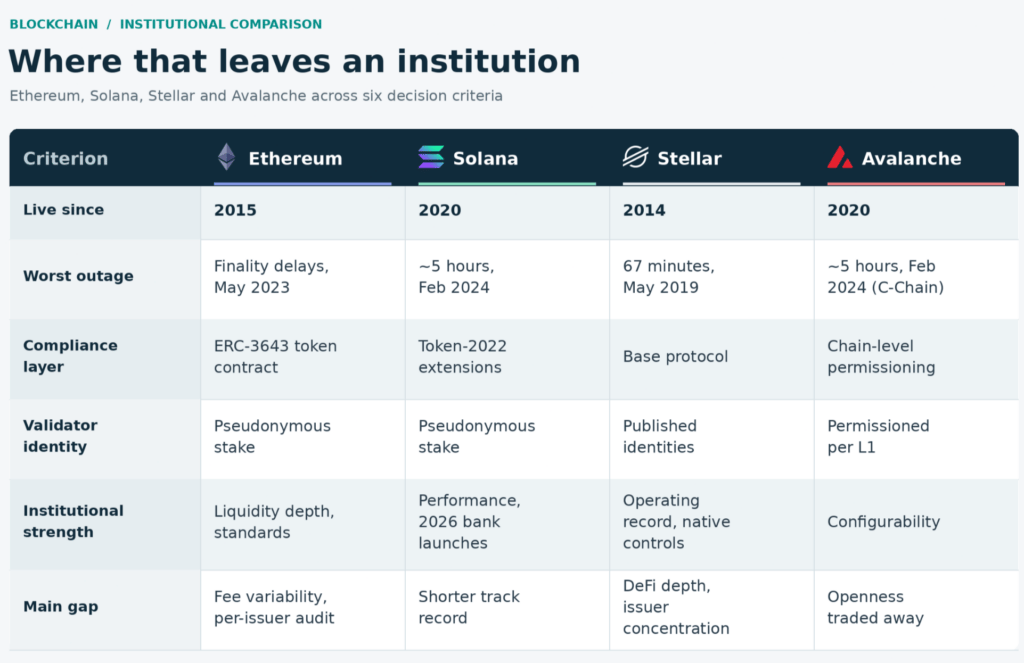
Operating record. How long has the network run, and what happened when it broke? A settlement layer that halts for five hours is a different procurement risk from one that has never halted.
Where compliance lives. Every institution needs the ability to freeze, claw back, restrict transfers and verify holder eligibility. The question is whether those controls sit in the base protocol, in a token standard, in a smart contract each issuer writes, or in a permissioned side environment. Each answer produces a different audit burden.
Who runs the network. Regulators increasingly want to know who validates transactions. Anonymous stake is difficult to reason about in a sanctions review. Named operators are not.
Whether the asset can move. Issuance is largely a solved problem at this point. The harder part is what happens afterwards: posting the asset as collateral, trading it on a licensed venue, settling it against cash at three in the morning. Analysts distinguish between distributed asset value, meaning what actually trades and settles onchain, and represented value, which counts total institutional commitment including assets that never move. The gap between those two figures is where a lot of tokenization marketing lives.
Ethereum: the deepest liquidity, the most mature standard
Ethereum’s position is not just an accident of timing. It has the deepest stablecoin liquidity of any public network, which matters to institutions that need to know a large trade will clear without moving the price. BlackRock’s BUIDL launched there in March 2024 with Securitize, and Ondo built out its product suite on Ethereum before expanding elsewhere.
It also has the closest thing tokenization has to a compliance standard. ERC-3643, developed by Tokeny and formalized as an Ethereum standard, embeds identity verification and transfer rules directly into the token contract, so non-compliant transfers fail at execution rather than being caught by an off-chain control. For a legal team, that architectural guarantee is worth a great deal, and it is one reason institutional tokenization has concentrated on Ethereum and EVM chains: deploying on EVM means inheriting the standard by default.
The traffic has not all run in that direction. Franklin Templeton’s FOBXX went the other way, reaching Ethereum in November 2024, more than three years after launching on Stellar, which remains the fund’s primary network.
The operating record is strong but not spotless. In May 2023 Ethereum’s consensus layer twice failed to finalize blocks, once for roughly four epochs and again the following day for nine, according to the post-mortem published by Offchain Labs and Prysm contributors. The execution layer kept processing transactions throughout and the network recovered on its own, but there were knock-on effects: some exchanges paused deposits and layer-two chains that wait on Ethereum finality saw delays. Client diversity is what kept it brief.
Ethereum’s real institutional cost is more mundane. Fees are variable, gas spikes are unpredictable, and compliance capability arrives as a contract each issuer deploys and each compliance team audits separately.
Solana: the performance argument, now with receipts
Solana spent years being dismissed as a retail chain, and that reputation has lagged behind the deployments. State Street launched SWEEP, its tokenized onchain liquidity fund built with Galaxy, in May 2026, making it the first tokenized fund from a globally systemic bank to go live on the network. Western Union chose Solana for its USD Payment Token, issued through Anchorage Digital and positioned as an alternative to correspondent banking. R3, the consortium that spent a decade building permissioned infrastructure for financial institutions, chose Solana as the settlement base for its Corda Protocol. By late July 2026 the network reported more than 313,000 RWA holders and $3.7 billion in non-stablecoin RWA value, including Baillie Gifford’s UK-regulated tokenized bond fund, which uses the blockchain itself as the legal register of record.
Solana’s compliance tooling has matured alongside that. Token-2022, live since January 2024, offers more than twenty optional extensions including permanent delegate, which lets an authorized party move or burn tokens from any holding account, confidential transfers, and transfer hooks that enforce an eligibility check inside the same atomic transaction. Solana’s own developer documentation notes that a failed hook rolls back the entire transfer, mirroring ERC-3643’s onchain enforcement. Functionally, this covers most of what a regulated issuer needs.
The open question remains resilience. Solana suffered seven major outages between 2020 and 2024, with total downtime measured in days rather than minutes. The causes ranged from bot-driven transaction floods to client bugs that hit nearly every validator at once. The most recent full halt, in February 2024, lasted about five hours. Solana’s design deliberately prefers halting to risking an inconsistent state, which is defensible engineering, but a five-hour stop is still a five-hour stop in an operational risk assessment.
Solana has addressed the root causes through QUIC, stake-weighted quality of service and priority fees, and the Alpenglow consensus upgrade, slated for mainnet later in 2026, is expected to cut finality from roughly 13 seconds to a few hundred milliseconds. The engineering has come a long way. It has just had less time to prove itself than the alternatives.
Stellar: the longest record and the controls in the base layer
Stellar’s numbers moved fast this year. On RWA.xyz’s distributed-value measure, which counts what actually settles onchain and applies the same method to every network, Stellar holds roughly $3.3 billion and ranks fourth. The network carried $868.8 million at the end of 2025, so that is a fourfold expansion in eight months, making Stellar arguably the fastest growing RWA blockchain in the world at this point in time.
The composition is more interesting than the total. Citing RWA.xyz data, the Stellar Development Foundation says the network held about $490 million in tokenized non-US government debt as of August 20, more than any other public blockchain, including Mexican CETES and Brazilian government bonds issued through Etherfuse. Spiko accounts for $1.55 billion of the network’s total through tokenized European treasury bills sold to small and medium enterprises, a segment that generally cannot get yield on cash in a bank account.
On the four criteria, Stellar’s case rests on the elements.
The operating record is the longest in this comparison set. The network has run since 2014 with a 99.99% uptime record, and has halted exactly once, for 67 minutes on May 15, 2019. No funds were lost and no fork occurred. The Stellar Consensus Protocol, like Solana’s, prefers a stop to an inconsistent state.
Compliance controls sit in the protocol rather than in a contract or a token standard. Authorization, freeze and clawback are base-layer operations available to any issuer without deploying anything. Research commissioned from the data firm Allium counts more than 79 million clawback and 105 million freeze operations executed on Stellar since inception, so the controls get daily use rather than sitting in the documentation.
Validators are named. The Stellar Consensus Protocol is a proof-of-agreement system in which anyone can run a validator but must publish identifying information, letting other nodes decide whom to trust. There is no mining, no stake-weighted voting and no gas-driven profit motive for validators, which also means no maximal extractable value. For a regulator asking who processed a given transaction, that is a straightforwardly answerable question.
The production evidence is verifiable by outsiders. Franklin Templeton has run a US-registered money market fund on Stellar since April 2021. Ric Golubov, who leads digital assets business development and partnerships at the firm, has said publicly that they chose Stellar because it offered the token-level controls needed to satisfy the SEC’s criteria for operating a mutual fund onchain. Franklin Templeton reports that running the share registry onchain cut the cost of a transfer-agent transaction from $75,000 to a whopping $1.13. MoneyGram launched its MGUSD dollar stablecoin on the network in June, issued by Bridge, reaching a retail footprint of roughly 500,000 locations.
The strongest external signal arrived in May, when DTCC announced plans to connect its tokenization service to Stellar, with DTC-tokenized assets expected in the first half of 2027 under the three-year pilot authorized by the SEC no-action letter DTC received in December 2025. DTCC has said its blockchain evaluation centered on three properties: compliance-minded architecture, open and configurable infrastructure, and risk management. Nadine Chakar, DTCC’s global head of digital assets, cited Stellar’s record with institutional assets onchain as an important factor in that evaluation.
Stellar’s weaknesses are real. Its DeFi depth and secondary liquidity trail Ethereum’s by a relatively wide margin, and the issuer base is narrow: Spiko, Realiz, Tradable, Franklin Templeton and Ondo together account for roughly 93% of tokenized asset value on the network. That is a real concentration risk, and it cuts against a claim of broad institutional adoption rather than a handful of large deployments. The common critique that tokenized assets on compliance-friendly chains simply sit in custody is a fair hit on the category as a whole. The Foundation’s answer is a measurable one in that it self-reports that 97.5% of real-world asset value on the network is freely transferable, rather than locked inside a restricted environment.
Avalanche: the deepest customization, at the cost of openness
Avalanche took the most explicitly institutional path of the four. Its Evergreen architecture, now called Avalanche L1s, lets an institution run an EVM-compatible chain with a permissioned validator set, a custom non-crypto gas token, wallet allowlists and non-transferable credential tokens issued after KYC. Spruce, the flagship institutional environment, drew T. Rowe Price, WisdomTree, Wellington Management and Cumberland as its first cohort, with onboarding handled through third-party identity verification and custody support from Fireblocks. Citi used it to test private-markets tokenization alongside clients including Wellington and ABN AMRO, and has since announced plans to deploy a tokenized private equity fund on an Avalanche subnet.
For compliance depth, this is the most configurable option available. It is also the one that trades away the most. An institution running its own permissioned L1 gets control and gives up the shared liquidity, open composability and third-party verifiability that made public infrastructure interesting in the first place.
Avalanche’s operating record sits in the middle of the field. The C-Chain, which carries most network activity, stopped producing blocks for roughly five hours in February 2024 after a mempool gossip bug, halted for about an hour in March 2023 on a client bug, and stalled again for close to five hours in March 2024. None of those were capacity failures; all three were code.
There is also a measurement issue. Avalanche’s headline RWA figure looks like a top-five finish, but independent analysis of the mid-2026 data attributes much of it to a single issuer, and only a small fraction is genuinely distributed onchain rather than held as internal bookkeeping records.
Where that leaves an institution
Regulation is pushing this decision forward rather than settling it. The GENIUS Act and MiCA have given institutions a workable framework for stablecoins and tokenized products, and for most regional banks the practical consequence is upgrading blockchain connectivity, real-time settlement, custody and compliance capability rather than issuing anything themselves. That is a procurement question, and procurement questions get answered on track record.
The market is not going to resolve into a single network, and institutions have largely stopped expecting it to. Franklin Templeton’s BENJI now spans nine chains and BlackRock’s BUIDL spans eight. Deploying an existing product onto a second or third network costs a fraction of the original launch, so issuers increasingly choose per use case rather than settling on one vendor.
What each network is for is getting clearer as a result. Issuers go to Ethereum for liquidity depth and standard maturity, to Solana when performance and payment-scale distribution are the binding constraints, and to Avalanche when they want a controlled environment more than they want a shared one. Stellar’s value-add is narrower and, for a compliance team, easier to check: the controls are already in the protocol, the validators are already named, and the operating record is already on a public ledger.
Whichever way that argument lands, it is not simply a question a market-share table can settle for all.
Data as of early September 2026. Tokenized asset values move continuously; readers should check RWA.xyz or issuer disclosures for current figures.
Featured image via Shutterstock.