
Nvidia (NASDAQ: NVDA) stock faces further downside risks over the next 12 months as concerns about AI spending and US-China trade restrictions weigh on investor sentiment.
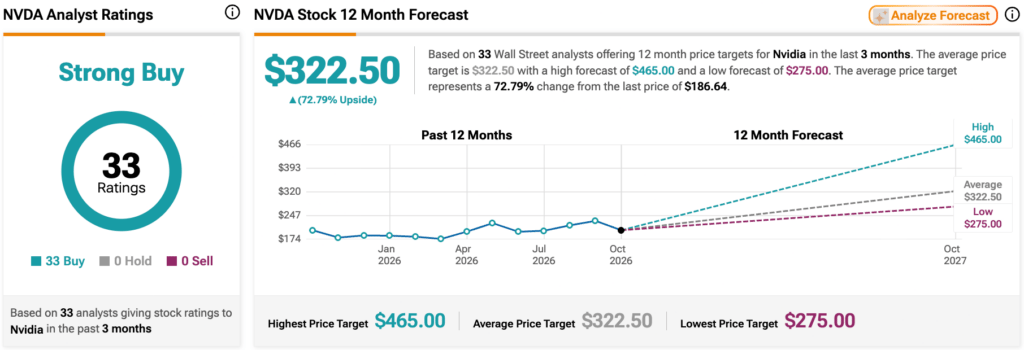
However, Wall Street analysts remain bullish, with all 33 analysts surveyed by TipRanks maintaining a ‘Buy’ recommendation and a ‘Strong Buy’ consensus.
The average 12-month price target stands at $322.50, implying 72.79% upside from the November 6 close of $186.64. Targets range from $275 to $465, representing potential gains of 47.34% and 149.2%, respectively.
Advertisement
Despite the optimistic forecasts, Nvidia fell 9.26% on November 5 in its worst session since the DeepSeek sell-off. Shares recovered 2.78% the following day, closing at $186.64, but several factors could trigger further losses.
Nvidia stock’s technical analysis
Nvidia’s technical outlook remains bearish, with shares trading below their 50-day simple moving average (SMA) of $219.77 and 200-day SMA of $204.39. Its 14-day Relative Strength Index (RSI) stood at 30.77, approaching the oversold threshold of 30.
The first key support lies at $176.62, followed by $171.65. A deeper correction could expose $161.84, about 13.3% below the last closing value.
On the upside, resistance stands at $191.41 and $201.23. Reclaiming the 200-day SMA at $204.39 could improve momentum, while the 50-day SMA at $219.77 remains a higher hurdle.
At the same time, Wall Street analysts’ forecasts remain positive. For instance, Barclays’ Thomas O’Malley has a $275 target, Bernstein’s Daniel Zhu expects $400, and Rosenblatt Securities’ Kevin Cassidy sees $390.
Meanwhile, banking giant Morgan Stanley has reaffirmed Nvidia as its top semiconductor pick, maintaining an ‘Overweight’ rating and a $288 price target.
Advertisement
These forecasts suggest analysts view the correction as a buying opportunity, although price targets are not guaranteed.
What could drive further Nvidia stock losses?
Nvidia’s correction reflects concerns about AI infrastructure spending and geopolitical risks. Notably, on Friday, NVDA shares had lost approximately $450 billion in market value following its November 5 decline, with the sell-off also affecting semiconductor peers such as Advanced Micro Devices (NASDAQ: AMD).
Investors are concerned that tougher AI regulations and delays in data center construction could slow spending by Nvidia’s largest customers.
Delays involving infrastructure, power connections, and regulatory approvals could also affect orders and revenue.
Meanwhile, despite its lower forward earnings multiple, Nvidia remains vulnerable to concerns that AI spending could peak sooner than expected.
China presents another risk after approximately 600,000 Nvidia H200 chips were being held in Hong Kong pending approval for shipment to mainland China.
Advertisement
Beijing has yet to authorize large-scale imports and is encouraging domestic companies to prioritize local alternatives. However, Chinese firms have ordered more than three million export-compliant RTX Pro 5500 graphics cards, with a combined sticker price exceeding $35 billion.
Despite these headwinds, Nvidia’s financial performance remains strong. Fiscal second-quarter 2027 revenue reached $96.22 billion, up 105.8% year over year, while the company forecast third-quarter revenue of around $108 billion.
How low will NVDA shares fall?
Overall, based on the Nvidia analyst forecasts, $275 represents the lowest 12-month price target, rather than a projected downside level.
However, Nvidia’s technical indicators suggest that further weakness remains possible, particularly if the stock fails to reclaim its 200-day moving average and breaks below immediate support around $181.
Featured image via Shutterstock