
SanDisk (NASDAQ: SNDK) stock has emerged as one of the market’s biggest winners over the past year, rewarding investors who capitalized on the firm’s venture into artificial intelligence infrastructure and high-performance data storage solutions.
Notably, by press time, SanDisk stock was trading at $1,694, having gained 4,440% over the past year.
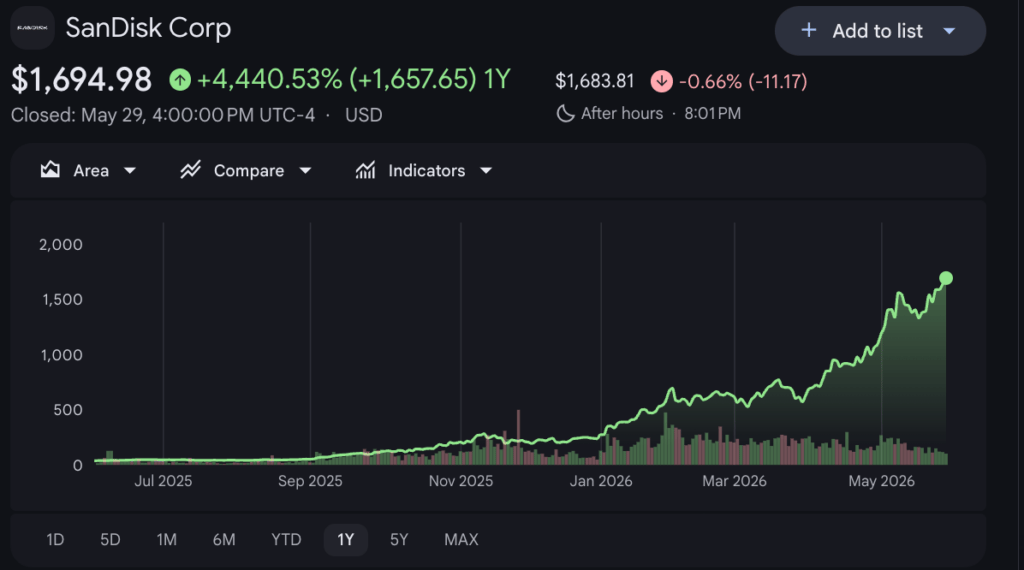
This translates to a return of about $45,400 for investors who invested $1,000 in the stock a year ago, bringing the total investment profit to $44,400.
The main driver behind SanDisk stock’s rally has been booming demand for AI infrastructure. The company became an independent public entity in February 2025 after separating from Western Digital, creating a pure-play NAND flash and SSD business at a time when AI-related storage demand was accelerating.
Since the spin-off, SanDisk stock has surged from the $36-$52 range to almost $1,700 by the end of May 2026.
The rally has been fueled by heavy spending on AI data centers by major technology companies, increasing demand for enterprise SSDs and NAND flash memory, as well as rising memory prices across the industry.
SanDisk stock fundamentals
SanDisk has also benefited from strong earnings growth, repeated guidance increases, expanding data center revenue, and favorable industry supply conditions.
In its fiscal third quarter ended April 2026, SanDisk reported revenue of $5.95 billion, a staggering 251% increase from the year-ago period and well above analyst forecasts.
Non-GAAP earnings per share skyrocketed to $23.41, crushing consensus estimates by over 60%. The standout performer was the company’s Data Center segment, which generated $1.47 billion in revenue, up 645% year-over-year and 233% sequentially, as hyperscalers ramped up purchases of AI-optimized storage solutions for training and inference workloads.
Looking ahead, analysts remain optimistic that continued AI investment and tight memory supply could support further growth.
However, after its massive run, some investors warn that elevated valuations may increase the risk of volatility or profit-taking.
Future performance will largely depend on the sustainability of AI-driven demand and broader semiconductor market trends.