

Investors are pouring record amounts of capital into U.S. industrial and infrastructure-focused exchange-traded funds (ETFs), reflecting growing confidence in the next phase of the artificial intelligence (AI) boom.
In this line, industrial sector ETFs attracted about $25 billion in inflows over the past 12 months, marking a record high.
At the same time, infrastructure and power-related ETFs drew roughly $21 billion, according to data shared by financial markets commentary platform The Kobeissi Letter on May 3.
The surge marks a sharp increase from 2024 levels, with inflows into industrial ETFs jumping about 400%, while infrastructure and power ETFs rose roughly 200%.
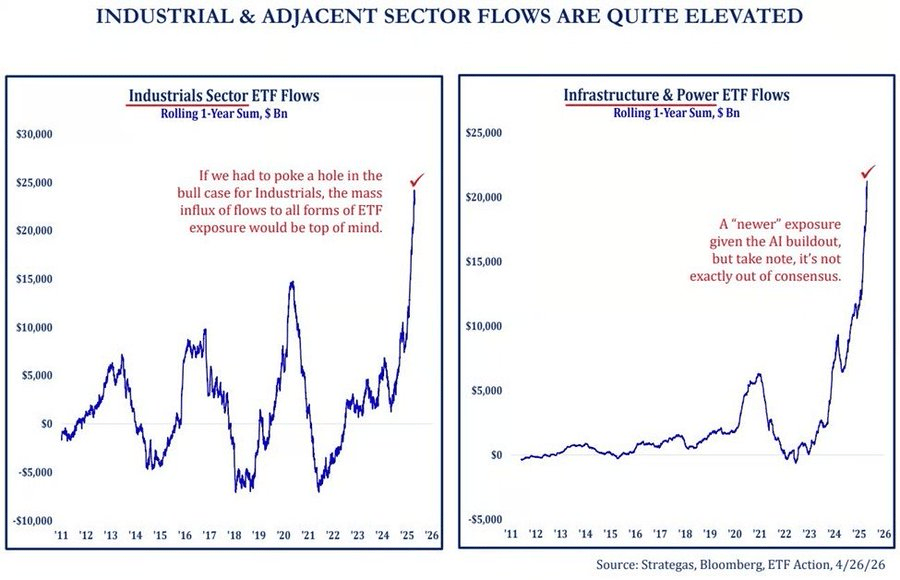
After uneven activity through the early 2020s, inflows accelerated in late 2025 and into 2026 as enthusiasm around AI infrastructure intensified.
The rally is being driven by growing recognition that AI expansion depends not only on semiconductor chips but also on electricity, grid capacity, cooling systems, and industrial equipment.
Expectations of increased spending
With hyperscale data centers expanding rapidly, technology companies are expected to spend hundreds of billions of dollars on infrastructure projects in 2026, boosting interest in ETFs tied to power generation, utilities, industrial equipment, natural gas infrastructure, nuclear energy, and data center construction.
Energy infrastructure ETFs focused on natural gas and midstream operations are also gaining momentum as utilities seek reliable power sources for data centers.
At the same time, nuclear- and uranium-related funds are drawing renewed interest for their potential to provide long-term electricity supply for AI-driven demand.
Broader ETFs tied to data centers, digital infrastructure, and electrification have also posted strong gains, highlighting growing investor belief that infrastructure will be a major beneficiary of the AI boom.
Compared to some high-growth technology stocks, industrial and utility-related companies are also viewed as offering steadier cash flows and dividend income.
However, these new trends come with several risks. In this case, infrastructure projects can face permitting delays, grid connection issues, and rising costs, while concerns persist that AI-related spending may not generate expected returns if adoption slows.
For investors seeking exposure, diversified ETFs may offer a lower-risk way to benefit from the AI infrastructure buildout while reducing concentration risk.