
After the protracted downturn in 2023 and 2024, one of the biggest semiconductor companies in the world, Intel (NASDAQ: INTC), has been enjoying a period of recovery that had something of a culmination with a one-session 8.84% rally to $48.03 on April 1.
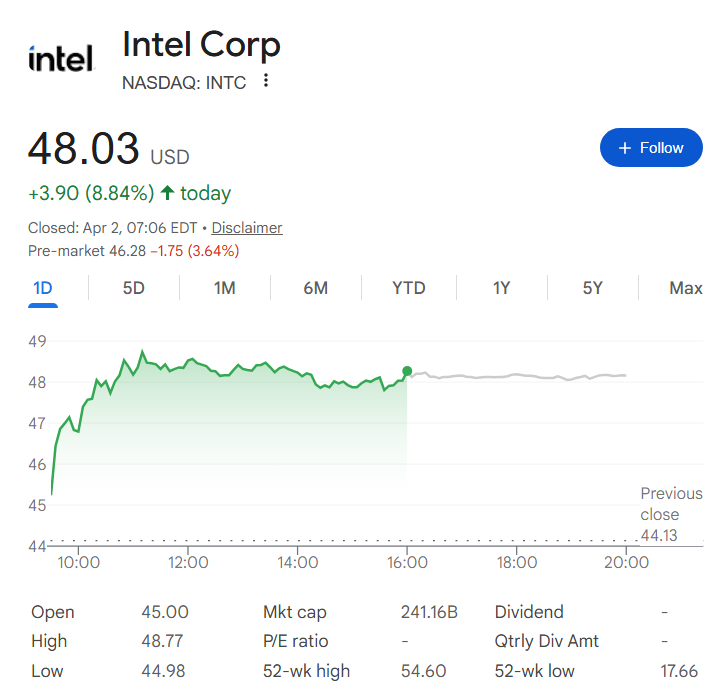
The regular session surge was driven by the decision to undergo a $14.2 billion repurchase of equity in Ireland’s Fab 34 manufacturing facility. This move was widely interpreted as a sign of strength, considering that Intel sold the 49% stake in 2024 in an effort to raise cash amidst the then-ongoing decline.
Furthermore, the rally was accelerated by the April 1 rumor that the world’s second-largest blue-chip chipmaker, Advanced Micro Devices (NASDAQ: AMD), was planning to purchase Intel. However, that alleged acquisition was part of an April Fool’s joke.
“At press time, the companies said the deal was expected to close shortly after the industry finished checking the calendar,” TechSpot wrote at the end of its article on the supposed deal.
Still, given INTC stock’s one-day 8% and 12-month 118% rally and between the confirmed and false news, the question of whether the equity is a ‘buy,’ ‘sell,’ or ‘hold’ remains very much open.
Wall Street sets Intel stock price 12-month target
To begin with, Intel shares’ recent success is yet to impress Wall Street experts. Indeed, the analyst consensus for the stock is, at press time on April 2, a ‘Hold,’ while the average 12-month price forecast predicts a 0.12% decline to $47.97.
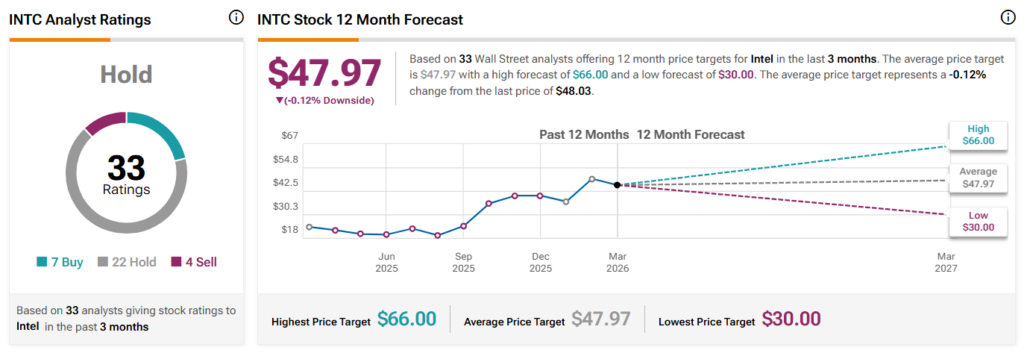
Additionally, though the tally displayed on TipRanks accounts for all ratings assigned in the last 3 months, indicating the recommendations and figures are not truly up-to-speed, it is notable that 2026 revisions are dominated by ‘Hold’ and ‘Sell’ estimates with very few ‘Buys.’
Technical analysis indicates strong Intel stock short-term rally
Still, if Wall Street is unconvinced, technical analysis (TA) of Intel stock strongly indicates that investors who purchase at the start of April are in for substantial returns.
Specifically, the moving averages (MA), oscillators, and overall readings Finbold retrieved from TradingView on April 2 appear to advise traders to purchase INTC shares, whether based on the last 24 hours, one week, or one month in the stock market.
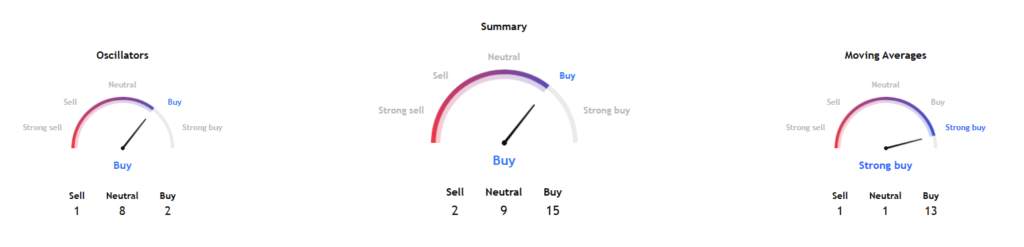
Lastly, despite Intel being on a path of recovery with the repurchase in Ireland, showcasing mounting confidence, the wider factors at play at the start of 2026 might, after all, be urging neutrality regarding the equity.
Is the technology sector about to collapse and drive Intel stock lower?
The wider technology sector – led by the artificial intelligence (AI) industry – has been on a knife-edge since 2026 started. On the one hand, OpenAI recently completed a $122 billion fundraiser, showing confidence in coming breakthroughs and profits remains relatively high.
On the other hand, the very same company recently announced the end of its Sora platform – once touted as an AI-powered TikTok – and reportedly internally forecasts a $14 billion loss this year.
Similarly, while technology executives remain vocally confident, investors have been showing a degree of anxiety regarding the AI boom, as seen in Microsoft (NASDAQ: MSFT) suffering one of its worst first quarters (Q1) of the XXI century and Nvidia (NASDAQ: NVDA) spending most of the recent months either declining or stagnating in the stock market.
Intel stock headwinds remain strong in April
Lastly, while Intel would likely be affected by sector-wide movements – whether bullish or bearish – it might soon have its rally halted in the short-term by geopolitical concerns.
Although INTC stock’s latest regular session upswing was helped along by company-specific developments, it is worth noting that it came amidst a sweeping rally driven by an expectation that President Donald Trump would be winding down military operations against Iran.
Under the circumstances, it is not entirely clear if the 3.64% drop in the April 2 pre-market is the result of a more typical correction following the 8% surge, or a sell-off triggered by the commander-in-chief’s apparent decision to re-escalate in the Middle East and the concerns over the disruptions the war is set to continue generating.
Featured image via Shutterstock