
Tesla (NASDAQ: TSLA) stock is back in focus after the company unveiled its next-generation Roadster on October 15, raising the question of whether the long-awaited electric supercar can help drive shares toward $1,000.
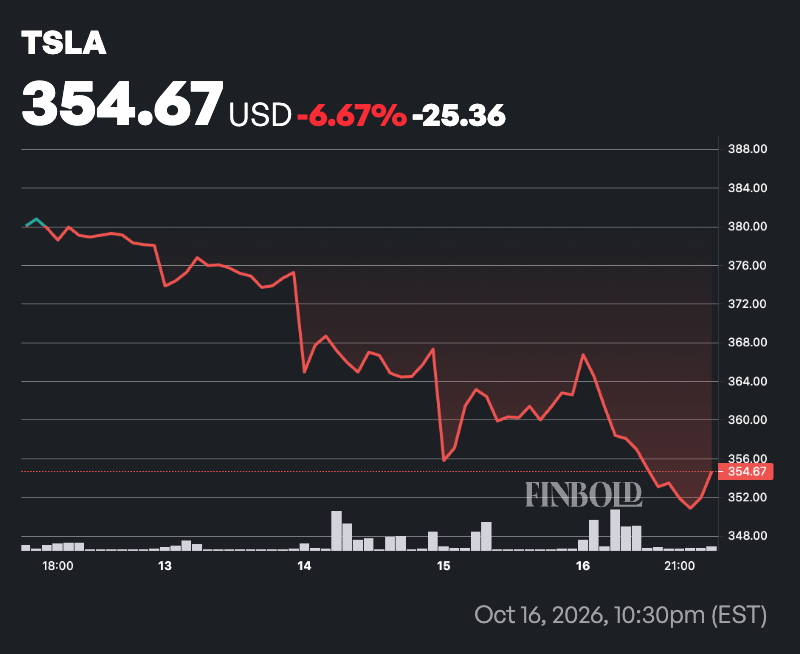
However, with TSLA closing at $354.72 on October 16, the stock would need to gain 182% to reach that level.
Notably, the Roadster is not expected to enter production until 2028, leaving Tesla’s financial performance and progress in autonomous driving and robotics as key factors in its valuation.
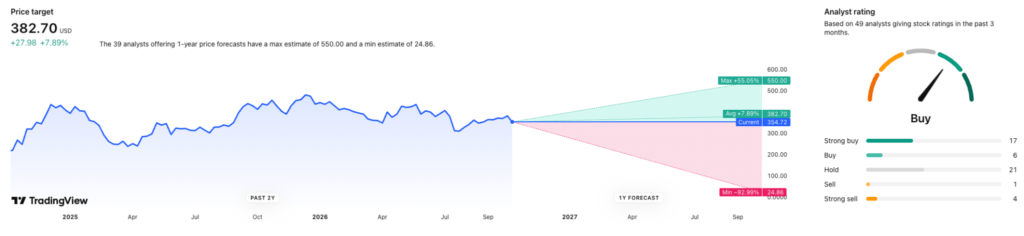
Wall Street’s current Tesla stock price targets suggest that $1,000 remains an ambitious scenario rather than the prevailing expectation.
According to TradingView data, Tesla’s average 12-month price target stands at $382.70, implying 7.89% upside from the current price of $354.72. The forecast is based on 39 analysts, with estimates ranging from $24.86 to $550.
Tesla’s Roadster path to $1,000
Tesla unveiled the redesigned Roadster, showcasing a prototype equipped with rocket-style thrusters developed with SpaceX.
The demonstration included mid-air maneuvers, jumps, and upside-down driving using a suction system. The electric vehicle manufacturer is targeting production in 2028, more than a decade after first presenting the next-generation model.
The vehicle can strengthen Tesla’s reputation for engineering innovation, but its immediate financial contribution is expected to be limited.
CEO Elon Musk has described the Roadster as important for the company’s brand rather than a major revenue driver.
Its high-performance positioning and limited production volumes also constrain its potential impact on Tesla’s overall sales.
The initial market reaction was mixed. Tesla shares rose in premarket trading following the reveal but subsequently reversed.
That suggests investors are looking beyond the demonstration to assess whether the announcement translates into meaningful financial growth.
Consequently, the Roadster reveal alone is unlikely to justify a sustained rally toward $1,000. Tesla would need additional catalysts capable of supporting a much higher valuation.
Tesla’s long-term outlook
Tesla’s long-term growth prospects increasingly hinge on autonomous driving, robotaxis and humanoid robotics alongside its electric vehicle business.
Its Cybercab, self-driving technology and Optimus robot could unlock new revenue streams, although their success depends on costs, regulatory approvals and adoption.
Investors are also watching speculation about a potential Tesla-SpaceX combination, but no merger agreement has been announced, making it an unconfirmed catalyst for TSLA stock.
Meanwhile, Tesla delivered 486,532 vehicles and deployed 13.7 GWh of energy storage in the third quarter of 2026, according to its October 2 update.
Its earnings report, scheduled for October 21, should provide further insight into revenue, margins, and cash flow, alongside updates on autonomous driving and robotics.
Featured image via Shutterstock