
Intel (NASDAQ: INTC) could extend its recent rally into the start of October, according to a forecast generated by Finbold’s AI Agent.
Using predictions from DeepSeek Chat, Gemini 3.5 Flash, and GPT-5.7 Luna, the machine learning model projects Intel stock to trade at an average price of $129.50 on October 1, 2026, representing a 6.42% gain from its current price of $121.69.
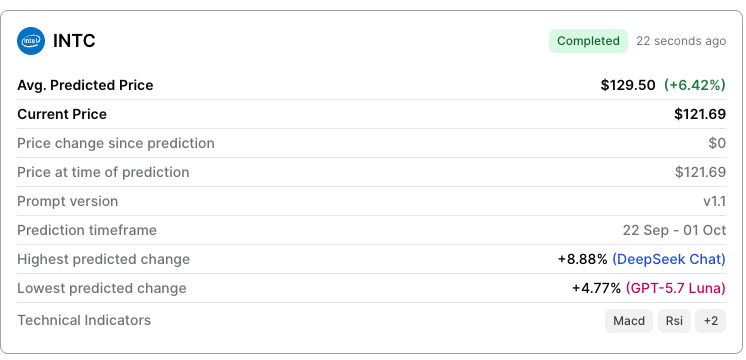
The Finbold AI Agent forecast showed all three underlying models expecting Intel shares to move higher over the next nine days.
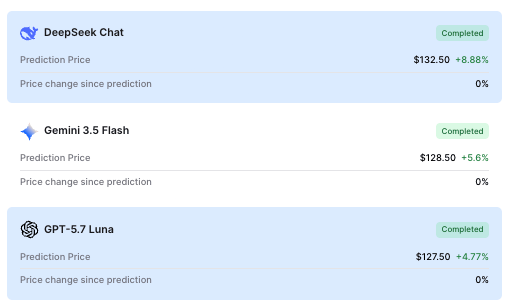
DeepSeek Chat delivered the most optimistic target at $132.50, implying upside of 8.88%. Gemini 3.5 Flash projected Intel at $128.50, representing a gain of 5.6%, while GPT-5.7 Luna forecast a price of $127.50, indicating potential upside of 4.77%.
Technical indicators used by the AI Agent included the Moving Average Convergence Divergence (MACD), Relative Strength Index (RSI), stochastic oscillator, MACD slope, the 50-day simple moving average, and the 200-day simple moving average (MA).
Intel stock fundamentals
Overall, Intel’s improving fundamentals have helped reshape investor sentiment in 2026. The technology company reported second-quarter revenue of $16.1 billion, up 25% year-over-year, marking its fastest revenue growth in more than 15 years. Non-GAAP earnings per share reached $0.42, comfortably ahead of market expectations.
A key driver was Intel’s Data Center and AI segment, where revenue surged 59% to $6.3 billion as enterprises increased spending on AI infrastructure. The Client Computing business also posted double-digit growth, while gross margins improved significantly.
Management’s third-quarter guidance further reinforced confidence, with Intel forecasting revenue between $15.8 billion and $16.8 billion and non-GAAP EPS of $0.38, both above Wall Street estimates.
The company has also raised its 2026 capital expenditure plans to more than $20 billion as demand for server processors and AI-related computing hardware continues to outpace supply.
Beyond earnings, investors are increasingly focused on Intel’s role in the expanding AI ecosystem.
While Nvidia remains the dominant GPU supplier, the growing adoption of AI inference and agentic systems has increased demand for high-performance CPUs, an area where Intel has been regaining momentum through its Xeon product lineup.
At the same time, Intel continues to advance its foundry strategy. Management has reported encouraging progress with its 18A process technology, while development of the next-generation 14A node remains on track for future customer deployments.
Although challenges remain, including supply constraints, intense competition, and the long road to foundry profitability, Intel’s transformation into a major AI infrastructure player has strengthened its investment narrative.
Featured image via Shutterstock