
Nvidia (NASDAQ: NVDA) could see its stock climb modestly by August 1, 2026, according to a forecast generated by Finbold’s AI Agent.
The model analyzed the semiconductor giant using four large language models and technical indicators.
The machine learning-driven prediction projects Nvidia shares will trade at an average price of $203.63 by August 1, representing a 0.41% gain from the stock’s press-time price of $202.
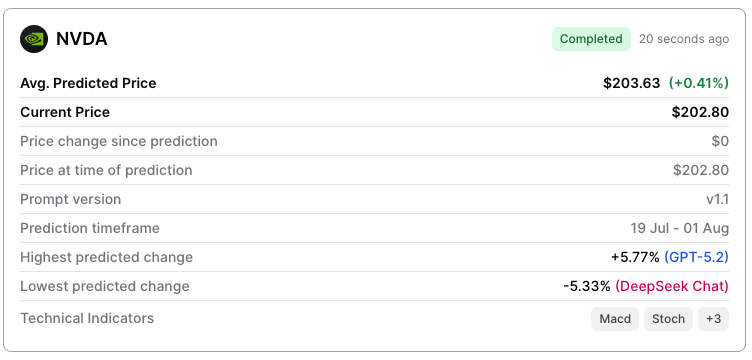
The forecast was derived from models including Claude Opus 4.6, DeepSeek Chat, GPT-5.2, and Grok 4.1, alongside technical signals such as the Moving Average Convergence Divergence (MACD), Relative Strength Index (RSI), Stochastic Oscillator, and a broader AI scoring system.
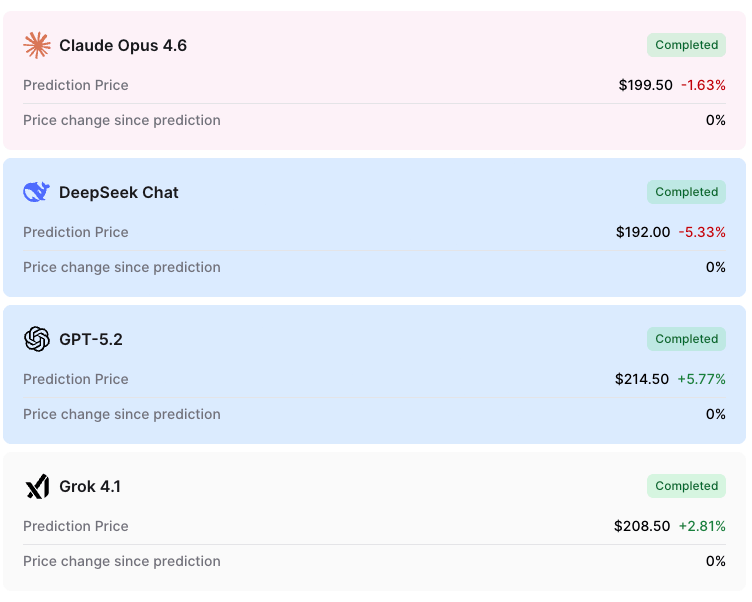
Among the four models, GPT-5.2 delivered the most bullish outlook, forecasting Nvidia stock at $214.50, implying upside of 5.77% from current levels.
Grok 4.1 was also positive, projecting a price of $208.50, or a gain of 2.81%. In contrast, Claude Opus 4.6 predicted Nvidia would decline to $199.50, while DeepSeek Chat issued the most bearish forecast, targeting $192.00, which would represent a 5.33% drop from current levels.
The prediction comes as Nvidia continues to trade in a relatively tight range following recent volatility after testing support near the $197-$198 area and recovering above the psychologically important $200 level.
Technical indicators used by the AI Agent suggest mixed momentum. In this line, Nvidia’s RSI remains near neutral territory, indicating neither overbought nor oversold conditions. Meanwhile, MACD readings point to stabilizing momentum after a period of weakness earlier in the month.
The stock has largely remained between $190 and $220 in recent weeks as investors assess the pace of artificial intelligence spending and broader semiconductor sector performance.
Nvidia stock fundamentals
The relatively cautious short-term outlook contrasts with Wall Street’s bullish long-term view. Analysts continue to back Nvidia, citing its leadership in AI infrastructure, strong demand for accelerated computing, and the ongoing rollout of its Blackwell platform.
Nvidia’s fundamentals also remain robust, having reported quarterly revenue of $46.7 billion, up 56% year-over-year, while data center revenue rose 56% to approximately $41 billion. The segment continues to drive most of Nvidia’s growth as hyperscalers and enterprises expand AI infrastructure spending.
Still, the stock has faced pressure in recent months as investors reassess AI valuations and future spending trends.
Concerns over export restrictions, rising competition, and a potential slowdown in AI capital expenditures have contributed to volatility across the semiconductor sector.