
Oracle (NYSE: ORCL) stock has attracted a $3.48 million insider purchase from board member and former Quest Diagnostics CEO Stephen Rusckowski, as shares trade nearly 60% below their all-time high.
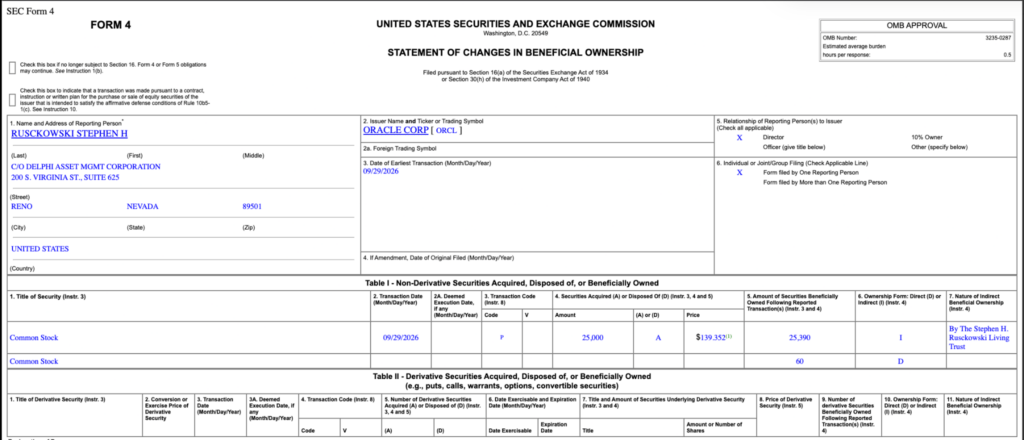
According to a U.S. Securities and Exchange Commission (SEC) Form 4 filing, Rusckowski’s living trust purchased 25,000 shares on September 29 at a weighted-average price of $139.352. The filing was accepted on October 1, bringing the trust’s holdings to 25,390 shares.
The purchase contrasts with recent insider sales. On September 22, Oracle CEO Michael Sicilia sold 22,562 shares for approximately $3.42 million at $151.59 per share. The transaction was made under a Rule 10b5-1 trading plan adopted on December 24, 2025, which allows insiders to schedule trades in advance.
Oracle accounting executive Maria Smith also sold 2,631 shares at $151.70 on September 22 following restricted stock unit conversions. Her filing included tax-related share withholding.
While Rusckowski’s open-market purchase provides a bullish signal, the transactions occurred under different circumstances.
The buying activity alone does not establish that Oracle is undervalued, making its financial performance, valuation and investment risks equally important considerations for investors.
Oracle stock fundamentals
Oracle’s latest results show strong operating momentum despite the stock’s decline. In its first-quarter fiscal 2027 results, released on September 10, revenue rose 30% year over year to $19.3 billion.
Total cloud revenue climbed 62% to $11.6 billion, driven by a 121% surge in cloud infrastructure revenue to $7.4 billion. Cloud applications revenue grew 10% to $4.2 billion.
Meanwhile, remaining performance obligations, representing contracted revenue yet to be recognized, increased by $209 billion year over year to $664 billion, providing substantial visibility into future revenue.
However, Oracle faces mounting funding demands as it expands its AI infrastructure. In fiscal 2026, operating cash flow rose 54% to $32 billion, but free cash flow fell to negative $23.7 billion as infrastructure investment increased.
The company raised $43 billion through debt and $5 billion through equity financing in fiscal 2026. For fiscal 2027, management expects to raise approximately $40 billion through debt and equity, including a previously announced $20 billion at-the-market equity issuance.
These funding needs could increase borrowing costs and dilute shareholders, making returns on data-center investments crucial to Oracle’s valuation.
Oracle’s exposure to major AI customers, including OpenAI, also presents risks, as changes in spending plans or delays could affect future revenue.
The bullish case rests on accelerating cloud growth, a substantial backlog and rising AI demand.
The bearish case centers on negative free cash flow, financing needs, customer concentration and uncertainty over whether infrastructure investments will generate adequate returns.
Meanwhile, at last market close, ORCL shares were valued at $137 down 27% YTD.
Featured image via Shutterstock