

Despite her track record of backing winning stocks, former House Speaker Nancy Pelosi’s decision to exit Micron Technology (NASDAQ: MU) in 2022 has proven costly, with the chipmaker rallying nearly 2,000% since the sale.
The trade has resurfaced as Micron emerged as one of the biggest winners of the artificial intelligence boom, transforming from a struggling memory-chip manufacturer into a key supplier of AI infrastructure.
Congressional trading disclosures show that Pelosi’s family sold Micron call options on September 16, 2022.
Receive Signals on US Congress Members' Stock Trades
Stay up-to-date on the trading activity of US Congress members. The signal triggers based on updates from the House disclosure reports, notifying you of their latest stock transactions.
The position consisted of 100 call options purchased on December 21, 2021, with a strike price of $50 and an expiration date of September 16, 2022. The transaction, disclosed on October 14, 2022, was valued between $15,001 and $50,000.
At the time, Micron was grappling with a semiconductor downturn as weakening demand and falling memory prices weighed on earnings.
Since then, the stock has surged about 1,915%, vastly outperforming the broader market. Over the same period, the SPDR S&P 500 ETF (SPY) gained roughly 102%.
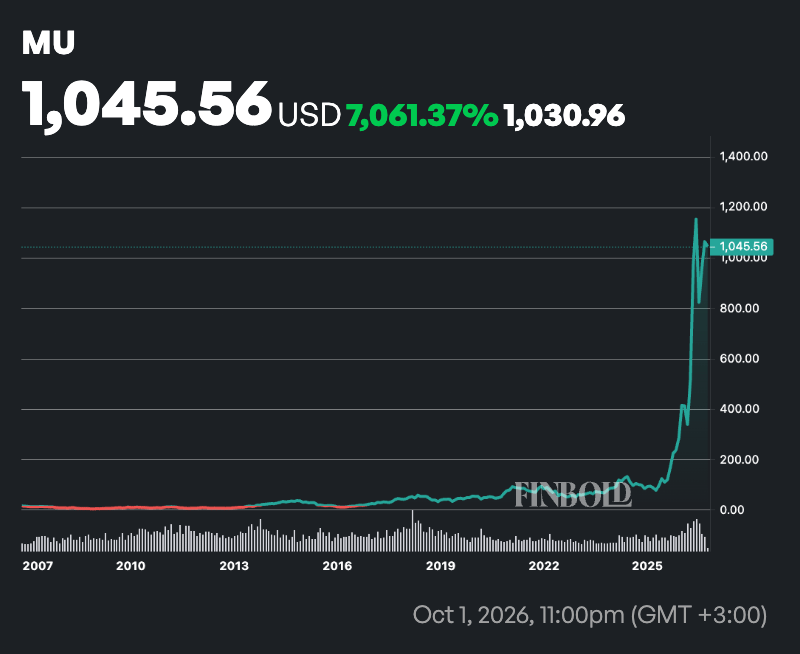
MU stock’s turnaround
At this point, it can be assumed that few investors anticipated the scale of Micron’s turnaround.
The company has since become one of the biggest beneficiaries of the AI spending boom, driven by soaring demand for memory products used in data centers and AI accelerators.
Micron’s high-bandwidth memory (HBM) chips have become a key component in advanced AI systems, while strong demand and industry-wide supply constraints have enabled memory manufacturers to raise prices and expand margins.
The surge in AI demand has translated into record financial results. In its latest fiscal fourth quarter, Micron reported revenue of $54.23 billion, up from $11.32 billion a year earlier, while non-GAAP earnings climbed to $33.42 per share. Operating cash flow reached a record $43.97 billion.
For fiscal 2026, revenue jumped to $133.19 billion from $37.38 billion, while operating cash flow surged to $89.68 billion. The company also ended the year with $73.48 billion in cash and investments.
Investor optimism has been further supported by Micron’s expanding backlog. The technology company disclosed that customer commitments under long-term supply agreements increased to $32 billion from $22 billion in the previous quarter, while remaining performance obligations rose to $150 billion from $100 billion.
Micron now has 26 strategic customer agreements, some extending through 2031, with those contracts expected to account for more than 35% of projected revenue through 2030.
Pelosi’s stock trading controversy
The Micron trade is also likely to reignite debate surrounding congressional stock trading. Much of the scrutiny stems from successful Pelosi-linked investments in technology giants such as Alphabet (NASDAQ: GOOG/GOOGL), Amazon (NASDAQ: AMZN), Apple (NASDAQ: AAPL), Nvidia (NASDAQ: NVDA ), and Microsoft (NASDAQ: MSFT), many of which significantly outperformed the broader market.
The strong performance of Pelosi-linked trades has fueled calls to ban members of Congress from trading individual stocks, with critics citing potential conflicts of interest.
Pelosi has maintained that she does not personally trade stocks and that investment decisions are made by her husband, Paul Pelosi.
Ironically, the Micron trade stands out as one of the rare Pelosi-linked transactions that missed a major market move.
Featured image via Shutterstock