
Nvidia (NASDAQ: NVDA) increased its SpaceX (NASDAQ: SPCX) stake to almost $20 billion in the third quarter of 2026, making the aerospace company its largest reported equity holding.
The chipmaker added 7.7 million SpaceX shares, increasing its position by 6.3% to approximately 130.5 million shares as of September 30, according to a regulatory filing published on November 16.
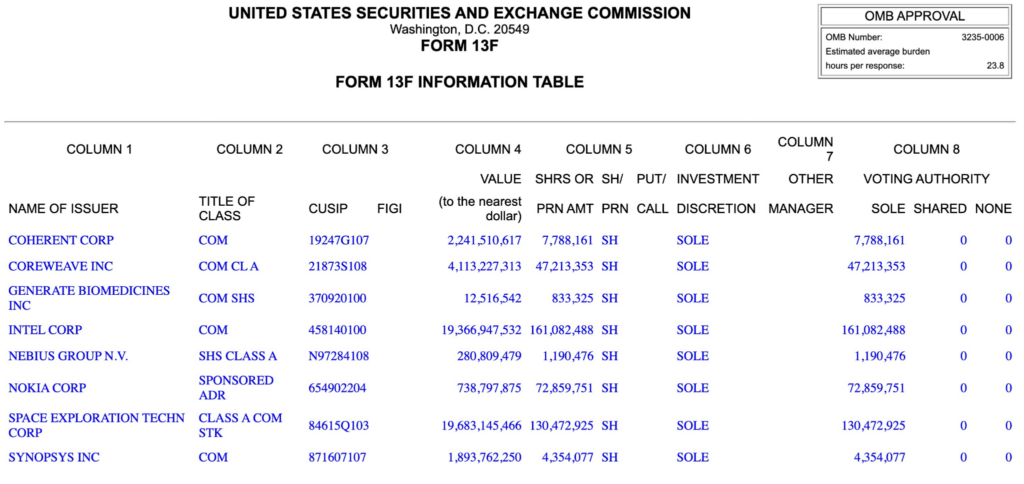
Nvidia’s SpaceX investment was valued at approximately $19.7 billion at the end of September, narrowly ahead of its $19.4 billion Intel position.
Three months earlier, Intel (NASDAQ: INTC) was Nvidia’s largest holding, valued at approximately $30 billion compared with SpaceX’s $21 billion.
The latest figures highlight how quickly the balance has shifted. SpaceX now accounts for approximately 40.7% of Nvidia’s $48.3 billion reported equity portfolio, slightly above Intel’s 40.1%.
While increasing its SpaceX exposure, Nvidia reduced its Intel position by approximately 53.7 million shares, or 25%, to 161.1 million shares.
Nvidia’s Intel stock trimming
The reduction follows Nvidia’s $5 billion investment in Intel in September 2025, when it acquired shares at $23.28 apiece as part of a broader collaboration involving data center and PC products.
Intel subsequently experienced significant share price volatility. By September 30, Nvidia’s remaining position was valued at approximately $19.4 billion.
The chipmaker also reduced its Nokia (NYSE: NOK) holdings by 56% and its Synopsys (NASDAQ: SNPS) position by approximately 10%.
Meanwhile, its share counts in CoreWeave (NASDAQ: CRWV), Coherent (NASDAQ: COHR), Nebius (NASDAQ: NBIS), and Generate Biomedicines remained unchanged.
Nvidia’s portfolio reshuffling comes as investors prepare for its third-quarter fiscal 2027 earnings report, scheduled for November 17 after the U.S. market closes.
Wall Street expects the chipmaker to report approximately $108.9 billion in revenue, representing roughly 91% year-over-year growth. Adjusted earnings per share (EPS) are forecast at $2.47, while its data center division is expected to contribute approximately $101.8 billion.
Nvidia Jensen Huang’s controversy
The results will also test Nvidia’s leadership transition following the departure of co-founder and longtime CEO Jensen Huang.
Huang resigned on November 11 amid controversy surrounding reported relationships with employees and an investigation into whether his association with Chinese businesswoman Alice Huang created national security risks.
Nvidia subsequently appointed Chief Financial Officer Colette Kress as interim CEO while its board searches for a permanent replacement. Longtime board member Harvey Jones was also appointed chairman.
Kress faces the challenge of maintaining investor confidence in Nvidia’s growth strategy while addressing concerns about leadership continuity and the company’s multibillion-dollar AI investments.
The leadership change has also triggered a campaign for Huang’s reinstatement, backed by prominent technology executives and thousands of Nvidia employees and shareholders. A petition supporting his return has attracted more than 180,000 signatures.
Featured image via Shutterstock