
Nvidia (NASDAQ: NVDA) shares are now lagging behind the broader semiconductor sector by the widest margin in more than two years, despite an overwhelmingly bullish analyst outlook.
More precisely, as of May 7, Nvidia’s ratio in comparison to the PHLX Semiconductor Sector Index (SOX) is at levels comparable to those seen in May 2024, according to data Finbold obtained from Barchart.
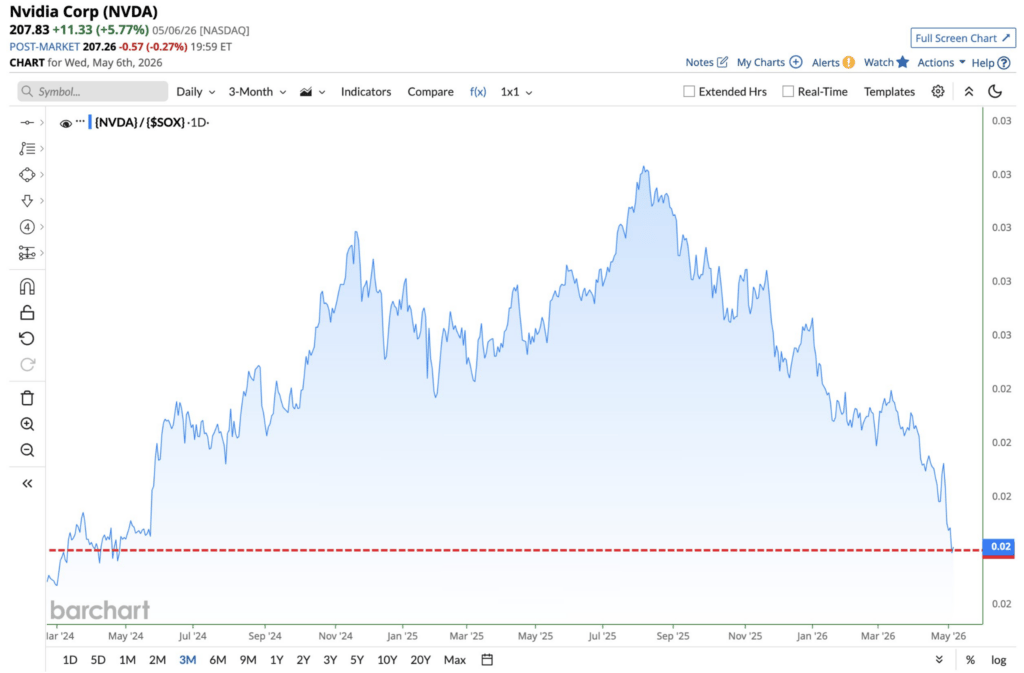
The statistics illustrate how much of an impact the initial artificial intelligence (AI) boom had on Nvidia’s stock, which gained roughly 171% in 2024.
For comparison, the shares are currently up only 10% year-to-date in 2026, while SOX has shot up more than 55% in the same period.
Microsoft threatens to surpass Nvidia as the most valuable company
Additional pressure on Nvidia now comes from Alphabet (NASDAQ: GOOGL), which is closing in on Jensen Huang’s firm in the race to become the world’s most valuable company.
In comparison with Nvidia, Google’s parent company has had an explosive run this year, rising around 45% since hitting the 2026 bottom at the end of March.
As a result, it is approaching the top market capitalization spot for the first time in more than a decade, as it last held the position in 2016 before losing it to Apple (NASDAQ: AAPL).
The news shift marks a broader change in Wall Street sentiment, with Alphabet emerging not only as a leading AI platform provider through Google Cloud, but also as a potential challenger to Nvidia in AI hardware.
Goldman Sachs still bullish on Nvidia
Be that as it may, analysts still appear positive on Nvidia. Notably, Goldman Sachs reaffirmed its ‘Buy’ rating and $250 price target just before the time of writing.
The bank was bullish ahead of the company’s upcoming results, saying investors will likely focus on the scale of potential upside to Nvidia’s $1 trillion data center opportunity outlined at GTC.
However, the firm noted that expectations remain elevated and that the hurdle for meaningful stock outperformance is relatively high heading into earnings. Ultimately, though, Goldman Sachs argues the slow performance relative to peers discussed above is a sign of a buying opportunity.
Featured image via Shutterstock